
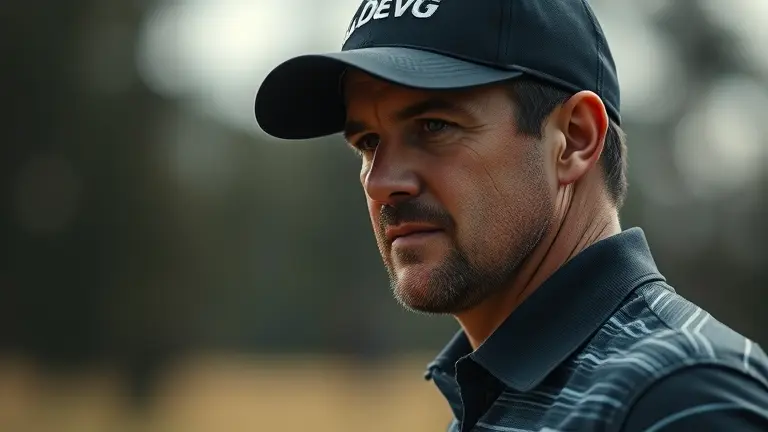
As the 2026 PGA Championship unfolds at the iconic Aronimink Golf Club, the familiar presence of Michael Block has once again ignited a firestorm of debate across the sports landscape. For many, his eighth major championship appearance is a heartwarming underdog story—a club professional standing toe-to-toe with the titans of the game. For others, however, it represents a saturation point, fueling a growing fatigue toward a narrative that many feel has overstayed its welcome. Yet, beneath the polarizing public discourse and the viral practice rounds with stars like Bryson DeChambeau, there is a more compelling, analytical story waiting to be told.
Beyond the surface-level critique lies a professional performer operating under the weight of immense psychological pressure. To understand Block’s longevity in the majors is to look past the ‘fan favorite’ label and examine the cognitive mechanics required to remain competitive when the spotlight is blinding. True performance in professional golf is not merely about swing speed or putting precision; it is about the sustained ability to maintain flow state amidst external distractions. How does a professional hold onto their technical foundation while the world watches every move? The answer lies in the neuroscience of focus, a discipline increasingly essential for any elite achiever aiming for consistency in a high-stakes environment.
Michael Block at the 2026 PGA Championship: The Eighth Chapter

The 2026 PGA Championship at the historic Aronimink Golf Club marks a significant milestone for Michael Block, representing his eighth start in one of golf’s most prestigious majors. As the quintessential “club pro” representative, Block has successfully navigated the transition from a Cinderella story to a consistent, if polarizing, staple of the professional circuit. His presence in Newtown Square is not merely a testament to his qualification skills but a highlight of the evolving narrative surrounding non-tour professionals competing against the world’s elite. Unlike previous years where his entry felt like a singular anomaly, his current consistency—underscored by a notable T-15 finish in recent lead-up events—suggests a player who has matured into the high-pressure environment of major championships.
Practice Rounds and High-Stakes Preparations
A major focus of the pre-tournament buzz at Aronimink has been Block’s tactical preparation, specifically his high-profile practice rounds. Observers noted him teeing it up alongside powerhouse names like Bryson DeChambeau, a pairing that highlights his integration into the inner circles of the professional game. This access is crucial for a club professional, as it allows him to calibrate his game against the ball speed and distance metrics that now define major championships.
Key aspects of his current campaign include:
- Tactical Adaptation: Leveraging practice rounds with top-tier talent to identify nuanced lines on the Aronimink layout.
- Technical Resilience: Maintaining his fundamental swing mechanics despite intense scrutiny from both the gallery and the media.
- The Betting Narrative: Tracking his performance against established stars, such as his competitive odds pairing against players like Dustin Johnson, which serves as a barometer for his perceived standing in the field.
Ultimately, Block’s eighth start serves as a focal point for the broader debate regarding the PGA Championship’s qualification standards. While some fans view his recurring presence as a victory for the working professional, others argue that the saturation of “Block-mania” shifts focus away from the tournament’s primary objective. Regardless of the public discourse, his performance this week remains a critical case study in how a club pro sustains relevance in an era of elite specialized talent.
The ‘Club Pro’ Narrative: Beyond the Cinderella Story
The rise of Michael Block from a teaching professional to a household name represents one of the most unique case studies in modern sports branding. Initially, the “everyman” narrative served as a refreshing tonic to the hyper-professionalized world of the PGA Championship. His ability to compete against the game’s elite while maintaining his day-to-day role at a local club provided a relatable human interest angle that captured the imagination of casual fans and golf traditionalists alike. However, as Block has evolved into a recurring staple at major championships, the public perception has shifted from wonderment to a complex discourse regarding media saturation and the sustainability of his “Cinderella” archetype.
Evidence suggests that this shift is not merely about his performance on the course, but rather a reflection of the industry’s reliance on his persona to bridge the gap between amateur aspirations and professional reality. As he makes his eighth tournament start at the 2026 PGA Championship at Aronimink Golf Club, the sentiment has become increasingly polarized. Critics point to the disproportionate media coverage he receives compared to other club pros, leading to a “fatigue” that often overshadows his technical consistency. Conversely, supporters argue that his continued presence remains a vital reminder of the accessibility of the sport, even if his status has transitioned from an underdog story to an expected tournament entity.
To understand why the Michael Block narrative feels increasingly meta, it is essential to observe the following friction points:
- Professional Consistency vs. Narrative Stagnation: While his T-15 finishes indicate legitimate skill, the media cycle continues to treat him as a novelty act, creating a disconnect between his actual data-driven performance and his public-facing brand.
- The “Club Pro” Ceiling: By positioning him as the definitive representative of the club pro, the media inadvertently sets a narrow binary that ignores the diverse journeys of other professionals who struggle for similar recognition.
- Saturation Fatigue: As noted in recent sports analysis, there is a tangible exhaustion regarding the repetitive nature of his interviews and the “surprise” factor that is no longer surprising, leading to the current divide between mainstream coverage and critical forums like GolfWRX.
Ultimately, Michael Block has transcended his initial role, becoming a polarizing fixture whose impact on the game is now measured as much by his media footprint as his scorecard. Moving forward, the conversation must evolve beyond the “Cinderella” trope to examine whether a club pro can maintain a permanent seat at the table of elite golf without exhausting the very audience that first embraced him.
Media Saturation vs. Golf Fandom: Decoding the Polarization
The narrative arc surrounding Michael Block at the 2026 PGA Championship reveals a complex psychological divide within the golf community. While his initial rise was celebrated as a victory for the “everyman” club professional, the discourse has shifted toward a state of meta-fatigue. This friction is not necessarily rooted in his technical ability—which remains formidable—but in the disconnect between his authentic performance on the course and the aggressive branding machine that has enveloped his career. Audiences are increasingly wary of “media saturation,” where the sheer volume of social media features, brand partnerships, and tournament-sanctioned interviews creates a perception of an overexposed celebrity rather than a humble PGA professional.
The Anatomy of ‘Block Fatigue’
The polarization stems from two distinct viewpoints: those who respect his consistent ability to qualify for majors and those who feel the media narrative has become manufactured. Data from golf forums suggests that fans are not necessarily tired of Michael Block as a golfer, but rather the constant re-packaging of his “club pro” story. Key drivers of this phenomenon include:
- Excessive Media Presence: The relentless focus on his practice rounds with stars like Bryson DeChambeau, which creates a loop of coverage that many fans find disproportionate to his actual leaderboard impact.
- Brand Commercialization: The proliferation of endorsements post-breakthrough has altered the public perception of his “relatability,” causing some to view him as a commercial entity rather than a grass-roots competitor.
- The ‘Once-in-a-Lifetime’ Narrative: Media outlets continuing to frame his appearances through the lens of a miracle story, even as he has become a recurring tournament staple, creates a dissonance that observant viewers find jarring.
Ultimately, the challenge for Michael Block is navigating the thin line between being a fan-favorite and an industry-fed product. While his technical game remains strong, the current climate of sports media demands a more nuanced approach to his coverage, one that acknowledges his reality as a professional competitor while dialing back the hype that fuels negative sentiment among the more cynical segments of the golfing public.
Technical Performance: Can the Branding Match the Scorecard?

At the 2026 PGA Championship at Aronimink, the discourse surrounding Michael Block has shifted from the novelty of his 2023 breakthrough to a rigorous evaluation of his technical consistency. While his public persona continues to dominate headlines, analysts are increasingly scrutinizing whether his competitive metrics validate his repeated presence in major fields. Recent data, including his T-15 finish in lead-up events, suggests that Block is no longer just a “feel-good” qualifier; he has effectively transitioned into a player capable of sustaining professional-level volatility. However, the gap between his social media presence and his scorecard performance remains a primary point of contention for golf purists.
Measuring Competitive Reliability
Block’s technical game is defined by a reliance on precise iron play and a high-percentage putting stroke that compensates for a lack of elite tour-level distance. When comparing his performance to his peers, several key performance indicators emerge:
- Approach Play: Block demonstrates elite proximity to the hole from 125–175 yards, a necessary skill set for the demanding layout of Aronimink.
- Scrambling Efficiency: His ability to save par from difficult lies around the green has been the bedrock of his longevity in majors, effectively mitigating bogeys during high-pressure stretches.
- Consistency vs. Volatility: Unlike many “club pro” invitees who experience a massive drop-off after round two, Block maintains a relatively stable scoring average, suggesting he has adapted his mental game to the rigors of multi-day major formats.
While critics argue that his media saturation overshadows his actual standing in the Official World Golf Ranking, the evidence suggests he performs significantly better than the average club professional. By focusing on his technical execution—specifically his shot-shaping and short-game control—it becomes clear that Block’s recurring invitations are less about marketing and more about a sustained, repeatable baseline that allows him to compete alongside tour regulars. Whether this level of play warrants his status as a recurring fixture remains a subjective debate, but the empirical data supports the narrative that his game has matured beyond the “one-hit wonder” label.
Mastering Your Cognitive Edge
At the end of the day, Michael Block’s endurance at the 2026 PGA Championship isn’t just about his swing mechanics; it is a testament to the cognitive durability required to thrive under the relentless pressure of public scrutiny. While the sports world remains divided on the ‘Block Party’ narrative, the reality is that maintaining a peak mental state amidst high-stakes noise is the ultimate competitive advantage in any professional arena.
You don’t have to be a professional golfer to understand the value of deep, uninterrupted focus. Just as elite athletes are increasingly turning to neuro-acoustic training to bypass mental fatigue and enter a state of total clarity, you can leverage the same scientific principles to enhance your own decision-making and performance. The Brain Song offers a bridge to that high-performance flow state, stripping away the mental fog that often acts as the greatest hurdle to your success.
By integrating this 12-minute neuroscience-based routine into your daily regimen, you aren’t just training your brain—you are conditioning your mind to stay sharp when the stakes are at their absolute highest. It is the precise ‘off-course’ preparation needed to ensure that, regardless of your personal arena, you remain unfazed by the competition and laser-focused on your goal.
 Optimize your own cognitive endurance and mental focus for your next challenge by incorporating this 12-minute neuroscience-based routine.Transform My Mental Focus Today!