

NVDA stock has reclaimed its position at the heart of global market volatility, signaling a decisive shift in investor sentiment as we approach the highly anticipated Q1 2026 earnings report on May 20. Following a period of relative consolidation, Nvidia’s share price has staged a robust rally, fueled by a critical geopolitical breakthrough: the successful negotiation of H200 chip access to the Chinese market. This development, spearheaded by Jensen Huang during the latest diplomatic delegation, has effectively cleared a major regulatory hurdle that threatened to dampen Nvidia’s growth trajectory compared to its semiconductor peers.
While retail traders scramble to interpret these price movements as binary buy or sell signals, institutional investors are looking much deeper. The market is beginning to price in the massive potential of Agentic AI—an evolution in computing that promises to move Nvidia’s utility far beyond traditional GPU supply toward a $1 trillion revenue opportunity. To navigate this pivot, investors must look past the surface-level hype and understand how the H200 clearance redefines the playing field. In a landscape defined by rapid-fire news cycles and high-stakes geopolitical maneuvering, the ability to synthesize this data into a coherent strategy is the new ultimate competitive advantage.
The China Breakthrough: Unpacking the H200 Catalyst
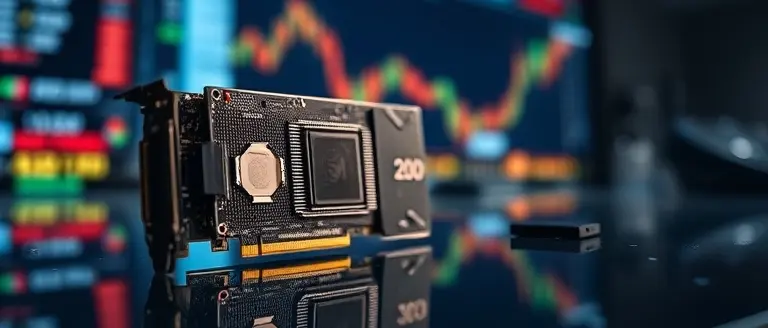
The recent geopolitical pivot signaled by President Trump’s diplomatic mission to China has fundamentally altered the investment thesis for NVDA stock. By including Nvidia CEO Jensen Huang in the delegation, the administration effectively turned a dormant geopolitical risk into a primary growth catalyst. The subsequent regulatory clearance for the sale of the H200 chip to the Chinese market removes a significant revenue roadblock that had previously hampered Nvidia’s international expansion. For institutional investors, this move is viewed as a “green light” that restores access to a vital segment of the global semiconductor demand pool, directly impacting the company’s revenue guidance for the remainder of fiscal 2026.
Why the H200 Chip Matters
The technical implications of this authorization cannot be overstated. The H200 is not merely an iterative update; it provides superior memory capacity and bandwidth compared to its predecessors, making it the preferred hardware for training and deploying large-scale AI models. With this specific hardware cleared for export, Nvidia can now:
- Restore Market Dominance: Re-capture enterprise AI contracts in China that were previously shifting toward domestic laggards or restricted alternatives.
- Buffer Revenue Volatility: Utilize the Chinese market as a critical hedge against potential saturation in US hyperscaler demand.
- Strengthen Pricing Power: Command premium margins on high-performance infrastructure that remains unrivaled in speed and energy efficiency.
This clearance is the primary engine behind the recent breakout in NVDA stock price. While earlier in May, market sentiment was dampened by concerns over the company’s performance relative to competitors like Intel and AMD, the China news has effectively shifted the narrative. Analysts suggest that the market is now aggressively pricing in this recovery, with capital flows increasing as investors scramble to reposition before the May 20, 2026, earnings call. This geopolitical “wild card” has transformed the stock from a defensive hold into a renewed growth play, as the tangible prospect of high-margin H200 sales provides a concrete floor for future revenue expectations.
Agentic AI: The New Valuation Paradigm for Nvidia

Institutional investors monitoring NVDA stock are increasingly looking past traditional hardware metrics, shifting their focus toward the transformative potential of Agentic AI. Unlike standard generative models that require human-in-the-loop prompts, Agentic AI refers to autonomous systems capable of executing complex workflows, decision-making, and multi-step tasks independently. This evolution represents a fundamental shift in how the market evaluates Nvidia’s long-term revenue potential, moving the narrative from simple GPU unit volume to the value of the software-hardware ecosystem powering the next industrial revolution.
Beyond Hardware: The Software-Defined Moat
As the market matures, the debate between NVDA stock and its semiconductor peers like Intel and AMD is no longer just about chip performance or supply chain efficiency. While competitors focus on high-speed hardware, Nvidia’s proprietary software stack—CUDA and its associated AI enterprise suites—is becoming the operating system for Agentic AI.
Key reasons why institutional capital is recalibrating their valuation models include:
- Autonomous Scalability: Agentic systems require massive, persistent compute resources, ensuring that Nvidia’s H200 and upcoming architectures remain the backbone of enterprise infrastructure.
- Higher Revenue Multiples: Wall Street analysts are beginning to treat Nvidia more like a high-margin software firm. The transition toward autonomous agents implies a recurring revenue model embedded within the hardware purchase, justifying higher price-to-earnings ratios compared to legacy chipmakers.
- Geopolitical Resilience: The ability to deploy Agentic AI tools globally makes Nvidia’s technology a “must-have” utility, which provides a strategic buffer against the volatility associated with regional market access, such as the recent successes in the China trade landscape.
Ultimately, the shift toward Agentic AI positions Nvidia not merely as a component supplier, but as the essential infrastructure layer for the global economy’s future autonomous processes. For investors, this suggests that the current valuation is less about quarterly GPU sales and more about the company’s monopolistic grip on the architecture of intelligent, self-directed software.
Institutional Positioning vs. Retail FOMO
As NVDA stock approaches the critical May 20, 2026, earnings date, a pronounced divergence has emerged between retail sentiment and institutional strategy. Retail investors, fueled by the recent price surge following the successful negotiation of H200 chip sales to China, are exhibiting classic Fear Of Missing Out (FOMO). This retail enthusiasm is primarily focused on the immediate supply-side narrative, ignoring the complex risk-adjusted models currently being deployed by large-scale desks. While public interest remains high, institutional players are pivoting toward more defensive hedging strategies, recognizing that the “China catalyst” is a double-edged sword that could be subject to sudden regulatory volatility.
Professional investors are currently rebalancing their portfolios by focusing on the following indicators:
- Option Skew Adjustments: Institutional desks have been aggressively adjusting their call/put ratios to account for the geopolitical “wild card” of Chinese market access, opting for protective puts despite the bullish momentum.
- Agentic AI Valuation: Sophisticated capital is shifting its gaze from legacy GPU unit sales toward the long-term potential of Agentic AI systems. Institutional models are prioritizing revenue streams that extend beyond hardware cycles, treating the H200 clearance as a bridge rather than the final destination.
- Capital Allocation Discipline: Rather than chasing the recent rally, smart money is tightening stop-loss orders, preparing for post-earnings volatility that often accompanies high-valuation tech stocks.
The recent recovery of NVDA stock—which saw it move from a laggard position relative to AMD and Intel to a market leader—suggests that the market has already “priced in” a significant portion of the China sales news. Consequently, the institutional stance is one of cautious accumulation. They are prioritizing the sustainability of the $1 trillion revenue forecast over the short-term retail frenzy. Investors looking to mirror professional success should note that the current share price, while buoyant, necessitates a look at the underlying volatility metrics rather than relying solely on the headlines emerging from the recent presidential delegation. Institutional hedging suggests that while the long-term outlook remains robust, the immediate post-earnings window is expected to be marked by high variance.
Q1 Earnings Outlook: Revenue Guidance in a Geopolitical Vacuum

As investors pivot toward the May 20, 2026, earnings call, the primary focus for NVDA stock has shifted from pure domestic demand to the reintroduction of the Chinese market. With the recent diplomatic breakthrough regarding the clearance of H200 chip exports to China, analysts are currently scrambling to revise their revenue models. Historically, guidance in a geopolitical vacuum—where sales were restricted—forced Nvidia to rely almost exclusively on aggressive North American hyperscaler expansion. Now, the potential for a fresh revenue stream in the East adds a layer of complexity to the quarterly outlook, forcing management to weigh the sustainability of international sales against the unpredictable nature of trade policy.
Evaluating the China Revenue Delta
Institutional investors are looking for specific quantitative signals that clarify how the H200 sales pipeline will materialize in the coming fiscal quarters. To properly assess the upcoming report, shareholders should monitor the following areas:
- Regional Revenue Mix: Look for management’s commentary on the percentage of total data center revenue now attributed to China versus domestic markets. A rapid ramp-up in China could signal immediate liquidity, but sustainability remains a key concern.
- Operating Margin Compression: Determine if the logistical and compliance hurdles associated with the H200 exports impact the overall gross margins that have defined Nvidia’s recent performance.
- Agentic AI Growth: Pay close attention to references regarding Agentic AI infrastructure. If Nvidia positions the H200 not just as a commodity chip, but as the essential backbone for sovereign AI deployments in Asia, it justifies a shift in valuation away from historical cyclical norms.
- Supply Chain Constraints: Analysts will be listening for updates on whether current production capacity for the H200 is sufficient to satisfy both the U.S. hyperscaler demand and the newly reopened China quota without sacrificing margins.
Ultimately, the market is currently pricing in a “Goldilocks” scenario where geopolitical tensions subside just enough to allow hardware access while maintaining enough friction to prevent a supply glut. Investors should remain cautious, as any management tone indicating that Chinese demand is a one-time “catch-up” event rather than a recurring growth engine could trigger volatility, regardless of a strong headline beat.
Mastering the AI Pivot: Cognitive Infrastructure for the May 20 Earnings
As the May 20 earnings window approaches, the narrative around NVDA stock is shifting from simple semiconductor supply-chain speculation to a complex evaluation of ‘Agentic AI’ dominance. The successful clearance of H200 chip sales to China has acted as a vital geopolitical release valve, clearing the path for Nvidia to reclaim its position as the undisputed market leader. However, for the serious investor, the real challenge is not merely tracking stock price fluctuations, but maintaining the mental acuity required to distinguish between transient market noise and foundational shifts in AI revenue architecture.
Just as Nvidia’s H200 architecture is engineered to maximize efficiency in Agentic AI tasks, your own cognitive processing power serves as your most critical investment asset. Navigating this high-stakes environment requires more than just raw data; it demands sustained focus and the mental stamina to synthesize complex, high-frequency signals. This is where The Brain Song bridges the gap between passive observation and decisive action.
By integrating this science-backed productivity tool into your daily routine, you aren’t just reading the market—you are optimizing your ability to filter through the noise and capitalize on institutional repositioning. Elevate your analytical endurance and ensure you are prepared to interpret Nvidia’s Q1 guidance with total clarity.
 Optimize your decision-making framework and sharpen your cognitive edge for the May 20 earnings window here.Secure My Cognitive Edge Now!