
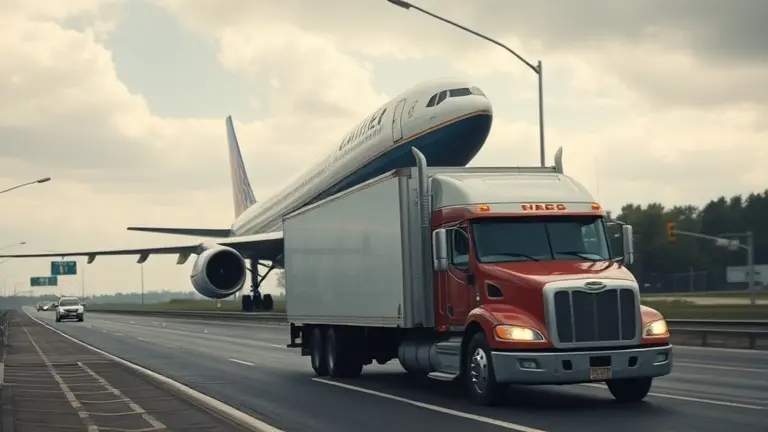
On May 3, 2026, a routine arrival at Newark Liberty International Airport (EWR) transformed into a viral moment that left millions questioning airport safety protocols. As a United Airlines passenger jet completed its flight from Venice, Italy, a series of precise, high-stakes events unfolded during the final approach. A light pole on the New Jersey Turnpike was struck by the aircraft, sending debris cascading toward a passing bakery delivery truck. While the term ‘plane hits truck’ has circulated wildly across social media platforms, the reality is a complex sequence of geometry and physics rather than a catastrophic collision.
Separating the sensationalist headlines from the technical reality is essential for understanding modern aviation. By breaking down the flight path, airport approach proximity to public roadways, and the actual mechanics of the landing gear contact, we gain a clearer perspective on this rare near-miss. In a world inundated with fragmented video clips, developing a sharp, analytical eye is more important than ever to distinguish between a simple viral video and the intricate technical operations of commercial aviation.
Understanding the Newark Airport Incident: What Actually Happened

On May 3, 2026, a significant aviation event occurred involving a United Airlines passenger jet arriving from Venice, Italy, during its final approach to Newark Liberty International Airport (EWR). The incident gained widespread media attention after viral dashcam footage surfaced, showing a bakery delivery truck being struck by debris. To clarify the technical reality of the event: this was not a plane crash, but rather a complex sequence of mechanical interactions between the aircraft and airport perimeter infrastructure. As the flight descended, the aircraft struck a light pole on the New Jersey Turnpike, which serves as a critical boundary near the airport’s approach path. The impact with the pole caused structural debris or a landing gear component to dislodge, which subsequently struck the passing delivery vehicle.
Fact-Checking the Incident: A Near-Miss, Not a Crash
It is vital to distinguish between a catastrophic failure and the operational anomaly that occurred in Newark. The United flight successfully completed its landing, and the aircraft itself did not collide with the truck. The confusion often stems from the dramatic nature of the dashcam footage, which led many to incorrectly label the event as a plane hits truck collision. The following points summarize the established facts:
- Primary Impact: The aircraft made contact with a light pole on the NJ Turnpike, not the vehicle itself.
- Secondary Debris: The damage to the bakery truck was caused by falling debris generated by the initial collision with the pole.
- Safety Status: The plane landed safely at the airport, and the truck driver sustained only non-life-threatening cuts.
- Aviation Context: This incident highlights the proximity of public thoroughfares to major Newark airport runway approach paths.
Industry experts and aviation enthusiasts on platforms like Reddit have analyzed the geometry of the approach, noting that while such incidents are rare, they underscore the inherent risks of flight paths located near high-traffic infrastructure. The United Newark truck incident remains a subject of ongoing investigation, serving as a reminder of the precision required during final approach maneuvers.
Analyzing the Viral Dashcam Footage

The viral dashcam footage captured by an H&S Family of Bakeries truck has become the focal point of public discourse surrounding the May 3, 2026, incident at Newark Liberty International Airport. The video, which shows a United Airlines passenger jet appearing to strike a light pole on the New Jersey Turnpike during its final approach, has been widely shared across platforms like Reddit and X. While the visuals are undeniably startling, they have contributed to significant public confusion. Many viewers initially interpreted the footage as a full-scale plane crash; however, technical analysis confirms that the aircraft did not collide directly with the truck. Instead, the plane’s landing gear or related debris clipped a light pole, which then fell into the path of the passing bakery delivery truck.
Understanding the Collision Mechanics
The distinction between a direct impact and a secondary collision is critical for understanding the safety implications of this event. When a plane hits a truck—or more accurately, when aircraft debris influences ground traffic—the kinetic energy involved is massive. The dashcam perspective provides a visceral look at the event, but it lacks the contextual scale of the airport’s approach geometry. Key takeaways regarding the incident include:
- Secondary Impact: The truck was not struck by the fuselage or engines of the United flight, but by infrastructure compromised by the aircraft.
- Driver Status: Despite the intensity of the visual, the truck driver miraculously escaped with only non-life-threatening cuts, serving as a testament to the vehicle’s structural integrity and a degree of fortune.
- Aviation Safety: Discussions in forums like r/aviation have shifted toward the safety buffer zones between Newark’s flight paths and the high-traffic New Jersey Turnpike.
While the footage remains a compelling piece of evidence for investigators, it is essential to avoid the sensationalism often associated with viral clips. By clarifying that this was a near-miss landing incident rather than a catastrophic hull loss, we can better appreciate the complex coordination required for safe aviation operations in such high-density urban corridors.
Aviation Safety Protocols During Final Approach
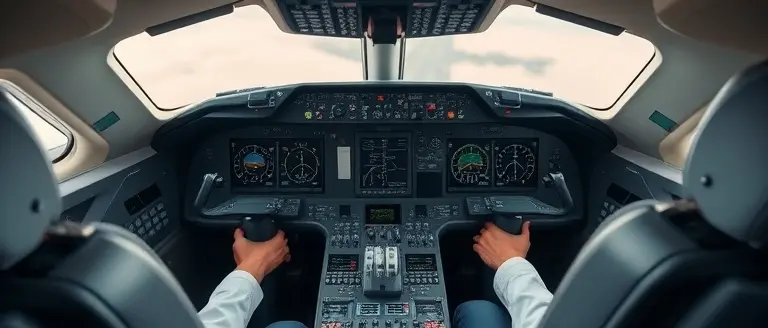
The May 3, 2026, incident involving a United flight approaching Newark Liberty International Airport (EWR) highlights the complexities of managing flight paths near high-density infrastructure. When a plane hits a truck—or, more accurately in this instance, strikes a light pole that causes debris to impact a vehicle—it raises critical questions regarding approach geometry. Pilots operating at Newark must navigate a narrow corridor where the New Jersey Turnpike runs in close proximity to the runway thresholds. During the final approach, flight crews rely on an Instrument Landing System (ILS) and precision monitoring to maintain the correct glide slope. However, as evidence suggests, even minor deviations or unexpected environmental factors can place aircraft within reach of ground-level obstacles, such as light poles situated along the airport’s perimeter.
Technical Resilience and Crew Response
Aviation safety protocols are designed with the assumption that unexpected contact with external objects can occur. Modern landing gear systems are engineered for extreme durability, capable of sustaining impacts from runway debris or minor ground contact without compromising the structural integrity of the wing or fuel systems. In the case of the United Newark truck incident, the flight crew’s ability to maintain control indicates that the collision was localized. Key technical factors include:
- Contingency Training: Pilots are trained to handle “non-normal” landing scenarios where aircraft components may be damaged, ensuring a stabilized descent even after an mid-approach disturbance.
- Surface Navigation: Newark’s proximity to major highways requires strict adherence to vertical descent profiles to avoid infringing on ground-level safety clearances.
- Structural Integrity: The incident involving the plane hits a bakery truck demonstrates how kinetic energy from falling debris can cause damage on the ground while the aircraft remains airworthy.
While the visual spectacle of a United plane hits light pole event is alarming, aviation safety experts emphasize that the primary goal is maintaining the aircraft’s flight path and landing sequence. The fact that the truck driver sustained only minor injuries speaks to the localized nature of the debris strike. Ongoing investigations by aviation authorities continue to review the approach vectors to determine if further adjustments to perimeter lighting and obstacle positioning are required to mitigate future risks in this high-traffic zone.
Separating Fact from Fiction: The Reality of Landing Near-Misses

In the immediate aftermath of the May 3, 2026, incident at Newark Liberty International Airport (EWR), social media platforms and news outlets were flooded with headlines claiming a “plane crash” on the New Jersey Turnpike. However, technical analysis confirms that the United plane hitting a truck was not a controlled flight into terrain or a fuselage impact, but rather a localized secondary collision. When a United flight hits a light pole on final approach, the resulting debris or landing gear engagement with a passing bakery delivery truck is categorized by aviation authorities as an aviation incident rather than an accident. Distinguishing between these two terms is vital for public understanding; an incident involves an occurrence where the safety of operations is compromised, whereas an accident involves significant damage or loss of life.
Understanding Aviation Safety Categorization
Sensationalist reporting often conflates proximity to the ground with a total hull loss. To clarify the technical reality of the United Newark truck event, consider these distinctions:
- Controlled Trajectory: The aircraft remained under pilot control throughout the landing sequence, differentiating this from a loss-of-control accident.
- Secondary Impact: The damage to the bakery truck resulted from contact with ground-based infrastructure (a light pole) or jettisoned components, not the aircraft’s main body.
- Regulatory Oversight: The NTSB and FAA are currently conducting a comprehensive investigation to analyze the approach geometry and the sequence of events.
Relying on official investigative findings is the only way to maintain public trust in commercial aviation. While the viral footage of the plane hits bakery truck scene is visually jarring, it serves as a case study in why rapid, unverified reporting can be misleading. By analyzing these near-misses through the lens of safety protocols, the aviation industry continues to refine runway safety areas and approach paths to prevent future interactions between aircraft and public thoroughfares.
Maintaining Clarity in a High-Stakes World
The events at Newark remind us that even the most complex systems operate on the thin margins of precision. While aviation safety remains robust, the incident underscores how quickly sensory and spatial awareness can become the primary focus during unexpected anomalies. Analyzing such technical events requires a high level of cognitive acuity, allowing you to filter out the noise of sensationalism and focus on the cold, hard facts of the scenario.
Just as pilots and ground crews require peak sensory acuity to manage complex flight operations, your own ability to process and analyze technical information depends on maintaining optimal cognitive clarity. This is where Audifort becomes an indispensable asset. Designed for those who value sharpness and precision, Audifort supports long-term sensory focus and auditory clarity, ensuring you remain as analytical and informed as the experts studying these complex events.
By investing in your cognitive well-being, you are not just staying informed; you are ensuring that your mind remains a high-performance tool capable of navigating the complexities of our modern, fast-paced world. Don’t let mental fog cloud your analysis of the world around you—elevate your focus today.
 Support your focus and cognitive clarity as you dive deep into complex topics like aviation safety—learn more about Audifort today.Boost My Cognitive Clarity Now!