
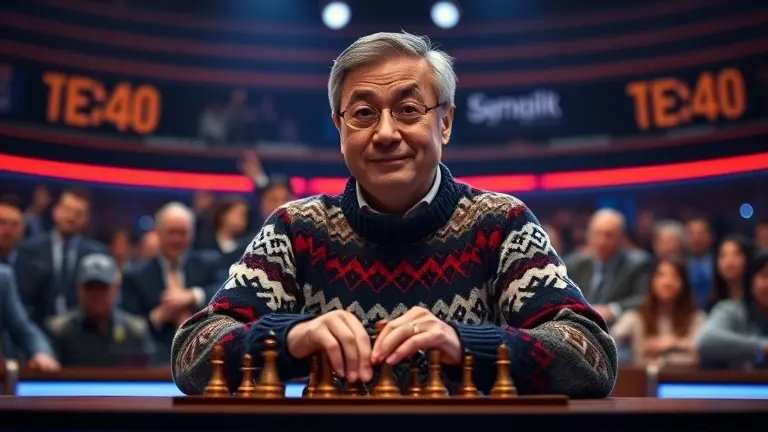
On April 27, 2026, the Jeopardy! stage witnessed the end of a modern dynasty. Jamie Ding, the New Jersey bureaucrat who captivated audiences with his 31-game winning streak and trademark collection of sweaters, finally saw his run conclude in a stunning ‘runaway’ loss to chess master Greg Shahade. Retiring as the 5th all-time highest-winning contestant with $885,605, Ding leaves behind a legacy defined by his ‘ice-cube calm’ and a level of gameplay that forced fans to re-examine the mechanics of a true super-champion.
Jamie Ding’s Jeopardy! journey was never just about trivia; it was a masterclass in psychological stamina and strategic positioning. From his nuanced ‘buzzer trick’—a technique that dismantled countless opponents—to his stoic refusal to buckle under the spotlight, Ding transformed from a faceless contestant into a cultural icon. As we dive deep into the statistics, the chess-like decision-making that led to his final defeat, and the unique ‘sweater-culture’ he popularized, we uncover the true ‘Why’ behind one of the most successful streaks in the history of the show.
The End of an Era: Jamie Ding’s 31-Game Jeopardy! Streak Concludes

On April 27, 2026, the television landscape shifted as the historic 31-game winning streak of Jamie Ding finally reached its conclusion. A New Jersey bureaucrat who became a cultural icon, Ding captivated millions with his signature “ice-cube calm” demeanor and his distinctive sweater collection. However, his run on Jeopardy! ended abruptly in a “runaway” game against International Master of chess Greg Shahade. The defeat stunned a massive audience, marking a poignant end to a tenure that saw Ding ascend to 5th place on the list of Jeopardy! longest winning streaks and all-time earnings.
A Historic Run and Final Financial Legacy
Ding retires with an impressive total of $885,605 in winnings, cementing his legacy among the elite Jeopardy! super-champions. His transition from a private citizen to a household name was fueled by his analytical approach to the game and a unique style that resonated with viewers. His performance throughout the streak was defined by:
- Calculated Precision: Ding’s ability to remain composed under pressure, often referred to as his “ice-cube calm.”
- Strategic Gameplay: A masterclass in buzzer timing and wager management that kept him ahead of the field for over a month.
- Cultural Impact: His preference for varied, colorful knitwear became a focal point for social media discussion, earning him significant coverage in major outlets like The New York Times.
The upset victory by Greg Shahade was a masterclass in tactical aggression. By specifically targeting Daily Doubles, Shahade effectively neutralized Ding’s buzzer speed and rhythm, forcing a shift in the game’s momentum that led to the final outcome. While fans had grown accustomed to seeing jamie ding jeopardy episodes conclude in his favor, this loss serves as a stark reminder of the volatile nature of the competition. As the Jeopardy! today community processes this transition, the focus shifts to how Ding’s gameplay mechanics—specifically his “buzzer trick”—will influence future contenders looking to climb the all-time ranks.
The Anatomy of a Runaway: Jamie Ding vs. Greg Shahade

The final match of Jamie Ding’s legendary 31-game run was a masterclass in calculated aggression. Facing an opponent with the “ice-cube calm” demeanor that defined his entire Jeopardy! tenure, International Master (IM) of chess Greg Shahade opted for a high-stakes strategy reminiscent of grandmaster-level positional play. By aggressively hunting Daily Doubles early in the game, Shahade effectively vacuumed capital out of the board, preventing Ding from establishing his typical rhythm. This tactical pivot neutralized Ding’s famed buzzer speed, forcing the New Jersey bureaucrat into a defensive position where he could no longer rely on his hallmark comeback mechanics.
Strategic Aggression and The Chess Mind
The gameplay mechanics of this “runaway” loss highlight a shift in how Jeopardy! super-champions are being challenged. Shahade’s background in high-level chess provided a distinct advantage in risk management. By maintaining a high “Time Pressure” index, Shahade forced Ding into sub-optimal wagering positions. Analysts from the r/chess community noted that Shahade treated the board as an endgame scenario, where maximizing his own score was prioritized over defensive play.
Key factors that led to the end of the jamie ding jeopardy streak included:
- Targeted Daily Double Hunting: Shahade’s ability to locate and secure high-value clues early stripped Ding of his primary engine for accumulation.
- Positional Aggression: By betting aggressively early, Shahade reached a threshold that mathematically prevented Ding from forcing a comeback, even with a strong performance in Final Jeopardy.
- Buzzer Neutralization: By controlling the flow of the game, Shahade disrupted the timing cues Ding had mastered over his 31-game stint, leading to the first significant lapse in his buzzer efficiency.
Ultimately, Ding’s defeat was not a result of a lack of knowledge, but a triumph of strategic interference. As the 5th all-time highest-winning contestant, Ding retires with $885,605, but his final game remains a fascinating case study in how chess-like analytical thinking can dismantle even the most dominant jeopardy longest winning streaks.
Decoding the ‘Ice-Cube Calm’: Ding’s Buzzer Strategy and Gameplay Mechanics

Jamie Ding’s 31-game run on Jeopardy! was defined less by erratic outbursts and more by a methodical, “bureaucratic” precision that left opponents struggling to keep pace. Fans and analysts alike dubbed his signature approach the “ice-cube calm,” a demeanor that allowed him to navigate high-pressure categories without the common pitfalls of buzzer anxiety. Unlike the hyper-aggressive betting strategies popularized by James Holzhauer, Ding utilized a steady, incremental approach to building his lead. By consistently securing low-to-mid-value clues early in the game, he established a psychological rhythm that often unsettled his challengers before the first commercial break.
Mastering the Buzzer: The Mechanics Behind the Streak
Central to Ding’s success was his mastery of the Jeopardy! buzzer strategy. While he remained modest about his technique, post-game analysis and insights from the r/chess community suggest that his timing was rooted in pattern recognition rather than raw reaction speed. Ding likely utilized a rhythmic anticipation method, syncing his thumb to the cadence of the host’s voice to trigger the lockout mechanism the millisecond it went live.
Key components of his dominant gameplay mechanics included:
- Predictive Timing: Utilizing the “buzzer trick” to anticipate the end of long, complex clues.
- Selective Aggression: Avoiding the high-variance, “all-in” style of play in favor of calculated wagering on Daily Doubles.
- Mental Fortitude: Maintaining a poker face that preserved his focus, regardless of the score or category difficulty.
This disciplined approach allowed him to accumulate $885,605 in total winnings, making him the 5th highest-winning contestant in Jeopardy! longest winning streaks history. While he was eventually unseated by the strategic play of Greg Shahade, Ding’s legacy remains a masterclass in controlled, analytical trivia performance. His transition from a quiet bureaucrat to a household name proves that in the modern era of the show, cool-headed consistency is often just as lethal as high-risk gambling.
Ranking Among the Greats: Where Jamie Ding Stands in Jeopardy! History

The conclusion of Jamie Ding’s remarkable run marks a significant milestone in Jeopardy! longest winning streaks history. With a total of 31 consecutive victories and $885,605 in winnings, Ding has officially ascended to the 5th all-time highest-winning contestant position. This performance solidifies his status among the titans of the game, placing him in an elite cohort that includes legends like Ken Jennings and James Holzhauer. While his total haul reflects a more measured, tactical approach than the high-stakes wagering often seen in the modern era, Ding’s consistency under pressure has set a new benchmark for “ice-cube calm” gameplay that future contestants will undoubtedly study.
Analytical Comparison: Ding’s Strategic Legacy
Ding’s success is defined by a distinct departure from the hyper-aggressive betting styles popularized over the last decade. Instead, his gameplay focused on:
- The Buzzer Trick: A refined technique that emphasized timing and rhythm, allowing him to maintain control of the board even against formidable opponents.
- Bureaucratic Precision: Leveraging his background to treat the game as a structured, repeatable process, minimizing emotional volatility during daily double rounds.
- Sustainability: Unlike players who rely on “all-in” maneuvers, Ding maintained high-percentage accuracy across all categories, proving that steady, strategic accumulation remains a viable path to long-term dominance.
When analyzing Jamie Ding Jeopardy! performance against his peers, the evolution of the game becomes clear. His defeat at the hands of Greg Shahade—a master of chess strategy—highlights the growing importance of game-theory application in high-level trivia. By prioritizing Daily Double hunting and board control, Shahade exploited the precise defensive play that had defined Ding’s tenure. Ultimately, Ding’s 5th place ranking is not just a reflection of his prize money, but a testament to how professional, data-driven preparation continues to redefine what it means to be a “super-champion” in the contemporary Jeopardy! landscape.
The Science Behind the Jeopardy! Genius
The reign of Jamie Ding on Jeopardy! will be remembered not just for his impressive $885,605 haul or his legendary sweater collection, but for the ice-cube calm that defined his gameplay. His 31-game streak proved that success at the highest level of trivia isn’t just about raw knowledge; it’s about the mental agility to manage pressure, master the buzzer, and maintain deep strategic focus while the clock is ticking. As we’ve analyzed his tactical brilliance against the chess-like precision of Greg Shahade, it becomes clear that elite performance demands more than just preparation—it requires a peak cognitive state.
While watching champions like Ding, many viewers find themselves wondering how they could possibly replicate that level of split-second mental clarity in their own high-stakes lives. Whether you are navigating a demanding career, studying for a major exam, or simply looking to sharpen your reaction times, achieving that ‘champion focus’ is a skill that can be developed. This is precisely where The Brain Song becomes the essential tool for cognitive optimization.
By utilizing scientifically-backed auditory stimulation, The Brain Song is designed to bridge the gap between passive curiosity and active mental excellence. It helps you enter a state of high-focus, making it the perfect ‘warm-up’ tool for anyone seeking to improve their mental processing speed and sustained concentration. Just as elite contestants train for the Jeopardy! stage, you can now harness the neuroscience of sound to sharpen your own intellect and achieve the focus of a champion.
 Discover how you can sharpen your own mental clarity and achieve the focus of a champion with The Brain Song.Yes, I Want to Sharpen My Focus Now!