
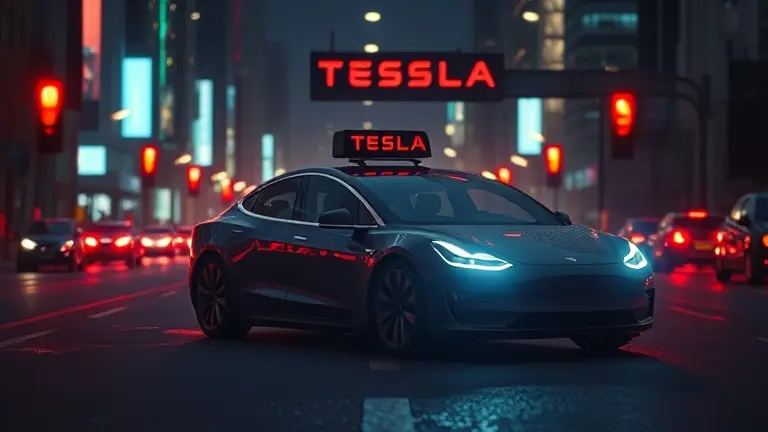
TSLA stock has become the epicenter of market debate following the Q2 2026 earnings report, as investors grapple with the company’s first period of significant cash burn in over two years. While the headlines focus on a miss in profit estimates, a deeper look reveals the catalyst: a massive $5.8 billion capital expenditure surge dedicated exclusively to the company’s aggressive pivot toward AI and Robotaxi infrastructure. This development has effectively divided the investor base, creating a friction-filled divide between those prioritizing short-term margin stability and those betting on the long-term viability of a transformed, AI-integrated business model.
Moving beyond the standard ‘beat vs. miss’ narrative, we must analyze whether this capital intensity is an act of fiscal negligence or a calculated, strategic evolution. As Tesla crosses the $100 billion revenue milestone, the fundamental question for shareholders is no longer about quarterly sales figures, but about the ROI trajectory of its AI investment. Navigating this shift requires more than just reading a balance sheet; it demands the cognitive stamina to distinguish between transient liquidity concerns and the foundational hardware shift that will likely define the company’s next decade.
Q2 2026 Earnings: Analyzing the $5.8 Billion AI Pivot
The July 22, 2026, tesla earnings report marked a definitive pivot point for the company, triggering significant volatility in the tsla stock price as investors grappled with the implications of a massive capital expenditure surge. While the company achieved a major milestone by reaching $100 billion in trailing 12-month revenue, the bottom-line performance failed to meet Wall Street’s consensus. Specifically, Tesla reported a GAAP operating income of only $0.4 billion, a figure that disappointed analysts and reignited debates regarding the firm’s transition from an automotive manufacturer to an AI and robotics-focused entity.
Understanding the Cash Burn
The primary driver behind the market’s nervous reaction was the emergence of a cash burn—the first observed in over two years. Evidence suggests this is not a result of operational inefficiency or declining consumer demand for EVs, but rather a deliberate and aggressive deployment of liquidity. The $5.8 billion surge in capital expenditure (CAPEX) represents a “bet-the-company” investment cycle aimed at securing long-term dominance in two specific domains:
- Robotaxi Fleet Infrastructure: Massive hardware procurement and software development costs related to the autonomous taxi ecosystem.
- Generative AI Compute: Expansion of internal data centers and supercomputing capacity necessary for training next-generation neural networks.
Strategic Sustainability vs. Short-Term Pressure
Investors analyzing the tesla stock price must distinguish between cyclical financial headwinds and fundamental structural changes. When excluding the $5.8 billion AI-driven CAPEX from the tesla earnings call commentary, the underlying core business remains structurally profitable. Institutional shareholders are now forced to evaluate whether the current liquidity strain is a necessary prerequisite for the Robotaxi era or a premature commitment to high-risk AI infrastructure. Moving forward, the market will likely shift its focus from binary earnings beats to the tangible ROI of these AI initiatives, as Tesla prioritizes long-term technological moat-building over immediate quarterly profitability.
Revenue Milestones vs. CAPEX Acceleration: A Data-Driven View

The Q2 2026 Tesla earnings report serves as a definitive turning point for the company’s long-term financial strategy. While the firm proudly surpassed the $100 billion trailing 12-month revenue milestone—a testament to the resilience of its core automotive business—the market reaction to the TSLA stock price has been tempered by a significant shift in capital allocation. The central friction point is the $5.8 billion surge in capital expenditure, which has triggered the first instance of cash burn in over two years. By isolating this spend, analysts can see that Tesla is effectively transitioning from a high-margin, traditional automotive manufacturing model toward a capital-intensive AI and robotics firm.
Analyzing the CAPEX-to-Revenue Divergence
The structural shift in Tesla’s spending reflects an aggressive push into autonomous infrastructure. To understand the impact on tesla stock, consider the following breakdown of the current financial landscape:
- The AI/Robotaxi Pivot: Of the $5.8 billion in recent CAPEX, the vast majority is earmarked for compute clusters and robotic hardware, rather than traditional vehicle assembly lines.
- Pro-Forma Profitability: When stripping away the massive AI-specific investments, Tesla’s core operations remain highly profitable. The reported $0.4 billion GAAP operating income is intentionally suppressed to facilitate rapid scaling of autonomous platforms.
- Big Tech Comparison: Tesla’s spending pattern now mirrors the compute-heavy infrastructure strategies seen in other Big Tech firms, signaling that management views the “Robotaxi” play as a high-stakes, multi-year bet on artificial intelligence leadership.
This strategic pivot suggests that tesla earnings will remain volatile as the company prioritizes total addressable market expansion over short-term GAAP margins. Investors must weigh the current liquidity concerns against the potential for an eventual, software-driven moat. While the current cash burn may unsettle short-term traders, the long-term viability of TSLA now rests entirely on whether this massive capital injection translates into a dominant, autonomous-ready infrastructure that competitors cannot easily replicate.
Strategic Sustainability: Why Long-Term AI Infrastructure Trumps Short-Term Liquidity
The recent volatility in tsla stock following the Q2 2026 tesla earnings call highlights a fundamental disconnect between market expectations and the company’s long-term pivot. While the immediate reaction to the reported cash burn has been bearish, a deeper analysis suggests that the $5.8 billion surge in capital expenditure represents a calculated transition rather than a fiscal failure. By prioritizing aggressive infrastructure investment, Tesla is attempting to fortify its competitive advantage in the race toward fully autonomous transport. For long-term investors, the relevant question is not whether current liquidity is constrained, but whether the “Robotaxi moat” being constructed justifies this temporary departure from historic profitability margins.
Building the Robotaxi Moat
The path to wide-scale autonomous adoption requires massive up-front investment in compute power and specialized hardware. By directing capital toward AI initiatives, Tesla is betting that its future revenue will be driven by software-defined services rather than traditional automotive sales. Key considerations for this strategic shift include:
- Infrastructure Scalability: The current $5.8 billion outlay acts as the foundational layer for future fleet management and real-time neural network training.
- Operational Control: Unlike competitors who rely on third-party silicon or software licensing, Tesla’s vertical integration ensures higher margins once the AI infrastructure achieves maturity.
- Data Dominance: The accumulation of edge-case driving data serves as an insurmountable barrier to entry for legacy manufacturers.
While the current tesla stock price may experience short-term pressure, the firm’s strategy aligns with the necessity of winning the “compute arms race.” If Tesla successfully integrates its proprietary AI stack, the current cash burn will likely be viewed retrospectively as a pivotal milestone in the company’s evolution from a hardware-centric EV maker into an AI and robotics powerhouse. Investors who prioritize fundamental business shifts over quarterly earnings misses may find this transition phase essential for the company’s sustained dominance in the next decade of mobility.
The Evolution of the Tesla Business Model: Beyond Automotive
The recent market volatility surrounding TSLA stock following the Q2 2026 earnings report highlights a fundamental disconnect between traditional automotive valuation and Tesla’s trajectory as a vertically integrated AI infrastructure firm. While analysts often scrutinize car-delivery margins, the reality is that Tesla has pivoted its core identity. With a staggering $5.8 billion surge in capital expenditure dedicated to AI and robotics, the company is signaling that its future output is not merely physical vehicles, but rather autonomous miles and robotic labor. Investors must reconcile that the current “cash burn”—a sharp departure from the previous two years—is a calculated strategic allocation rather than a systemic operational failure.
Decoupling Revenue from Manufacturing Margins
To understand the current tesla stock price, one must distinguish between legacy automotive revenue and the burgeoning AI-driven ecosystem. If we extract the massive capital allocation earmarked for the Robotaxi initiative and long-term AI infrastructure, Tesla’s underlying business remains highly liquid. However, this transition requires a shift in how stakeholders evaluate tesla earnings:
- Asset Utilization: Tesla is pivoting from hardware-centric sales to software-defined autonomy, where the vehicle serves as the primary data-collection node for its AI models.
- Infrastructure Scalability: The current CAPEX cycle is designed to build the “brain” of the operation—the compute power and robotics training architecture—that will eventually commoditize the driving experience.
- Strategic Sustainability: By treating AI research as a capital investment rather than an ongoing operational expense, Tesla is building a competitive moat that legacy automakers simply cannot afford to replicate.
The tesla earnings call underscored a transition point where the company is trading near-term GAAP operating income for long-term scalability. For institutional holders, the focus is shifting from quarterly profit volatility to the potential ROI of this multi-billion dollar bet on AI. As the firm continues to prioritize these long-term plays, the market must prepare for a valuation model that rewards platform dominance over traditional vehicle unit economics.
Navigating the Tesla Pivot with Cognitive Clarity
The market’s immediate reaction to the Q2 2026 earnings report focuses on the $5.8 billion cash burn, yet this short-term volatility masks the most significant structural transition in the company’s history. Tesla is moving decisively from a traditional automotive manufacturer into an AI and robotics infrastructure powerhouse. While the current impact on profitability is palpable, the long-term ROI potential of its Robotaxi and AI ecosystem represents an unprecedented shift in business model valuation that requires patience and a deep analytical perspective.
Understanding this transition requires immense cognitive heavy lifting, as you must decouple legacy manufacturing metrics from the new, high-stakes realities of AI development. Just as Tesla is optimizing its hardware, you must ensure your own mental infrastructure is sharp enough to cut through the noise of market cycles. The ability to stay focused and process complex data-heavy financial reports is not just an advantage—it is the baseline for success in this era of rapid technological disruption.
The Brain Song is designed for the high-performing investor who refuses to get bogged down by the mental fatigue of volatile earnings cycles. By incorporating this neuroscience-based audio routine, you sharpen your cognitive edge, ensuring that when the next earnings call arrives, you have the sustained focus necessary to interpret the real strategic shifts before the rest of the market catches up. Align your mental state with your investment thesis and gain the clarity to navigate this complex evolution with confidence.
 Optimize your analytical focus for the next earnings cycle by incorporating this neuroscience-based audio routine into your daily workflow.Sharpen My Analytical Edge Now!