
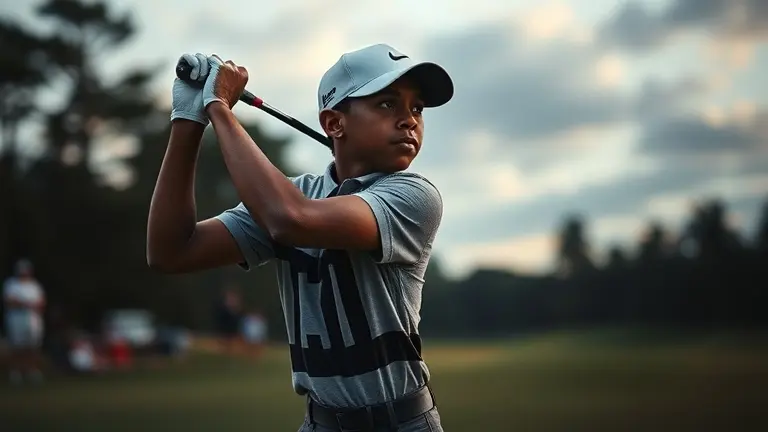
For years, the narrative surrounding Charlie Woods has been tethered to the towering shadow of his father’s legacy. Yet, as we move through the 2026 amateur circuit, the conversation is fundamentally shifting. Observers at high-stakes tournaments are witnessing something different: a young golfer moving past the ‘prodigy’ label to refine a distinct, individual identity. The spotlight is brighter than ever, but Charlie’s performance in the U.S. Junior Amateur suggests a player who is not merely emulating a past icon, but methodically building his own mechanical and strategic foundation.
This transition into late adolescence brings a set of challenges that transcend traditional coaching. While his swing mechanics continue to evolve, the true test for any modern second-generation athlete lies in the psychological discipline required to perform while the world watches every movement. Mastering the internal game—the ability to remain composed under a global microscope—is rapidly becoming the most critical variable in his developmental arc.
Carving a Unique Path: Charlie Woods Beyond the Legacy

As of July 2026, the discourse surrounding Charlie Woods has undergone a significant transformation. For years, public interest was inextricably tied to his lineage, often reducing his amateur efforts to mere footnotes in the storied career of his father, Tiger Woods. However, recent performances at high-profile events like the U.S. Junior Amateur indicate a shift in the media narrative. Analysts and observers are increasingly pivoting away from the “son of” trope, opting instead to evaluate Charlie as an independent prospect honing his craft within the competitive amateur golf circuit. This change in perspective acknowledges that while he undeniably benefits from world-class tutelage, his developmental arc is his own, defined by the specific, modern pressures of competing in an era of intense social media scrutiny.
The consensus within the golf community is that Charlie Woods is progressing at a measured, organic pace. While he draws massive galleries—a testament to his name and the curiosity he inspires—he is no longer expected to mirror his father’s historical dominance. Current reporting emphasizes that his technical maturation is steady, marked by a clear focus on long-term skill acquisition rather than seeking immediate, manufactured success. Key elements of this independent trajectory include:
- Autonomy in Development: Shifting the focus from legacy comparisons to individual statistical growth and swing mechanics.
- Navigating High-Stakes Environments: Proving his capacity to compete in prestigious tournaments while managing the weight of external expectations.
- Resilience Under the Spotlight: Developing the mental fortitude required for professional-level golf without the immediate pressure of an “overnight sensation” label.
By moving beyond the inevitable comparisons to Tiger’s prime years, experts now highlight Charlie’s distinct role as a developing athlete. This balanced approach provides a more accurate reflection of his potential, framing his journey not as a quest to replicate a legend, but as the deliberate, hard-earned progression of a young competitor carving his own path in the sport. Evidence suggests that this maturation process is vital for his long-term success, allowing him to build an identity independent of his last name.
Performance Analysis: Navigating High-Stakes Amateur Events

As Charlie Woods continues his transition into the upper echelons of elite amateur golf, his performance at events like the U.S. Junior Amateur serves as a vital barometer for his developmental trajectory. Rather than viewing his game through the lens of historical comparisons, analysts are increasingly focused on his objective technical markers and his capacity for sustained performance under the weight of high-profile gallery attendance. Evidence from his recent tournament outings suggests a maturation in his ball-striking, characterized by a more refined swing plane and improved consistency in greens-in-regulation (GIR) percentages. While he is still refining the nuances of his short game to match the standards of the world’s top-ranked amateur prospects, his foundational mechanics reflect a player who is deliberately layering technical complexity onto his natural athletic ability.
Developmental Benchmarks and Tournament Pressure
The reality of competing in high-stakes environments—where crowd sizes often dwarf those found in standard amateur circuits—presents a unique psychological test. Charlie Woods has demonstrated a composed demeanor, navigating these external pressures with a professionalism that belies his age. When analyzing his recent tournament rounds, several developmental trends emerge:
- Consistency under pressure: Woods has shown a refined ability to maintain his competitive composure, keeping his round together during high-traffic stretches where spectators are most intrusive.
- Technical adaptability: Recent competition data highlights a shift toward more deliberate course management. He is increasingly prioritizing position over aggressive play, suggesting a growing maturity in his decision-making process.
- Ball-striking evolution: His trajectory analysis indicates a higher launch window and improved spin control, essential attributes for competing on the longer, firmer setups typically found in U.S. Golf Association (USGA) championships.
By shifting the narrative toward these specific metrics, it becomes clear that Charlie Woods is carving a distinct path as a serious contender. His focus remains fixed on the incremental improvements necessary for long-term success, prioritizing sustainable growth over the volatility of rapid, expectation-fueled progression. As he moves forward, his ability to translate this technical refinement into consistent low scoring will be the defining metric of his amateur career.
The Modern Amateur: Balancing Autonomy and Digital Scrutiny

Navigating the transition from a junior phenom to a high-level amateur in the age of viral social media requires more than just technical precision; it demands an ironclad psychological temperament. For Charlie Woods, the challenge is compounded by the “always-on” nature of modern media, where every swing, interaction, and tournament round is documented and dissected by a global audience. Unlike the golfing legends of the previous generation, who often developed their games in relative anonymity, Woods must cultivate his competitive identity while standing under a permanent digital microscope. Evidence suggests that he is successfully managing these unique pressures by prioritizing his developmental process over external validation, effectively shifting the narrative from that of a celebrity offspring to that of an emerging elite athlete.
The Evolution of Public Perception
The current sentiment in the sports world, as reflected in mid-2026 reporting, demonstrates a clear pivot in how observers track his progress. Rather than benchmarking him against his father’s historic milestones, the focus is shifting toward his individual arc. This shift is critical for his longevity, as it creates space for natural maturation. His approach to the game is characterized by:
- Consistency over Flash: Developing a repeatable, sound swing foundation that holds up under the scrutiny of prestigious events like the U.S. Junior Amateur.
- Selective Engagement: Maintaining a degree of autonomy by limiting unnecessary exposure, allowing his tournament results to serve as the primary indicator of his progress.
- Internal Locus of Control: Demonstrating the maturity to block out the “second-generation” tropes and focus on specific technical improvements as he enters late adolescence.
By maintaining this steady trajectory, Woods is proving that his development is a marathon, not a sprint. His ability to perform in large galleries while maintaining his own pace suggests that he is building the mental fortitude necessary to succeed in professional golf, independent of the historical shadow cast by his name.
Road to the Future: Collegiate Aspirations and Developmental Milestones

As Charlie Woods navigates the complexities of high-level amateur golf, his trajectory is increasingly defined by a focus on steady, incremental growth rather than the weight of his surname. Industry analysts emphasize that the transition from junior golf to the collegiate level serves as a critical crucible for any young prospect. For Woods, this phase is less about replicating his father’s record-breaking amateur resume and more about building the technical and psychological foundation required for professional longevity. Competing in premier events like the U.S. Junior Amateur provides more than just experience; it offers a high-stakes environment where developing the mental fortitude to handle large galleries and intense media scrutiny becomes part of his athletic identity.
Building a Distinct Professional Identity
The current landscape of amateur golf demands a multifaceted skill set. To successfully pivot toward a collegiate career, Woods is focusing on several developmental markers that distinguish elite prospects from the rest of the field:
- Swing Refinement: Rather than relying on power alone, recent technical observations suggest a move toward precision and shot-shaping consistency—traits essential for competing on diverse, championship-caliber courses.
- Strategic Maturity: Developing a more nuanced approach to course management, focusing on high-percentage play during tournament conditions rather than chasing aggressive, low-probability outcomes.
- Performance Under Pressure: Navigating the public spotlight while maintaining focus during high-pressure rounds is a skill that separates future professionals from talented amateurs.
Ultimately, the focus for Charlie Woods remains on autonomy. His ability to perform on the national stage at his own pace is a testament to a measured development plan that prioritizes long-term success over immediate, headlines-driven results. As he approaches his collegiate transition, the golf world is finally shifting toward viewing him as a dedicated student of the game, rather than simply an extension of his father’s historical legacy.
Mastering the Mental Game
As Charlie Woods navigates the pressure of high-profile competition, the distinction between a talented prospect and an elite champion often comes down to cognitive endurance. The ability to filter out external noise, crowd expectations, and the weight of a famous name is not just a personality trait; it is a skill that must be trained. Just as physical conditioning prepares the body for the course, advanced neurological focus determines whether that body can execute under the strain of a final round.
For those looking to understand the mechanics of elite performance, it becomes clear that physical talent is only half the equation. Modern athletes are increasingly turning to scientific methods to optimize their mental state, using specialized auditory tools to enter a flow state even in the most distracting environments. This is where The Brain Song becomes an essential asset for the ambitious competitor.
By integrating science-based auditory stimulation into your routine, you can sharpen your cognitive clarity and build the same type of mental resilience that separates the good from the great. Whether you are aiming for the greens or simply seeking peak performance in your daily life, the goal remains the same: maintaining absolute focus when it matters most.
 Learn how top-tier athletes use specialized auditory routines to maintain peak mental clarity during high-pressure competitions.Unlock My Peak Focus Now!