
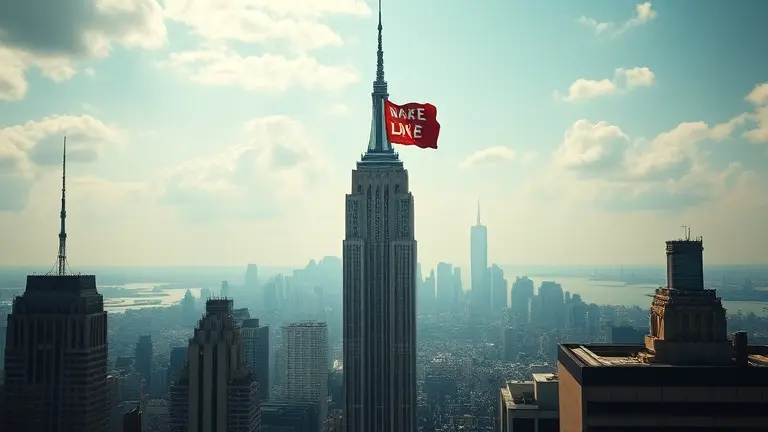
On July 1, 2026, the Manhattan skyline became the backdrop for a death-defying display of romantic theater that stopped traffic and sent shockwaves through global security circles. Internationally renowned daredevils Angela Nikolau and Ivan Beerkus, the stars of the Netflix documentary Skywalkers: A Love Story, executed a high-stakes, illegal climb to the very pinnacle of the Empire State Building. Amidst the dizzying heights, the pair unfurled a banner proclaiming that love conquers the hunger for power before engaging in a dramatic, televised marriage proposal. While the stunt was captured with cinematic precision, the immediate reality—a swarm of law enforcement and handcuffs—underscored the blurring lines between influencer-driven content creation and criminal trespass.
This event is more than a viral headline; it is a profound case study in the ‘performative crime’ economy, where the stakes are raised to life-or-death levels to feed an algorithm hungry for extreme experiences. As we analyze the intersection of urban exploration (urbex) and the modern influencer psyche, we are forced to confront an uncomfortable truth about human connection in the digital age. When extreme stunts are used as the ultimate currency of commitment, we must ask: are we witnessing a deeper devotion, or simply the commodification of intimacy in an era of manufactured viral fame?
The Empire State Spire Incident: A Timeline of the July 2026 Stunt

On the morning of July 1, 2026, the iconic skyline of midtown Manhattan became the backdrop for a high-stakes security breach that quickly captivated the globe. The incident involved internationally recognized daredevils Angela Nikolau and Ivan Beerkus, figures who previously gained fame through the Netflix documentary Skywalkers: A Love Story. The pair orchestrated a meticulously planned yet illegal ascent of the Empire State Building, bypassing complex security measures to reach the building’s upper reaches in broad daylight. This act of climbing the Empire State Building—a feat rarely attempted due to the structure’s heavily guarded status—highlighted significant vulnerabilities in the security protocols governing one of the world’s most famous landmarks.
The sequence of events unfolded rapidly as the climbers navigated the exterior of the spire. Once they successfully reached the summit, the duo executed a carefully choreographed performance:
- The Banner Unfurling: The climbers displayed a large message reading, “When the power of love beats the love of power the world knows peace,” designed to maximize visual impact for cameras and spectators below.
- The Proposal: In a move that garnered significant Empire State Building news coverage, the act culminated in a dramatic public marriage proposal. This performative element effectively blended extreme sports culture with social media-driven viral marketing.
- Law Enforcement Response: The presence of the climbers triggered an immediate mobilization by the NYPD and specialized security teams.
Following their brief time at the summit, the Empire State Building climbers were intercepted by authorities as they descended. The immediate arrest of Nikolau and Beerkus marked the end of the stunt but ignited a broader debate regarding the ethics of “urbex” and the dangers of professional influencers seeking digital virality through illegal means. While supporters of the pair pointed to the aesthetic nature of the footage, law enforcement and building officials emphasized the immense safety risks and the potential for a massive public security disruption. As investigations continue, this event stands as a definitive case study in the extreme lengths to which contemporary creators will go for global attention.
From ‘Skywalkers’ to the Skyline: The Psychology of High-Stakes Virality

The July 1, 2026, climbing of the Empire State Building by Angela Nikolau and Ivan Beerkus represents a significant escalation in the intersection of digital fame and transgressive behavior. Having achieved international notoriety through the 2024 Netflix documentary Skywalkers: A Love Story, the duo demonstrated a psychological profile deeply rooted in the “attention economy.” For creators whose brand identity is built on death-defying feats, maintaining relevance requires an constant, exponential increase in risk. This phenomenon, often termed “performative crime,” shifts the motive from pure exploration to the pursuit of global viral validation. By staging an illegal Empire State Building proposal at the spire, the pair essentially gamified their criminal trespass to cement their narrative arc for an audience conditioned by high-stakes streaming content.
The Dynamics of Risk and Digital Relevance
The transition from documentary subjects to active perpetrators of high-profile stunts reveals the pressure exerted by digital algorithms. Psychologists suggest that the “fear of irrelevance” in the creator space acts as a powerful driver for extreme behavior. In the case of these Empire State Building climbers, the stunt serves multiple strategic purposes:
- Audience Retention: By leveraging the momentum from their film appearance, the pair ensured that their actions were immediately contextualized by millions of followers.
- The “Legacy” Trap: Once a creator is known for extreme stunts, they risk losing their platform if they shift to safer content, effectively locking them into an escalating cycle of danger.
- Monetization of Infamy: The global news cycle coverage—spanning outlets from NBC New York to The Telegraph—guarantees a spike in digital visibility that traditional marketing cannot replicate.
Ultimately, this event highlights an urgent issue for metropolitan security. When iconic landmarks become backdrops for viral stunts, the boundary between art, extreme sports, and illegal security breaches blurs, forcing cities to re-evaluate how they protect infrastructure from those seeking to turn skyscrapers into stages.
Logistics of the Ascent: Analyzing Security Breaches in Iconic Skyscrapers

The July 1, 2026, incident involving Angela Nikolau and Ivan Beerkus highlights a sophisticated evolution in urban exploration, often referred to as “urbex.” While the Empire State Building maintains some of the most rigorous security protocols in New York City—including multi-layered biometric access, thermal imaging, and constant physical patrols—high-profile empire state building climbers often utilize “social engineering” and advanced surveillance of patrol rhythms to penetrate these systems. Scaling a landmark of this magnitude is rarely a spontaneous act; it requires months of site reconnaissance to identify blind spots in the surveillance grid. The technical challenge is exacerbated by the building’s unique architecture, particularly the narrow, wind-whipped spire which presents extreme physical risks that demand expert-level free-climbing proficiency.
Understanding Security Vulnerabilities and Law Enforcement
When daredevils attempt such a feat, they are essentially testing the limits of modern building security. The logistical reality of these stunts involves:
- Pattern Mapping: Observing shift changes and security guard rotations to minimize the window of detection.
- Structural Exploitation: Identifying exterior conduits or maintenance access points that may lack motion-sensor coverage.
- Technological Evasion: Avoiding infrared cameras through the use of specific low-thermal-signature materials or timing movements to coincide with building maintenance routines.
The immediate law enforcement response following the empire state building proposal incident demonstrated that while perimeter security may be bypassed, the interior and vertical envelope of such structures remain under heavy digital and human surveillance. Upon detection, NYPD units and specialized tactical teams are capable of sealing off exit points and tracking movement via interior cameras, effectively trapping trespassers. This intersection of extreme sports and the “performative crime” economy presents a modern dilemma for property management: the balance between maintaining an open, iconic landmark and securing a high-value target from those seeking digital virality through illegal acts. Ultimately, the arrest of these individuals confirms that even the world’s most recognizable skyscrapers remain hostile environments for unauthorized ascent.
The Ethics of Attention: Balancing Creativity and Public Safety

The July 1, 2026, Empire State Building incident involving Angela Nikolau and Ivan Beerkus highlights a troubling trend within the creator economy: the commodification of extreme risk. As professional daredevils who gained global notoriety following the 2024 Netflix documentary Skywalkers: A Love Story, the pair leveraged their audience’s appetite for adrenaline to justify a high-stakes, illegal stunt. This “performative crime” raises critical questions regarding the ethics of attention, where the pursuit of viral engagement seemingly outweighs legal boundaries and the preservation of public infrastructure. When influencers prioritize content creation over public safety, they transform iconic landmarks into stages for private drama, fundamentally shifting the responsibility of emergency services toward managing preventable man-made crises.
The True Cost of Viral Performance
The mobilization of New York law enforcement to the Empire State Building to address these empire state building climbers diverted critical city resources away from genuine emergencies. While proponents of the “daredevil” narrative argue that such stunts are purely artistic expressions, the reality is far more complex:
- Emergency Strain: The immediate response necessitated by an illegal climb in midtown Manhattan creates unnecessary liability and risk for first responders.
- Public Endangerment: Climbing the spire poses a threat not only to the participants but also to pedestrians below, who could be harmed by falling debris or equipment.
- Normalization of Risk: By romanticizing extreme, unauthorized acts, influencers risk inspiring copycats who may lack the training of professionals like Nikolau or Beerkus, leading to potentially fatal consequences.
The empire state building proposal—while intended to be a romantic gesture—cannot be decoupled from the illegality of the act itself. In an era where digital presence is synonymous with professional capital, platforms and creators must reckon with the consequences of turning public safety into a secondary consideration. When the “love of power” or the “power of love” necessitates a felony breach of one of the world’s most guarded structures, it serves as a stark reminder that the digital attention economy often lacks a necessary moral compass, prioritizing momentary virality over the safety of the collective urban environment.
Beyond the Spire: Building Genuine Devotion
The saga of Nikolau and Beerkus reveals the exhausting lengths to which individuals will go to broadcast a narrative of “ultimate” love. Yet, while their daring climb to the top of the Empire State Building offers a spectacle of extreme romantic signaling, it remains a fragile, performative gesture. Lasting relationships are not built on death-defying stunts or public banners; they are forged in the quiet, psychological architecture of daily connection. True, life-altering devotion doesn’t require a daring escapade—it requires a profound understanding of what truly drives a partner’s heart and mind.
While Angela and Ivan chose a death-defying stunt to express their commitment, most of us look for more grounded, sustainable ways to ignite that same level of profound devotion and partnership in our own lives. You do not need to risk your life to capture a partner’s undivided focus. Instead, by unlocking the psychological triggers that govern biological attraction and emotional security, you can foster a deep, enduring bond that survives far longer than a viral social media post.
We recommend a more scientific approach to building intimacy through His Secret Obsession. This guide acts as your psychological toolkit, helping you understand the ‘hero instinct’ and the secret signals that trigger a man’s desire for deep, committed connection. Rather than chasing the empty rush of external validation, you can master the skills to create a secure, obsessive bond that remains constant in the real world.
 Learn the secret signals that trigger a man’s hero instinct and create the deep emotional obsession you’ve been looking for.Transform My Life Today