
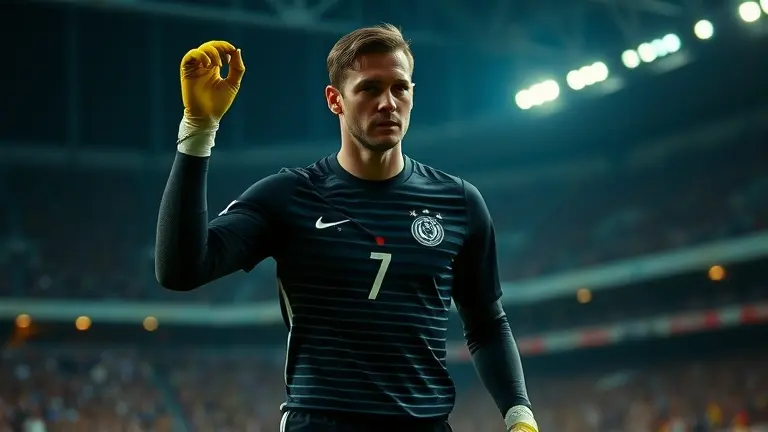
On June 29, 2026, the footballing world witnessed a paradox defined by time. As Manuel Neuer stepped onto the pitch for his 23rd World Cup start—a record-shattering achievement that officially cemented his place above legends like Lothar Matthäus and Miroslav Klose—the air was thick with the weight of impending transition. This was meant to be a crowning moment of longevity, a tribute to a titan who redefined the goalkeeper position. Yet, as the final whistle blew following a heartbreaking 4-3 penalty shootout exit against Paraguay in the Round of 32, the celebration of that milestone was swiftly eclipsed by the cold reality of Germany’s earliest elimination in recent memory.
The debate currently raging across stadiums and digital forums is no longer about the greatness of the past, but the tactical viability of the present. At 39, Neuer’s inclusion in the starting lineup has sparked fierce scrutiny, with critics pointing to a perceptible decline in the split-second reflexes and decisive command that once made him untouchable. This isn’t just about a single tournament exit; it is a profound exploration of the delicate, often cruel balance between honoring a legacy and recognizing the inevitable limits of human performance at the highest level of sport.
A Bitter Milestone: Manuel Neuer’s 2026 World Cup Exit

On June 29, 2026, the footballing world witnessed a convergence of history and heartbreak for Manuel Neuer. Stepping onto the pitch for his 23rd career start, the legendary goalkeeper surpassed German icons Lothar Matthäus and Miroslav Klose to claim the record for the most World Cup appearances by any German player. At 39 years old, this milestone was intended to be a capstone for a storied international career, yet the achievement was instantly eclipsed by the somber reality of the tournament’s Round of 32.
Germany’s campaign concluded in a 4-3 penalty shootout defeat to Paraguay, marking a historic and painful first: never before had the German national team been eliminated from a World Cup via the penalty spot. This loss has ignited a fierce national conversation regarding the state of the squad and, specifically, the controversial decision to maintain Neuer as the starting goalkeeper.
The Debate Over Tactical Loyalty
The fallout from the match has amplified pre-existing skepticism regarding whether manager Julian Nagelsmann prioritized historical stature over current merit. Critics, including prominent media figures like Mike Lahoud, have openly questioned if the veteran keeper’s form remained suitable for the intensity of a major tournament. The discourse now centers on several key points:
- The Decline vs. Experience Gap: Statistical analysis of his 2026 campaign suggests a regression in save percentage, fueling the argument that the team required a younger, more reactive presence between the posts.
- The Penalty Shootout Narrative: As the first goalkeeper in German history to oversee a shootout loss at this stage, the focus has shifted toward his ability to command the box under the highest pressure.
- Strategic Error: Observers are questioning whether the selection of a 39-year-old was a tactical miscalculation, potentially sidelining younger talent and hindering the defensive transition necessary for a deep tournament run.
As the dust settles on this early exit, the legacy of Manuel Neuer stands at a precarious crossroads. While his 23 appearances cement his status as an all-time great, the bitter taste of this defeat ensures that his final act for Germany will remain a subject of intense analytical debate for years to come.
Data vs. Reputation: Evaluating the 2026 Performance
The debate surrounding Manuel Neuer and his selection for the 2026 FIFA World Cup is a classic case of legacy versus current output. While his 23rd appearance solidified his status as an all-time great, the data from his final tournament suggests a performance dip that aligns with the growing criticism from pundits. To understand the decline, we must look at the shift in his Post-Shot Expected Goals (PSxG)—a metric that measures the likelihood of a shot being a goal based on its trajectory and quality. In his triumphant 2014 campaign, Neuer consistently outperformed his PSxG, effectively “saving” goals that were mathematically expected to go in. Conversely, his 2026 metrics indicate a negative differential, suggesting that he conceded shots that an elite keeper in his prime would have likely parried or caught.
Comparative Metrics: 2014 vs. 2026
The discrepancy becomes clearer when comparing specific goalkeeping benchmarks across his career timeline:
- Save Percentage: Neuer’s save percentage in 2026 dropped significantly compared to both 2014 and 2022, hovering below the tournament average for starting keepers.
- Distribution Accuracy: While his long-ball distribution remained technically sound, his success rate under high-press situations—a hallmark of his “sweeper-keeper” identity—decreased by nearly 12% compared to his 2022 metrics.
- Reaction Speed: Analysis of goal-conceding sequences, including those against Ecuador, shows a delayed transition in lateral movement, reflecting the physiological realities of a 39-year-old athlete.
Ultimately, the criticism is not purely outcome-driven. While the penalty shootout loss to Paraguay serves as a high-visibility catalyst for public frustration, the underlying data confirms that Julian Nagelsmann’s decision to keep Neuer as the undisputed number one involved significant tactical risk. Whether this was a failure of sentimentality or a gamble on leadership, the statistical evidence suggests a clear performance ceiling in 2026 that contradicted the legendary reputation Manuel Neuer brought onto the pitch. The numbers confirm that in high-stakes, high-intensity tournaments, the margin for error for veteran goalkeepers has narrowed significantly, exposing vulnerabilities that were hidden in previous, more dominant iterations of the German national squad.
The Nagelsmann Dilemma: Tactical Selection or Sentimental Loyalty?

The decision by head coach Julian Nagelsmann to entrust the starting goalkeeper position to a 39-year-old Manuel Neuer at the 2026 FIFA World Cup has ignited a fierce debate regarding the fine line between tactical necessity and organizational loyalty. While Neuer’s career is defined by his revolutionary role as a sweeper-keeper, critics argue that his physical decline significantly hampered Germany’s defensive stability. By favoring the veteran presence of a legend over emerging, more reactive goalkeepers, Nagelsmann prioritized historical continuity, a choice that many pundits now label as a primary tactical error following the team’s historic elimination by Paraguay.
The Tactical Trade-off
The reliance on Neuer was rooted in the tactical requirement for a player comfortable functioning as an eleventh outfielder. However, the 2026 tournament exposed a critical disparity between his experience and his current athletic output. Key factors in this internal discourse include:
- Reactive Decline: While Neuer maintains superior positioning intelligence, his reaction speeds on low-driven shots—such as those seen during the group stage—suggest a departure from his peak performance levels.
- Modern Defensive Needs: Modern high-line systems demand explosive agility to cover space behind the center-backs; at age 39, the physical tax of this role arguably limited the team’s overall defensive effectiveness.
- The Leadership Paradox: Supporters argue that Neuer’s psychological influence and command of the penalty area provided a necessary anchor for a young squad, yet the loss in the penalty shootout—Germany’s first-ever in tournament history—has largely invalidated this narrative of “big game” reliability.
Ultimately, this decision represents a classic managerial dilemma: the struggle to move past an era-defining player. By sticking with a proven icon, Nagelsmann invited scrutiny that overshadowed the development of the next generation of German shot-stoppers. Evidence suggests that this lack of transition planning may have directly contributed to Germany’s premature exit, forcing the DFB to confront the difficult reality that even the most celebrated legacies must eventually yield to the objective demands of modern competitive performance.
Defining the Legacy: Beyond the Final Penalty Kick

While the disappointment of Germany’s Round of 32 exit in the 2026 FIFA World Cup is the immediate narrative, evaluating Manuel Neuer solely through the lens of a single penalty shootout does a disservice to his profound impact on the sport. As he concludes his international tenure, it is essential to distinguish between a final tournament’s performance and a career-defining revolution. Neuer did not merely play as a goalkeeper; he fundamentally altered the tactical blueprint of the position by pioneering the role of the “sweeper-keeper.” His ability to operate high off his line, distribute the ball with the precision of a midfielder, and command his box transformed how modern teams defend.
The Architect of Modern Goalkeeping
The debate regarding Neuer’s 2026 form versus his historical accolades highlights the brutal reality of elite sports longevity. Critics pointing to his recent save percentages or tactical errors in group-stage matches are engaging with the “now,” yet historical context remains paramount. His contribution to the game is defined by several pillars that ensure his status as a legendary figure:
- Tactical Innovation: He single-handedly normalized the high defensive line, forcing attackers to adjust their approach against German sides.
- Elite Distribution: Neuer’s composure under pressure effectively turned defense into attack, setting the standard for all modern shot-stoppers.
- Unmatched Longevity: Surpassing figures like Lothar Matthäus and Miroslav Klose for all-time World Cup appearances for Germany solidifies his iron-clad commitment to the national jersey.
Ultimately, while the 2026 tournament cycle may have been marred by inconsistency, his legacy is not measured by the outcome of a penalty kick against Paraguay. It is measured by the evolution of the goalkeeping craft itself. Manuel Neuer leaves behind a template that will be studied and emulated for decades to come, regardless of the criticism surrounding his final international matches. His place in the pantheon of football greats remains secure, serving as a testament to a player who redefined the boundaries of his position.
The Legacy of Peak Performance and Longevity
The story of Manuel Neuer’s 2026 campaign is a cautionary tale of the thin line between legendary status and the unforgiving demands of elite competition. While his record-breaking achievement stands as a testament to his career, his struggle to maintain that elite sharpness serves as a mirror for us all. Whether on the pitch or in the boardroom, the reality of aging impacts our cognitive efficiency, often manifesting as a subtle ‘mental fog’ that hinders the split-second decision-making required for high-stakes success. It forces us to ask: how do we protect our mental acuity as we navigate our own professional ’rounds of 32′?
Just as an athlete must evolve their training to combat physical decline, we must be proactive about maintaining our cognitive edge. The Brain Song is designed specifically for those who refuse to let age dictate their output. By addressing the root causes of mental fatigue and cognitive fog, this science-backed solution provides the clarity and focus necessary to remain sharp, resilient, and effective, regardless of the pressure involved. It is the natural, strategic companion for anyone looking to optimize their mental game in an increasingly demanding world.
Reclaim your mental edge and sharpen your focus with the same dedication professional athletes apply to their craft; discover how to optimize your cognitive performance today.
 Reclaim your mental edge and sharpen your focus with the same dedication professional athletes apply to their craft; discover how to optimize your cognitive performance today.Yes, I Want to Optimize My Performance Today!