

The grass courts of Bad Homburg have become more than just a pre-Wimbledon pit stop; they have become the crucible for Naomi Osaka’s tactical rebirth. After dispatching Magdalena Frech and Elise Mertens with clinical precision, Osaka is displaying a rhythmic movement and service consistency that was noticeably absent in her previous grass-court campaigns. Amidst the sweltering German heat and high-stakes pressure, she isn’t just winning matches—she is refining a movement pattern that suggests a serious title contention at the All England Club.
Her recent performances have shifted the narrative from mere potential to tangible momentum. While much of the sports media remains fixated on the scoreboard, a closer look reveals a athlete who has learned to marry her raw, baseline aggression with the nuanced footwork required for the unpredictable bounce of grass. As the 2026 Grand Slam season reaches its fever pitch, Osaka’s newfound mental clarity and on-court composure have become her most dangerous weapons, marking a pivotal moment in her path toward reclaiming dominance on the sport’s biggest stages.
Naomi Osaka’s Momentum Shift: The 2026 Bad Homburg Open Performance

Naomi Osaka has arrived at the 2026 grass-court swing with a renewed sense of purpose, signaling her resurgence as a major force in professional tennis. Her performance at the Bad Homburg Open has been nothing short of clinical, providing a much-needed boost of confidence as she heads toward the prestigious Wimbledon Championships. By dispatching Magdalena Frech with a dominant 6-4, 6-1 scoreline and following up with a composed 6-3, 6-3 victory over Elise Mertens, Osaka has showcased a tactical maturity that was perhaps missing in her earlier season outings. These back-to-back straight-set wins are evidence that her game is successfully transitioning to the unique demands of grass, where lower bounces and faster surfaces punish indecision.
Tactical Mastery Under Pressure
Osaka’s ability to thrive in Germany has been tested by unpredictable weather conditions and, at times, sweltering heat. Rather than succumbing to environmental distractions, her on-court demeanor has remained remarkably stable. This psychological shift—often highlighted by her positive attitude and controlled ball-striking—is a critical component of her current momentum. Key observations from her recent matches include:
- Improved Serve Consistency: Osaka has utilized high first-serve percentages to dictate points early, preventing opponents from establishing a rhythm.
- Adaptive Movement: She is showing greater comfort with shorter, explosive steps, which are essential for maintaining balance on the slick grass of the Bad Homburg courts.
- Tactical Patience: Instead of over-hitting, she is waiting for the right moment to pull the trigger, a sign that she is trusting her conditioning and technical form.
This resurgence arrives alongside her recent nomination for Sportswoman of the Year, underscoring her ongoing cultural impact alongside elite peers like Jordan Chiles and Sha’Carri Richardson. As she advances to the quarterfinals in Bad Homburg, the tennis world is watching closely. Her current form suggests that she is not just a competitor, but a genuine dark horse for a deep run at the All England Club this July.
Tactical Evolution: Serving Mechanics on Grass

At the 2026 Bad Homburg Open, Naomi Osaka has showcased a refined approach to her service games, signaling a pivotal shift in her preparation for Wimbledon. Historically, Osaka has relied on sheer power; however, her performance against Magdalena Frech and Elise Mertens reveals a deliberate tactical evolution toward increased placement precision. By utilizing a flatter trajectory on her first serve, Osaka is effectively exploiting the low-bouncing nature of grass courts to shorten points and neutralize aggressive returners before they can establish rhythm. This adjustment is not merely about velocity but about maximizing the “skid” factor inherent to fast-surface tennis.
Evidence from her recent matches suggests that Osaka is prioritizing wide-angle deliveries in the deuce court, a technical change that forces opponents to stretch beyond their reach on a surface where recovery time is minimal. This strategic shift serves several key functions:
- Neutralizing Returner Positioning: By hitting lower through the court, she prevents opponents from taking the ball on the rise.
- Increased Serve Consistency: Her focus on a more compact ball toss under varying heat conditions has led to a noticeable uptick in first-serve percentage compared to her 2023-2024 grass-court campaign.
- Efficient Point Construction: Faster service holds are allowing Osaka to conserve energy, a critical asset given the high-stakes physical demands of the grass-court season.
Compared to previous grass-court appearances, where verticality and height on the serve often allowed opponents to counter-attack, the 2026 iteration of Osaka’s game is far more disciplined. By maintaining a flatter arc, she minimizes the time the ball spends in the air, granting her opponents virtually no window to react. As she advances deeper into the Bad Homburg bracket, these technical refinements position her as a formidable contender at the upcoming Wimbledon Championships, provided she continues to maintain this high standard of tactical execution under pressure.
Strategic Court Positioning and Baseline Aggression
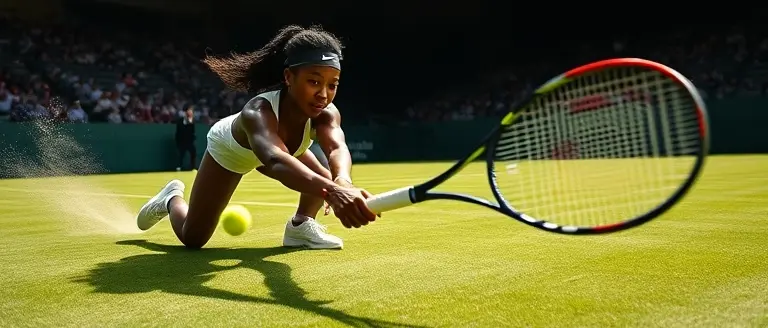
At the 2026 Bad Homburg Open, Naomi Osaka has displayed a refined tactical evolution that signals a significant shift in her approach to grass-court tennis. Historically known for blistering, flat groundstrokes from deep behind the baseline, Osaka’s recent performances against Magdalena Frech and Elise Mertens reveal a newfound commitment to shortening points through smarter court geometry. By hugging the baseline more aggressively, she has successfully reduced the time her opponents have to react, effectively neutralizing the erratic bounces often associated with grass surfaces. This shift is not merely about raw power; it is a calculated decision to dominate the “plus-one” shot—the ball immediately following her serve—to stifle rhythm before it can develop.
Tactical Refinements and Movement
Her movement patterns in Germany indicate improved efficiency, specifically regarding her lateral recovery. By utilizing short-angle cross-court shots, Osaka is forcing her opponents into uncomfortable wide positions, opening up the court for high-percentage winners. This transition is essential for her success at the upcoming Wimbledon Championships, where the low-skidding nature of the grass rewards proactive positioning over reactive retrieval. Key adjustments observed include:
- Aggressive Net-Play: Osaka is showing increased comfort when transitioning forward, cutting off angles that were previously left open.
- Minimized Unforced Errors: By focusing on depth rather than solely on velocity, she is maintaining higher consistency under pressure.
- Improved Serve Placement: Evidence suggests her serve is functioning as a setup tool rather than just a weapon, allowing her to dictate points from the opening strike.
This disciplined approach, coupled with her positive mindset during heat-affected matches, demonstrates a more seasoned tennis strategy. By blending her signature baseline aggression with surgical precision at the net, Osaka is transforming from a pure power hitter into a versatile threat capable of navigating the tactical nuances required for deep runs at Grand Slam events. As she heads to London, this tactical evolution remains her most significant weapon in her quest for grass-court glory.
Road to Wimbledon: Can This Form Translate to Grand Slam Success?

The recent performances of Naomi Osaka at the 2026 Bad Homburg Open offer a compelling preview of her potential impact at the upcoming Wimbledon Championships. By dispatching opponents like Magdalena Frech and Elise Mertens with clinical efficiency, Osaka has demonstrated that her game is rapidly rounding into form on the natural grass surface. Her ability to maintain composure during high-temperature matches in Germany highlights a significant evolution in her mental fortitude, a trait that will be tested extensively during the grueling two-week schedule at the All England Club. The tactical refinements observed—specifically her serve precision and controlled aggression from the baseline—suggest she is no longer merely relying on raw power, but rather a more nuanced approach to court geometry.
Translating Tactical Refinements to the All England Club
For Osaka, the transition from tune-up events to the intensity of a Grand Slam requires sustained focus and the ability to adapt to varying grass conditions. Her recent successes provide several key indicators that she could be a major threat in the London draw:
- Serve Efficiency: Her ability to secure quick service holds under pressure significantly reduces the energy expenditure needed for long, drawn-out matches.
- Adaptability: Her movement on the grass has shown marked improvement, with better anticipation of the low, skidding bounces that often frustrate baseline-heavy players.
- Mental Consistency: By maintaining a positive mindset even when facing challenging weather, she has cultivated a resilience that is essential for surviving the high-stakes environment of Wimbledon.
Evidence suggests that if Osaka can replicate this tactical discipline, she will enter the draw as one of the most dangerous players in the field. While the competition at the highest level remains fierce, her current form indicates that the 2026 grass-court season could be a pivotal chapter in her professional trajectory. As she shifts her focus to the world’s most prestigious tennis tournament, the tennis world is watching closely to see if this momentum can translate into a deep, title-contending run.
Mastering the Mental Game for Championship Excellence
Naomi Osaka’s current form is a testament to the fact that elite tennis is won as much in the mind as it is with the racquet. Her ability to maintain focus, process pressure, and execute under extreme environmental volatility provides a masterclass for any competitor striving for peak performance. However, this level of cognitive resilience is not merely a natural gift; it is a skill that can be developed and sharpened through intentional, neuroscience-backed training.
Just as Naomi Osaka relies on a sharpened mindset to navigate the physical and mental volatility of grass-court tennis, competitive players and fans alike are increasingly turning to neuro-scientific solutions to cultivate their own ‘on-court’ focus. The Brain Song serves as your personal mental conditioning tool, designed to help you eliminate mental fog and achieve the same level of sustained concentration that defines the world’s top-tier athletes. By integrating this into your daily routine, you bridge the gap between tactical analysis and the mental discipline required to excel at the highest level.
By leveraging the evidence-based methodology of The Brain Song, you are not just watching excellence—you are actively training your brain to replicate that poise and performance stability when the pressure is highest. Don’t leave your potential to chance; master the mental clarity needed to reach your own personal summit.
 Unlock your peak performance potential and sharpen your cognitive consistency today by incorporating The Brain Song into your daily routine.Transform My Mental Performance Today!