
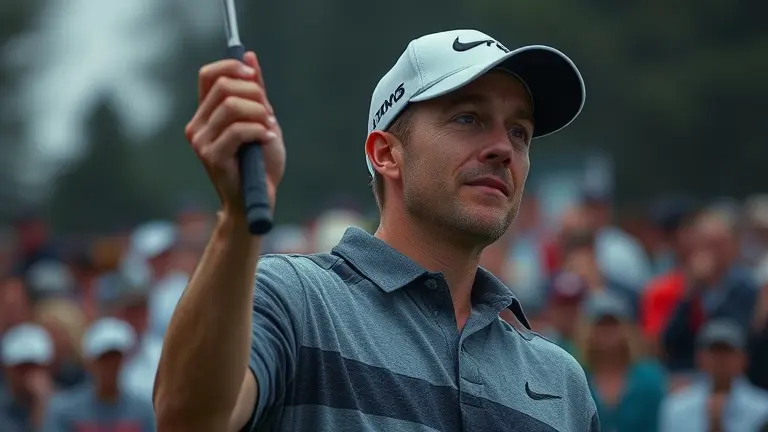
The 2026 U.S. Open will be remembered not only for its historic venue but for the intense psychological test endured by the champion, Wyndham Clark. After being banned from Oakmont Country Club in 2025 following a volatile outburst that damaged historic club property, Clark entered the 2026 championship with a target on his back. As he navigated the fairways at Shinnecock Hills, he faced a barrage of heckling from a crowd that hadn’t forgotten his past, creating a high-pressure atmosphere that would have shattered most professional golfers.
Yet, in a display of iron-willed resilience, the 32-year-old managed to silence his critics with a dominant wire-to-wire victory, framing the win as a hard-earned redemption. While internet debates continue to swirl around a controversial relief drop on the 17th hole, the true story of this year’s U.S. Open lies in Clark’s evolved mental approach. This article explores how a once-troubled athlete learned to master his focus, providing a lens through which we can all understand the necessity of emotional discipline when the stakes—and the scrutiny—are at their absolute highest.
The Oakmont Incident and the Road to Shinnecock Hills
The narrative surrounding the wyndham clark controversy is deeply rooted in a singular, high-profile disciplinary action that occurred during the 2025 season. Following a disappointing missed cut at the U.S. Open held at the storied Oakmont Country Club, frustration boiled over for the then-31-year-old golfer. Reports confirmed by various sports outlets indicate that Clark engaged in a locker room outburst, resulting in significant damage to historic lockers—artifacts that held over a century of club heritage. As a direct consequence of this behavior, the club administration took the rare step of issuing a lifetime ban against the athlete, a move that reverberated throughout the professional golf community and fundamentally altered his public image.
From Oakmont to Shinnecock Hills
The fallout from the Oakmont incident created a turbulent backdrop for Clark’s professional life leading into the 2026 season. As spectators began to ask what did Wyndham Clark do at Oakmont with increasing frequency, the athlete found himself at the center of a polarizing debate regarding golfer conduct and temperament. By the time the tour reached the 2026 U.S. Open at Shinnecock Hills, the atmosphere had shifted from simple scrutiny to active, vocal hostility from sections of the gallery. This environment tested the mental fortitude of the now-32-year-old Clark, who had spent the previous year attempting to reconcile his on-course performance with his reputation off it.
Navigating Public Sentiment
Despite the intense scrutiny and heckling, Clark’s wire-to-wire victory at Shinnecock Hills stands as one of the most resilient performances in recent major championship history. His journey from the fallout at Oakmont to his second U.S. Open title highlights several key factors in modern sports branding:
- Public Accountability: The shift in perception after the locker room damage forced a public reckoning with his past behavior.
- Performance Under Pressure: Clark’s ability to block out crowd noise—often fueled by memories of what Wyndham Clark did last year—demonstrated a newfound level of professional maturity.
- The Redemption Arc: By framing his 2026 triumph as a form of redemption, Clark effectively transitioned the conversation from his previous conduct to his athletic capabilities.
While fans continue to debate his character on social media forums like Reddit, the factual record remains clear: the path to his second major victory was paved with both significant disciplinary challenges and undeniable golfing excellence.
Navigating Hostility: The Psychology of Athlete Resilience

The professional sports arena often demands more than just technical skill; it requires an ironclad mental framework. For Wyndham Clark, the 2026 season—and specifically his second U.S. Open title—has become a definitive case study in emotional regulation. Following the much-discussed Oakmont incident, where Clark faced significant professional fallout, he entered the 2026 U.S. Open at Shinnecock Hills under a microscope. Navigating the sustained public heckling and negative social media sentiment required a level of focus that few athletes ever achieve under duress.
Mechanisms of Elite Emotional Control
When athletes face a hostile environment, the sympathetic nervous system often triggers a fight-or-flight response, which can be detrimental to the fine motor control required in golf. Clark’s wire-to-wire performance suggests he utilized several advanced psychological techniques to mitigate external noise:
- Selective Attention: By filtering out vocal outbursts from spectators, elite performers can maintain the meditative state required for high-pressure shots.
- Reframing Narrative: Clark utilized the “redemption” angle to convert external criticism into internal motivation, effectively changing the psychological weight of the event from a burden to a purpose.
- Cognitive Distancing: Experts suggest that successful athletes often distance their “on-course persona” from their personal lives, allowing them to compartmentalize past controversies—such as his 2025 conduct—to perform in the present.
The wyndham clark controversy highlights a broader trend in professional golf: the intersection of fan behavior and player accountability. While the US Open remains a stage for athletic excellence, the increased scrutiny—fueled by viral debates over rule interpretations and past mistakes—creates a unique psychological barrier. Clark’s ability to maintain his composure through the final round demonstrates that resilience is not the absence of pressure, but the capacity to maintain technical precision while the world is watching, and often, while the world is judging. By focusing on his mechanics rather than the crowd, Clark transformed a hostile atmosphere into a backdrop for his most significant career achievement.
Fact-Checking the 17th Hole: Understanding Rule Interpretations
The 2026 U.S. Open at Shinnecock Hills brought renewed scrutiny to Wyndham Clark, particularly following a viral social media debate surrounding a relief drop on the 17th hole. As fans and analysts dissected the moment, accusations of impropriety spread across platforms like Reddit and TikTok. However, a technical analysis of the USGA guidelines reveals that the relief procedure performed by the two-time U.S. Open champion was consistent with standard professional protocol. Understanding the mechanics of the drop requires looking past the online controversy to the specific rules governing relief from abnormal course conditions.
Under Rule 16.1, a player is entitled to free relief when their ball lies in or touches an abnormal course condition—such as a sprinkler head or temporary standing water—that interferes with their stance or swing. In the instance that drew such intense scrutiny, Clark identified the interference and proceeded with the mandatory drop process. Key elements of this compliance include:
- Establishing the Reference Point: The player must identify the nearest point of complete relief, which is the spot nearest to where the ball lies that is not in the relief area and avoids the interference.
- The One-Club-Length Rule: After identifying the reference point, the player is permitted to drop the ball within a relief area that extends one club length from that point, provided the ball stays in the general area and does not move closer to the hole.
- Official Oversight: Professional events, including those where Wyndham Clark competes, are overseen by USGA rules officials who monitor these drops in real-time.
Evidence suggests that the officiating team deemed the drop legitimate at the moment of play. By focusing on the objective application of the rules rather than the subjective “cheating” narrative, it becomes clear that the incident was a standard technical procedure. While the wyndham clark controversy—stemming from his past behavior at Oakmont—has made him a polarizing figure, the 17th-hole drop serves as an example of how the intensity of high-stakes sports can often lead to public misunderstandings of complex golf regulations.
Wyndham Clark: Career Profile and Path to Redemption
Born on December 9, 1993, Wyndham Clark has emerged as one of the most polarizing yet talented figures in professional golf. Now 32 years old, his journey to the pinnacle of the sport is marked by a unique blend of elite ball-striking capabilities and a turbulent public image. Clark first gained prominence through a stellar collegiate career, eventually translating his powerful game to the PGA Tour. While his early years were defined by his pursuit of consistent top-tier finishes, his trajectory shifted dramatically following the highly publicized wyndham clark oakmont incident in 2025. Following his missed cut at that U.S. Open, Clark’s frustration boiled over, resulting in the destruction of historic property and a subsequent lifetime ban from the venue.
From Controversy to Championship
The narrative of what did wyndham clark do at oakmont became a focal point of his career, casting a long shadow over his performances throughout the following year. However, his performance at the 2026 U.S. Open at Shinnecock Hills served as a definitive turning point. Despite facing intense heckling and a hostile environment, Clark secured his second U.S. Open title in a wire-to-wire performance that critics and supporters alike are now calling an act of professional redemption. This victory underscores his mental fortitude, proving that he can operate under extreme psychological pressure.
Professional Milestones and Legacy
Understanding the modern era of his career requires a look at both his physical dominance and his ability to navigate adversity:
- Elite Consistency: Clark has maintained high world rankings by refining his short game and emotional regulation.
- The 2026 Shift: His performance at the U.S. Open answered the question of who won the us open during one of the most scrutinized tournaments in recent memory.
- Resilience Under Fire: By focusing on his internal processes rather than the “cheat” allegations surrounding his 17th-hole relief drop, Clark successfully rebranded his image from an impulsive player to a disciplined major champion.
As he moves forward, Clark’s legacy will likely be defined by this transition—showing that while his actions at Oakmont were a low point, his subsequent mental growth and championship-level composure have solidified his standing among the world’s elite golfers.
Mastering the Mental Game Under Pressure
Wyndham Clark’s journey at the 2026 U.S. Open serves as a profound case study in emotional discipline. While the noise surrounding his past at Oakmont and the scrutiny of his 17th-hole relief drop threatened to derail his performance, Clark’s ability to compartmentalize and refocus allowed him to secure a wire-to-wire victory. This redemption arc was not merely about superior ball-striking; it was about the resilience required to thrive when the environment is hostile.
Much like elite athletes who utilize specific training protocols to maintain peak focus under fire, high-performers across all industries are increasingly turning to neuro-auditory tools to stay sharp and mentally composed during their own daily pressures. Just as Clark had to silence the hecklers to reclaim his championship status, you must be able to eliminate mental fog to perform at your highest potential.
The Brain Song is designed to mirror the cognitive conditioning required for professional success, offering a science-backed, 12-minute daily routine to sharpen your focus and restore clarity. By integrating this practice into your day, you equip yourself with the same psychological tools used by top-tier athletes to navigate high-stakes environments, ensuring that you remain undistracted by the chaos surrounding you.
 Harness the power of your own mental resilience and clear the noise; discover how the 12-minute Brain Song routine can help you achieve peak daily performance.Transform My Mental Performance Today