

The 2026 Nottingham Open has witnessed a stunning professional resurgence, with Emma Navarro emerging as the standout narrative of the grass-court season. By securing her maiden grass-court final—a journey marked by clinical precision against Jessica Bouzas Maneiro and a display of tactical maturity against Viktorija Starodubtseva—Navarro has transformed from a rising talent into a legitimate contender for the upcoming Wimbledon tournament. Her recent run isn’t just a streak of favorable results; it is the culmination of a deliberate technical and psychological evolution that has silenced critics of her previous inconsistency.
As the tennis world shifts its gaze toward the lawns of SW19, Navarro’s current form offers a fascinating case study in professional recovery. Beyond the box scores, her success on the low-bouncing, high-speed grass surfaces highlights a newfound ability to maintain intense cognitive focus under extreme competitive pressure. This deep dive examines the tactical shifts powering Navarro’s resurgence and explores how the mental fortitude required to dominate on grass mirrors the high-performance cognitive discipline found in the world’s elite, providing valuable lessons for anyone aiming to master their own professional field.
Emma Navarro’s Resurgence: The Breakthrough at the 2026 Nottingham Open
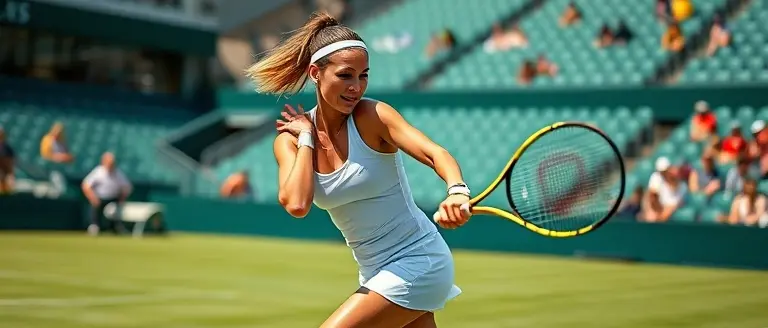
The professional trajectory of Emma Navarro has reached a pivotal juncture at the 2026 Nottingham Open, marking what analysts are calling a definitive professional resurgence. Following a period defined by inconsistent results and a strategic absence from the tour, Navarro has re-emerged as a formidable force on the surface that historically tests even the most seasoned competitors. Her performance this week serves as a testament to her technical adaptation, successfully transitioning from baseline-heavy play to the swift, decisive movements required for high-level grass-court tennis.
A Path to the Maiden Final
Navarro’s progression through the draw has been a masterclass in resilience and tactical execution. Her path to her maiden grass-court final required navigating both physical challenges and tactical puzzles posed by diverse opponents:
- Semifinal Victory: Navarro showcased impressive composure during her 7-6, 6-2 victory over Jessica Bouzas Maneiro, effectively neutralizing her opponent’s pace and capitalizing on critical break-point opportunities.
- Consistency Under Pressure: Earlier rounds, including her match against Viktorija Starodubtseva, demonstrated an improved ability to grind out victories in “marathon matches,” proving that her conditioning has reached peak levels.
- Technical Evolution: Observers have noted subtle adjustments in her backhand slice and serve placement, two components that are vital for success in the lead-up to Wimbledon.
This run in Nottingham is far more than a statistical anomaly; it represents a refined approach to match management. By maintaining her focus during high-leverage points, Navarro has silenced doubts regarding her form, solidifying her status as a player to watch as the grass season transitions toward the All England Club. Her ability to thrive under the bright lights of a tournament semifinal suggests that she is not merely competing, but actively reclaiming her place among the elite tiers of the WTA.
Analyzing Emma Navarro’s Grass Court Form and Tactical Evolution

The current Emma Navarro grass court form marks a significant milestone in the young American’s professional trajectory. Historically known for her baseline consistency on hard courts, Navarro has undergone a noticeable tactical evolution during the 2026 season. Her performance at the Nottingham Open, culminating in a maiden grass-court final, indicates that she has successfully adapted her game to the specific demands of faster, lower-bouncing surfaces. By shortening her backswing and embracing a more aggressive approach to net play, she has mitigated the risks associated with the unpredictable grass surface, transforming her traditionally defensive baseline style into an offensive weapon.
Tactical Shifts and Court Movement
The core of Navarro’s success lies in her refined movement and serving strategy. On grass, the speed of the ball requires faster reaction times; Navarro has addressed this by:
- Improved First-Serve Efficiency: By placing greater emphasis on placement over pure velocity, she has forced opponents into weak returns, setting herself up for shorter, cleaner rallies.
- Tactical Net Approaching: She has transitioned from being a pure grinder to a more versatile player, recognizing when to utilize a chip-and-charge tactic to disrupt her opponents’ rhythm.
- Low-Center of Gravity: Her ability to stay low during rallies has allowed her to handle the skidding bounce of the grass, a critical adjustment for anyone seeking a deep run at the upcoming Wimbledon tournament.
This strategic pivot is more than just a surface-level change; it represents a professional maturation. By moving away from the grinding, high-volume rallies that defined her earlier inconsistencies, she has cultivated a game style that is both resilient and adaptable. As experts analyze the Navarro Wimbledon 2026 outlook, it is clear that her ability to marry tactical discipline with raw athleticism makes her a formidable contender. Her recent Nottingham Open performance serves as empirical evidence that she is no longer just a hard-court specialist, but a well-rounded athlete capable of thriving on the world’s most prestigious lawns.
Navarro’s Wimbledon 2026 Outlook: A Player to Watch

The recent Emma Navarro Nottingham Open performance has shifted the narrative surrounding her 2026 season, transforming her from a consistent tour presence into a genuine dark horse for the upcoming Wimbledon tournament. By securing her maiden grass-court final, Navarro has demonstrated a tactical maturation that was previously absent in her game. Her ability to neutralize aggressive baseliners on a faster surface suggests that her grass court form is not merely a product of favorable draws, but a deliberate technical evolution. Analysts note that her composure during high-pressure tie-breaks—a hallmark of her run to the final—provides the psychological fortitude required to navigate the unique challenges of the All England Club.
Tactical Shifts and Psychological Momentum
Heading into Wimbledon, Navarro enters with a significant confidence boost. The “resurgence” narrative is supported by her improved serve placement and a more proactive approach to net play, which are essential for success at SW19. While the transition from Nottingham’s courts to the faster grass at Wimbledon presents a steep learning curve, her current rhythm gives her a tactical edge over opponents who have struggled with surface adjustments this summer.
Key factors influencing her success at the Grand Slam include:
- Improved Serve Consistency: Her efficiency in closing out games under pressure has become a focal point of her recent success.
- Mental Resilience: Recovering from inconsistent mid-season results to reach a premier grass-court final highlights her high emotional ceiling.
- Adaptability: Demonstrating the patience to engage in “marathon matches” while maintaining the fitness levels necessary to close them out strongly.
Despite these positives, the Navarro Wimbledon 2026 outlook remains contingent on her ability to manage the physical toll of her deep runs. The primary hurdle will be maintaining this intensity over the best-of-three format at a major, where top-seeded players will be eager to expose any remaining defensive lapses. If she carries her Nottingham form into London, she is well-positioned to make a deep, career-defining run.
The Road Ahead: Building Consistency Beyond the Grass Season

The breakthrough performance of Emma Navarro at the 2026 Nottingham Open represents more than a singular statistical achievement; it marks a pivotal shift in her professional trajectory. By reaching her maiden grass-court final, Navarro has effectively silenced concerns regarding her mid-season inconsistency. Analysts observe that her ability to navigate the transition to faster surfaces suggests a newfound tactical maturity, allowing her to dictate points rather than merely defending against high-velocity baseliners. This grass-court form is not merely a byproduct of luck but an intentional evolution in her shot selection and mental fortitude, which serves as a critical benchmark for the remainder of her 2026 campaign.
Sustaining Momentum for the WTA Tour
To evolve from a promising contender into a consistent top-tier force, Navarro must translate this Nottingham success into sustained deep runs at higher-category events. The challenge for many rising stars is the “post-final slump,” where the emotional exertion of a breakthrough week leads to physical or mental fatigue. Navarro’s camp has emphasized recovery and adaptive conditioning, strategies that will be tested thoroughly at Wimbledon. Key areas for her continued development include:
- Tactical Versatility: Refining her approach to low-bouncing surfaces, which complements her technical baseline game.
- Ranking Stability: Utilizing the points gained in the UK swing to secure higher seeds in upcoming hard-court events.
- Mental Resilience: Managing the elevated expectations that follow a high-profile “resurgence” narrative.
As she looks toward the remainder of the season, the Navarro Wimbledon 2026 outlook remains highly optimistic. If she continues to prioritize high-percentage tennis and minimize unforced errors, she is well-positioned to cement her status as a legitimate threat in the professional tennis hierarchy. Her ability to replicate this level of play will determine whether she becomes a mainstay in the final rounds of Grand Slam tournaments.
Mastering the Mental Game: Your Path to Peak Performance
Emma Navarro’s impressive resurgence at the 2026 Nottingham Open is more than a simple statistical turnaround; it is a masterclass in psychological resilience and tactical adaptation. Her ability to navigate the unique challenges of grass-court tennis proves that elite success on the professional circuit is as much about cognitive clarity as it is about physical technique. As she gears up for Wimbledon, Navarro stands as a testament to the fact that when an athlete clears the mental fog and commits to a focused process, extraordinary breakthroughs follow.
Just as Emma Navarro utilizes intense mental focus and cognitive recovery to navigate the complexities of grass-court tennis, enthusiasts looking to sharpen their own mental game can leverage similar principles of neuroscience-based auditory stimulation. Integrating The Brain Song into your daily routine offers the same cognitive edge that top-tier professionals rely on. By fostering enhanced focus and superior cognitive recovery, this tool acts as a bridge between high-pressure performance and your own daily intellectual goals, ensuring you maintain the mental stamina required to conquer your personal challenges.
Now is the time to elevate your focus, eliminate distracting mental fog, and adopt the habits of a high-performer. Whether you are navigating a career transition or simply striving for deeper concentration, the path to your own version of a ‘championship’ outcome starts with optimizing your cognitive environment.
 Unlock your own ‘championship focus’ and eliminate mental fog by incorporating this neuroscience-backed routine into your daily preparation.Yes, I Want to Sharpen My Focus Now!