
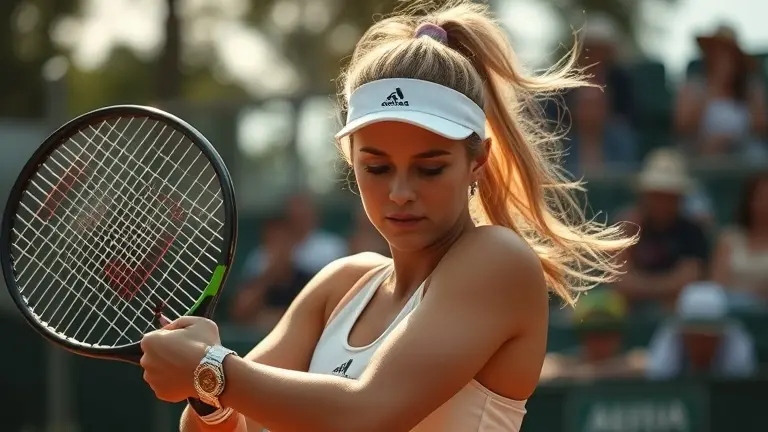
The Roland Garros 2026 clay courts have become the stage for a compelling display of grit and strategic brilliance, epitomized by Tamara Korpatsch’s resilient victory over Xinyu Wang. In a hard-fought three-set battle ending 6-2, 2-6, 6-3, Korpatsch proved that success at the Grand Slam level is rarely just about power—it is about the meticulous management of physical and mental resources under immense pressure. By analyzing her shot-making patterns and her ability to sustain intensity across long rallies, it becomes clear that Korpatsch is operating with a level of metabolic endurance that separates contenders from the rest of the field.
As she advances further into the tournament, the focus shifts from the scoreline to the underlying physiology of victory. What drives a player to grind out a win in the deciding set after nearly two hours of grueling play? The answer lies in elite metabolic efficiency, a quality that allows professional athletes to maintain peak performance when their competitors begin to fade. Understanding the science behind this sustained energy is not just for the pros; it is the fundamental key for anyone looking to optimize their own physical output.
Tamara Korpatsch’s Roland Garros Breakthrough: Defeating Xinyu Wang

The 2026 Roland Garros campaign has reached a boiling point for German professional Tamara Korpatsch, who secured a statement victory in the Round of 64 against Xinyu Wang. Winning with a hard-fought scoreline of 6-2, 2-6, 6-3, Korpatsch demonstrated the mental fortitude required to survive the grueling clay-court conditions in Paris. After a dominant opening set, Korpatsch weathered a second-set surge from Wang, ultimately stabilizing her game in the decider to close out the match. This win is not merely a statistical improvement; it serves as a testament to her current tactical evolution on the red dirt, where she has effectively balanced aggressive baseline play with the patience needed for long rallies.
Building Momentum on the Parisian Clay
Korpatsch’s current trajectory carries significant weight following her successful navigation of the Round of 128, where she overcame Sara Sorribes Tormo. By stringing together consecutive victories at the French Open, she has silenced critics and signaled a career-high level of consistency in Grand Slam environments. The atmosphere at Roland Garros has been electric, and Korpatsch’s ability to handle the pressure of the bright stage is a primary driver behind her surge in popularity among bettors and tennis analysts alike. Key takeaways from her performance include:
- Mental Resilience: Recovering from a mid-match dip in the second set to regain composure in the third.
- Tactical Precision: Exploiting clay-court angles that forced Xinyu Wang into uncomfortable defensive positions.
- Tournament Trajectory: Establishing herself as a dangerous floater in the draw with the potential to challenge higher-seeded opponents.
As Korpatsch moves forward in the bracket, observers are looking for her to maintain this momentum. Her victory against Wang suggests that her preparation for the 2026 season is paying dividends, proving that she is no longer just a participant but a legitimate competitor in major tournament formats.
Tactical Breakdown: Korpatsch’s Shot-Making Patterns

Tamara Korpatsch demonstrated a masterclass in tactical adaptability during her 6-2, 2-6, 6-3 victory over Xinyu Wang at the 2026 Roland Garros. On the slow, red clay of Paris, power often takes a backseat to patience, and Korpatsch utilized this to her advantage. Her ability to neutralize Wang’s baseline aggression relied heavily on her deep, heavy topspin groundstrokes, which forced the opposition into uncomfortable hitting zones. By stretching the court horizontally, she disrupted Wang’s rhythm, effectively turning the baseline exchange into a test of mental fortitude rather than pure ball speed.
Strategic Adjustments and Defensive Resilience
Korpatsch’s performance highlighted several key tactical shifts that allowed her to regain control after dropping the second set:
- Varied Shot Selection: Rather than engaging in a straight-set power battle, she integrated high-arching moonballs and precise drop shots to break up Wang’s timing.
- Neutralizing Power: By playing deep through the center of the court, she eliminated the acute angles Wang needed to dictate play.
- Mental Reset: Evidence suggests her ability to adjust her serve placement in the deciding set was the turning point, yielding higher percentage points on second serves.
- Clay Court IQ: Korpatsch consistently chose “high-margin” shots, opting for depth over lines, which forced Wang to generate her own pace on a surface that inherently rewards consistency.
This match showcased why Tamara Korpatsch remains a formidable presence on the WTA tour. Her tactical awareness during the final set against Wang proved that her game is built on a foundation of high-percentage tennis and spatial awareness. By forcing unforced errors through tactical redirection rather than brute force, Korpatsch proved that her 2026 French Open campaign is anchored in a sophisticated understanding of clay-court dynamics. Analysts watching her progression will look for this same level of discipline as she moves deeper into the tournament bracket.
Mental Resilience: The Key to Korpatsch’s Second-Round Success

The hallmark of a seasoned professional is not how they handle victory, but how they respond to adversity on the sport’s grandest stages. During her recent 2026 Roland Garros campaign, Tamara Korpatsch demonstrated a level of psychological fortitude that separated her from the pack. After cruising through the opening set against Xinyu Wang, Korpatsch faced a significant momentum shift as her opponent leveled the match in the second set. In a high-pressure environment like the French Open, many players might have faltered; instead, Korpatsch recalibrated her strategy and regained her composure to secure a decisive 6-2, 2-6, 6-3 victory.
Analyzing the Deciding Set Turnaround
Her ability to reset between sets reflects a mature approach to tactical and mental preparation. Rather than dwelling on the errors that cost her the second set, Korpatsch relied on a disciplined, point-by-point mindset that neutralized Wang’s aggressive baseline play. This specific sequence of events underscores several critical elements of her current form:
- Emotional Regulation: Korpatsch effectively lowered her heart rate during the set break, allowing her to approach the third set with a clean slate rather than carrying over frustration.
- Tactical Flexibility: By adjusting her depth and point construction in the final set, she disrupted the rhythm that Wang had successfully established.
- Grand Slam Focus: Her victory serves as a testament to her improved mental conditioning, which is essential for surviving the grueling three-set matches characteristic of the women’s tour on clay.
This performance indicates that the German professional has reached a new plateau in her career. By effectively managing the stressors inherent in a major tournament, she has proven that she possesses the grit required to compete against the world’s elite. Analysts are now closely monitoring her trajectory, as this type of mental durability is often the catalyst for a deeper run into the second week of a major championship.
The Road Ahead: Can Korpatsch Make a Deep Run in Paris?
Following her gritty three-set victory over Xinyu Wang, Tamara Korpatsch has cemented her position as a dangerous floater in the 2026 Roland Garros draw. Her tactical execution in the deciding set demonstrated a level of mental fortitude that has historically eluded her on the biggest stages. By effectively neutralizing Wang’s power through heavy, consistent topspin and disciplined court coverage, Korpatsch has proven that her clay-court game is maturing into a formidable weapon. As she eyes the remainder of the bracket, analysts are increasingly questioning whether her current momentum can propel her into the second week of the tournament.
Tactical Hurdles and Betting Market Shifts
The path forward presents significant challenges, as the competition intensifies with each passing round. To sustain this deep run, Korpatsch must maintain her baseline aggression while reducing the unforced errors that hindered her during the second set against Wang. Betting markets have begun to reflect a shift in sentiment; once viewed as a heavy underdog, her live-odds are shortening as bettors recognize her capacity to grind down higher-ranked opponents. Key variables for her continued success include:
- Shot Selection: Maintaining deep, penetration-heavy shots to prevent opponents from dictating the tempo from the center of the court.
- Mental Resilience: Managing the pressure of the French Open environment, particularly during high-stakes tie-breaks or final-set deciders.
- Physical Recovery: Effectively managing recovery windows between matches to ensure her stamina remains peak for potential marathon contests.
While the draw remains volatile, the evidence suggests that if Korpatsch continues to exploit the tactical patterns that saw her through to the Round of 32, she possesses a genuine opportunity to upset more established seeds. Fans and experts alike are now watching closely to see if this performance marks a career-defining breakthrough for the German pro.
The Science of Elite Performance and Your Potential
Tamara Korpatsch’s impressive run at Roland Garros 2026 serves as a masterclass in endurance, illustrating that the difference between winning and losing is often found in the engine that powers the athlete. Just as her physical conditioning became the deciding factor in her triumph against Wang, achieving peak metabolic output is the cornerstone for anyone looking to break through their own plateau and reach a new level of daily performance.
You don’t need to be a professional tennis player to demand more from your body. To support the level of focus and stamina required in the high-stakes world of elite sports—and in your own daily life—you need a solution that works with your biology, not against it. This is where CitrusBurn bridges the gap between passive ambition and active physical excellence. By optimizing your internal thermogenic processes, CitrusBurn helps you reactivate natural fat-burning and sustain consistent energy levels without the crash of stimulants.
If you are ready to mirror the discipline and resilience seen on the center court, it is time to upgrade your metabolic health. Experience the difference that scientific precision can make in your daily endurance and focus, and start performing at your absolute peak.
 Discover the science of metabolic resilience and optimize your daily energy performance here.Transform My Life Today