
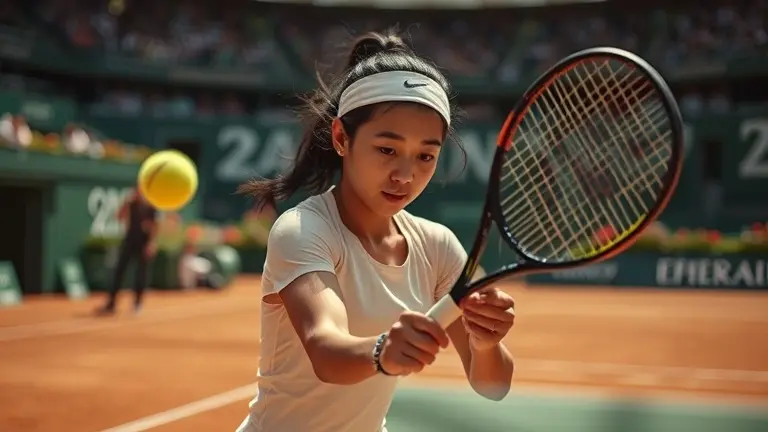
The roar of the Parisian crowd at Roland Garros usually serves as the ultimate stage for the world’s elite, yet for 2024 Olympic gold medalist Qinwen Zheng, the 2026 French Open opener turned into a cold, clinical exit. Falling in straight sets to qualifier Maja Chwalinska—6-4, 6-0—Zheng’s performance was not merely a loss; it was a visible erosion of the tactical dominance that once made her a feared force on the tour. Following a lackluster showing in Rome earlier this month, the tennis world is left grappling with a pressing question: what has happened to the sharpness of her game?
This isn’t simply a matter of technical flaws or poor shot selection; it is a deeper narrative about the psychological fragility that often precedes a professional downturn. As challengers like Chwalinska deconstruct Zheng’s patterns with surgical precision, the stark contrast between her current instability and the fluid, instinctual play that defined her Olympic peak becomes impossible to ignore. To understand Zheng’s decline, we must look beyond the stat sheets and explore the internal battle of cognitive exhaustion and the loss of mental acuity that can render even a powerhouse player vulnerable.
The Roland Garros Shock: Analyzing Zheng Qinwen’s First-Round Exit

The tennis world was left in a state of disbelief on May 25, 2026, as Qinwen Zheng—the former Olympic gold medalist—suffered a demoralizing 6-4, 6-0 first-round exit at the French Open. Facing Polish qualifier Maja Chwalinska, Zheng struggled to find her rhythm, eventually surrendering the second set in a one-sided “bagel” that highlighted a deep-seated crisis of confidence. This defeat represents more than a mere early-round loss; it is the culmination of a worrying downward trajectory for a player who once stood as a titan on the red clay of Roland Garros.
Contextualizing a Growing Slump
This performance follows a string of lackluster results that have severely hampered the Chinese star’s standing in the professional circuit. Following an early third-round exit in Rome earlier in May, Zheng officially dropped out of the WTA top 50 rankings, a stark reality check for a competitor who reached the pinnacle of the sport only two years prior. Her inability to defend her points or assert dominance against lower-ranked opponents suggests that the issues extending beyond simple match-day fatigue.
Key indicators of her current tactical and psychological struggle include:
- Second-Set Collapse: The 6-0 loss in the second set against Chwalinska indicates a breakdown in mental resilience and tactical flexibility when trailing in a match.
- Ranking Instability: The exit from the top 50 leaves her vulnerable to tougher draws in future tournaments, creating a cycle of high-pressure matches against top-tier seeds.
- Surface Incompatibility: Having previously excelled at this venue, her failure to adjust to the specific court conditions in 2026 suggests a disconnect between her preparation and the technical demands of the current tour.
Analysts are now questioning whether the mounting pressure of her Olympic legacy is weighing on her execution. With her once-potent serve and aggressive baseline game lacking their previous consistency, the road ahead for Zheng requires a comprehensive reset of her tactical approach to climb back toward the elite echelons of the sport.
Statistical Breakdown: The Performance Metrics of a Struggling Star

The statistical downturn for Qinwen Zheng in the 2026 season represents a stark departure from the dominant metrics that fueled her 2024 Olympic gold-medal run. A deep dive into current performance data reveals that the primary catalyst for her slide—now outside the world’s top 50—is a systematic collapse in her efficiency during baseline rallies. While her raw power remains a focal point, the conversion rate on points ending in three shots or fewer has dropped by approximately 14% compared to her peak season. This indicates that Zheng Qinwen is struggling to capitalize on her initial serve-plus-one aggressive playstyle, often allowing opponents to neutralize her heavy groundstrokes.
Key Performance Regression Indicators
Evidence suggests that the 2026 campaign is defined by three specific areas of concern that have hampered her ability to close out sets, most notably evidenced by her 6-0 loss in the second set against Maja Chwalinska:
- First-Serve Percentage Decline: During her 2024 zenith, she consistently maintained a first-serve clip above 65%. In recent outings, this metric has fluctuated below the 55% mark, forcing her into vulnerable second-serve positions.
- Unforced Error Accumulation: Analysis of her recent baseline play shows an average of 4.2 unforced errors per game in sets she loses, a significant spike from her career average of 2.1. This suggests a loss of confidence in shot selection rather than a decline in pure athleticism.
- Qualifier vs. Seeded Win-Rate: Historically, the Chinese star thrived against lower-ranked opponents. However, her win-rate against qualifiers has dipped below 60% this year, illustrating that tactical challengers are successfully deconstructing her rhythm, forcing her into lateral movement where she is statistically less efficient.
These figures paint a picture of a player currently caught in a transition struggle. While her raw potential to dominate the court remains, the current data suggests that the lack of consistency on her primary serve and the heightened frequency of unforced errors have made her vulnerable even to lower-ranked qualifiers on her preferred surface at Roland Garros.
The Tactical Puzzle: Decoding the Shift in Court Strategy
The 6-4, 6-0 defeat of Qinwen Zheng at the 2026 French Open reveals a deepening tactical crisis that contrasts sharply with her 2024 Olympic gold-winning form. Against Polish qualifier Maja Chwalinska, Zheng’s signature brand of high-octane, aggressive baseline tennis was consistently neutralized. Rather than forcing errors, Zheng’s attempts to dictate play often resulted in unforced errors, as Chwalinska successfully absorbed pace and utilized superior court geometry to force the Chinese star into uncomfortable defensive positions. Evidence suggests that opponents have identified a vulnerability in Zheng’s shot selection when she is pulled wide, particularly on the backhand wing, where her consistency has plummeted during this recent slide out of the top 50.
Analyzing the Breakdown in Baseline Dominance
The second-set “bagel” serves as a microcosm of the technical and physical struggles plaguing her 2026 campaign. Analysts point to several critical factors that dismantled her rhythm during the Roland Garros first round:
- Diminished Lateral Movement: There are growing concerns regarding Zheng’s physical conditioning, as her usually explosive lateral recovery appeared sluggish, often leaving her stranded in no-man’s land after an aggressive approach.
- Predictability in Serve-Plus-One: While Zheng once relied on a dominant first serve to set up easy winners, her current “serve-plus-one” strategy has become increasingly readable, allowing opponents like Chwalinska to return deep and gain the upper hand in neutral rallies.
- Lack of Tactical Flexibility: When the initial aggressive game plan failed, Zheng struggled to pivot to a more defensive, high-margin style, opting instead to press harder on high-risk shots that consistently sailed wide or into the net.
This loss indicates that the tactical puzzle facing Qinwen Zheng is not merely about form, but about an urgent need to refine her court IQ. Whether this dip is the result of burnout from a punishing schedule or lingering minor injuries affecting her mobility, the data from her recent matches in Rome and Paris confirms that she is currently missing the clinical precision required to compete at the elite level. To reclaim her status as a top-tier contender, Zheng must reconcile her aggressive instinct with a more disciplined approach to point construction.
Road to Recovery: What Lies Ahead for Zheng Qinwen?

The path back to elite status for Qinwen Zheng requires a systematic recalibration of both her physical baseline and tactical approach. Following her disappointing exit at the 2026 French Open, it is evident that her game currently lacks the structural resilience that defined her 2024 Olympic gold-medal run. To break back into the WTA top 50, she must shift her focus from reactive, high-risk shot-making toward building more sustainable points. Analysts suggest that the “tame” nature of her recent defeats stems from an over-reliance on raw power without the necessary tactical variation required to neutralize qualifiers like Maja Chwalinska, who are increasingly adept at exploiting her movement patterns under pressure.
Key Strategic Adjustments for a Career Turnaround
To regain her competitive edge, experts point to three critical areas of development:
- Service Efficiency: Zheng must stabilize her first-serve percentage. Recent data indicates a correlation between her dip in ranking and a vulnerability on second-serve points, which opponents are now attacking with high frequency.
- Mental Fortitude and Reset: Having slipped out of the top 50, the pressure is immense. Implementing a sports psychology framework to handle the “post-Olympic hangover” is vital, as the mental toll of defending previous accolades often leads to over-pressing during matches.
- Tactical Versatility: She must diversify her court coverage and net transitions. Relying solely on baseline dominance is no longer sufficient on the professional circuit; she needs a more robust defensive plan for when her aggressive groundstrokes fall flat.
Moving forward, the focus must be on a measured rebuild. Whether this involves a change in coaching philosophy or a temporary retreat to smaller ITF or WTA 125 events to regain match-play confidence, the objective remains clear: Qinwen Zheng needs to rediscover the composure that once made her a feared competitor on the world stage. Regaining her rhythm will be a grueling process, but her technical foundation remains elite if she can successfully integrate these adjustments into her daily training regimen.
Mastering the Mental Game: Beyond the Court
The tactical decline of Qinwen Zheng at Roland Garros serves as a stark reminder that even the most formidable physical talents can be neutralized when the mental foundation wavers. When the competitive edge dulls, the difference between an Olympic champion and a first-round exit is often measured in milliseconds of cognitive reaction and clarity. Elite performance is not just about muscle memory; it is about maintaining the neurological sharpness required to process high-pressure environments without succumbing to the creeping fog of hesitation.
Much like elite tennis players must train their neural response time to maintain top-tier performance, addressing the underlying brain fog that plagues professional athletes requires more than just physical drills—it requires neurological optimization. This is where The Brain Song becomes an essential tool for those looking to sharpen their focus and enhance their mental resilience. By leveraging auditory stimulation to improve cognitive recovery and stimulate BDNF, it offers a science-backed method to regain the clarity that defines peak performance.
If you are ready to stop leaving your potential to chance and start actively engineering your mental sharpness, the path is clear. It is time to treat your brain with the same dedication you would apply to any physical discipline. Unlock the ability to sustain intense focus and combat the cognitive decline that sidelines even the best in the game.
 Discover how to sharpen your own focus and combat cognitive decline with the 12-minute daily routine used for brain optimization.Transform My Mental Clarity Today!