
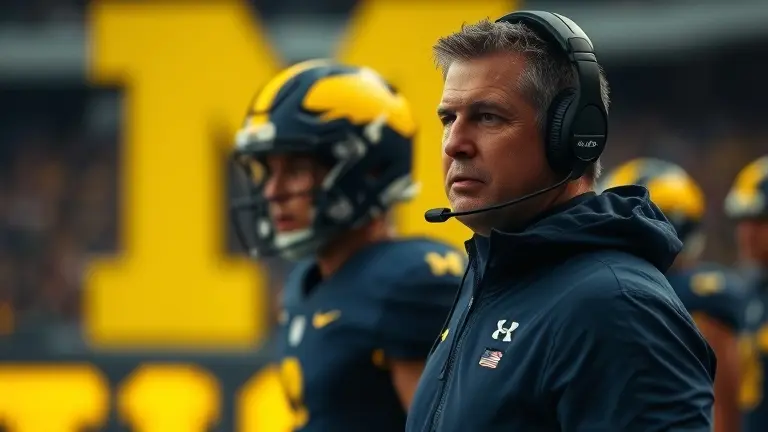
On May 21, 2026, the college football landscape shifted as former Ohio State head coach Urban Meyer ignited a firestorm by admitting he has ‘lost a little respect’ for the University of Michigan football program. Appearing on the Todd McShay Show, the man who famously went 7-0 against the Wolverines during his tenure in Columbus did not mince words. Meyer, who once approached ‘The Game’ with the intensity of an existential war, cited a pattern of recent violations and controversies as the driving force behind his diminished view of the program. This wasn’t merely standard rivalry-speak; it was a candid, biting critique from a coach whose legacy is permanently intertwined with the heated history of this clash.
For fans and analysts alike, Meyer’s comments have reopened deep-seated debates regarding the legitimacy of the current rivalry and the integrity of Michigan’s recent success. As we peel back the layers of this narrative, it becomes clear that Meyer is pointing toward a series of off-field issues that have plagued the Wolverines, leading him to even advise other coaches against aligning themselves with the program. To truly understand why a figure of Meyer’s stature would go public with such a sentiment, we must conduct a cold, objective examination of the timeline of these controversies and contrast them with the traditional, respect-based rivalry dynamics that defined the sport for generations.
Urban Meyer’s Statements on Michigan: Breaking Down the Controversy

On May 21, 2026, former Ohio State head coach Urban Meyer ignited a firestorm within the college football community during his appearance on the Todd McShay Show. Reflecting on the evolution of the storied urban meyer michigan rivalry comments, Meyer candidly admitted that he has “lost a little respect” for the University of Michigan football program. This statement serves as a stark departure from the mutual professional regard typically expected among blue-blood programs, pointing toward a significant shift in how the rivalry is perceived at the highest levels of the sport.
Meyer, who maintained an unblemished 7-0 record against the Wolverines during his tenure in Columbus from 2012 to 2018, framed his criticism around the series of off-field scandals and NCAA investigations that have shadowed Michigan in recent years. He characterized his own preparation for “The Game” during his active coaching days as an “existential war”—a high-stakes battle grounded in mutual intensity. However, he clarified that current events have fundamentally altered his view of the Michigan institution.
Key Factors in Meyer’s Critique
Meyer’s remarks were not merely performative; they included specific concerns regarding the organizational integrity of the program:
- Institutional Integrity: Meyer highlighted that the cumulative effect of recent violations has eroded the competitive baseline he once respected.
- Coaching Advisory: Perhaps most notably, Meyer revealed that he has actively advised other coaching candidates against taking positions at Michigan at certain points, citing the volatile environment.
- The “Respect” Threshold: By stating, “What’s gone on the last four or five years, I lost a little respect,” Meyer emphasizes that the controversy extends beyond mere on-field performance, touching upon the ethical framework of the program.
These comments have reignited intense debates among fans and analysts alike, leaving many to question whether this is standard “rivalry-speak” or an indictment of the current state of college football integrity. By positioning the conflict as a matter of respect rather than just wins and losses, Meyer has framed the ongoing rivalry tensions through the lens of program culture and administrative accountability.
The Weight of Violations: Contextualizing Meyer’s Frustrations

When Urban Meyer remarked that he has “lost a little respect” for the University of Michigan, he was referencing a turbulent half-decade that has fundamentally altered the perception of the Wolverines’ program. For a coach who defined the rivalry through an “existential war” lens—going a perfect 7-0 against Michigan during his tenure at Ohio State—the shift away from competitive integrity toward administrative and regulatory scandal represents a departure from the standard he expects from elite college football programs. These urban meyer michigan rivalry comments serve as a critique not just of the school’s performance, but of the culture that allowed multiple NCAA investigations to materialize.
A Timeline of Recent Wolverines Controversy
To understand the frustration Meyer articulated, it is necessary to examine the specific events that have cast a shadow over Michigan football in recent years. The program has faced several distinct regulatory hurdles that have fueled national discourse regarding their legitimacy:
- Recruiting Violations: Early in the recent cycle, the NCAA scrutinized the program for contact period violations, leading to internal disciplinary actions and self-imposed sanctions.
- Sign-Stealing Allegations: Perhaps the most significant blow to the program’s reputation involved an extensive, multi-year scouting operation. This scandal prompted widespread accusations of gaining an unfair competitive advantage, ultimately drawing the ire of fellow coaches and conference rivals.
- Staff and Coaching Turmoil: The departure of various high-level personnel and subsequent investigations into coaching staff conduct have contributed to an environment that many, including Meyer, view as detrimental to the spirit of the sport.
These events created a cumulative effect that stripped away the “respect” traditionally afforded to one of the sport’s blue-blood institutions. By highlighting these issues, Meyer is drawing a sharp contrast between the fierce, on-field competition that defined his era and the off-field controversies that currently dominate the narrative. While some supporters dismiss his comments as standard “rivalry-speak,” the sheer volume of NCAA-related headlines provides a factual basis for his skepticism, illustrating why institutional trust has become a central point of contention for followers of the Big Ten.
The ‘Existential War’: Meyer’s Era vs. Current Rivalry Dynamics

During his tenure at Ohio State from 2012 to 2018, Urban Meyer viewed “The Game” through a lens of absolute, unwavering intensity. His perfect 7-0 record against Michigan was defined by an “existential war” mentality, where the focus remained strictly on schematic execution, recruiting superiority, and the singular goal of dominating the Big Ten. For Meyer, the rivalry was a pure battle of football excellence, where both programs operated under the mutual understanding that victory was the ultimate validation of a program’s culture. In this era, the conflict was fueled by top-tier talent and coaching acumen, with both sides maintaining a professional, albeit fierce, standard of competition.
However, the modern landscape of the rivalry has shifted significantly, moving away from on-field dominance toward a contentious debate regarding program integrity and institutional culture. Meyer’s recent urban meyer michigan rivalry comments highlight a departure from the traditional sportsmanship that once defined this historic clash. Where the rivalry was once contested through grit and game planning, today’s discourse is dominated by investigations into:
- Sign-stealing allegations that brought national scrutiny to the Wolverines.
- NCAA compliance investigations regarding recruiting protocols and staff oversight.
- The broader erosion of trust between rival fan bases, moving the tension from the gridiron to the boardroom and legal offices.
This shift suggests that the definition of a “rivalry” is undergoing a metamorphosis. For Meyer, the decline in respect stems from the perception that the Wolverines bypassed the traditional, merit-based path to success. By suggesting he has actively advised coaching prospects to avoid the program, Meyer underscores a growing sentiment that the rivalry is no longer just about who can play better football, but rather about which program can maintain its ethical standing in the face of intense, high-stakes pressure. The “existential” battle has moved from the scoreboard to the integrity of the game itself.
Public Perception and the Future of ‘The Game’

Urban Meyer’s recent remarks regarding his diminished respect for the University of Michigan football program have ignited a fierce debate regarding the current state of “The Game.” While traditionalists argue that a rivalry is defined by competition on the field regardless of off-field optics, Meyer’s perspective suggests a paradigm shift. He posits that the urban meyer michigan rivalry comments are not merely inflammatory rhetoric but a reflection of a broader concern: the intersection of institutional integrity and competitive success. By highlighting the cumulative weight of recent investigations and violations, Meyer is challenging fans and analysts alike to weigh the cost of winning against the foundational ethics of college athletics.
Implications for the Rivalry’s Legacy
The discourse surrounding Meyer’s critique highlights a growing tension in modern college football. As programs face increased scrutiny, the “existential war” mentality that Meyer championed during his tenure (2012–2018) is now being filtered through a lens of professional accountability. Whether these comments serve to undermine the legacy of the Ohio State-Michigan rivalry or simply modernize it remains to be seen. Key factors influencing this public perception include:
- Standard of Conduct: The expectation that elite programs maintain a higher standard of compliance in an era of heightened transparency.
- The “Win-at-All-Costs” Narrative: How fans distinguish between high-intensity competitiveness and the potential bypassing of NCAA guidelines.
- Institutional Health: The growing trend of former coaches and analysts evaluating a program’s long-term sustainability rather than just seasonal win-loss records.
Ultimately, this debate signals a necessary transition. As the sport continues to evolve, the “respect” between programs may increasingly depend on institutional transparency. Meyer’s willingness to vocalize his disappointment reflects an industry-wide conversation about whether the University of Michigan and its peers can maintain their historic prestige while navigating the complex regulatory landscape of the modern era. Whether this is “rivalry-speak” or a genuine cautionary tale, it ensures that the intensity of the matchup will remain at the forefront of the national college football conversation for seasons to come.
Maintaining Cognitive Clarity in a Storm of Controversy
Ultimately, Urban Meyer’s critique highlights a fundamental shift in how we perceive modern college football: where once the rivalry was defined by mutual intensity and respect, it is now often clouded by complex, ongoing investigations and ethical debates. Successfully navigating these dense, multi-layered sports storylines requires more than just passion; it demands a high level of mental acuity to distinguish between hearsay and hard facts. As this saga continues to unfold, fans will need to remain sharp, attentive, and intellectually resilient to keep pace with the evolving truth behind the headlines.
Synthesizing years of complex NCAA controversies requires sharp mental clarity and focus. Just as elite coaches must be mentally dialed in for a high-stakes rivalry game, maintaining your own cognitive performance is essential for deciphering the nuances of today’s dense, data-heavy sports landscape. The Brain Song is designed to be your secret weapon, providing a science-backed, non-invasive method to enhance your focus and reduce cognitive load while you analyze the latest developments in your favorite sports leagues.
By integrating a 12-minute daily routine, you can sharpen your mental edge, ensuring you are always ready to absorb complex information without succumbing to the mental fog that often accompanies fast-paced, high-stakes reporting. Give yourself the advantage of total cognitive clarity and stay ahead of every breaking update.
 Sharpen your focus and process the latest sports analysis with total clarity; try The Brain Song’s 12-minute daily routine to unlock your cognitive potential.Unlock My Cognitive Potential Today!