
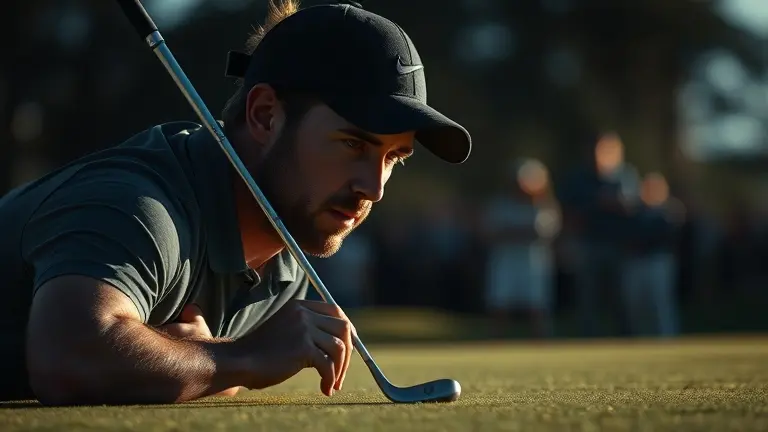
Brooks Koepka arrived at the 2026 PGA Championship at Aronimink with the weight of expectation on his shoulders, yet he left with more questions than answers. While his ball-striking remained formidable, his campaign was derailed by a recurring, haunting specter that has plagued his recent seasons: an inconsistent and often fragile putting game. From critical misses on the 17th and 18th holes to visible displays of frustration on the greens, Koepka’s performance ignited a heated debate among analysts. Is he suffering from a mechanical breakdown, or is this a psychological hurdle that even a multiple-major champion cannot easily overcome?
The conversation surrounding Koepka has moved beyond simple highlight reels to a deeper investigation of his competitive trajectory. At this elite level, the difference between hoisting the Wanamaker Trophy and slipping down the leaderboard is often found in the millimeters of a putter face. As fans and pundits analyze his 2026 season, the focus is shifting toward a critical question: what happens when physical talent hits a cognitive wall? We are peeling back the layers of his technical struggles to explore whether the key to his resurgence lies in a change of swing, or a fundamental shift in his neural approach to pressure.
Brooks Koepka at the 2026 PGA Championship: A Tournament Recap
The 2026 PGA Championship at the historic Aronimink Golf Club served as a complex stage for Brooks Koepka, whose performance underscored the ongoing volatility that has defined his recent major championship appearances. While the narrative of the tournament was ultimately captured by Aaron Rai’s historic victory—marking the first win by an Englishman at this event since 1919—Koepka remained a focal point of media scrutiny. His week was characterized by a paradoxical mix of elite ball-striking and recurring struggles on the greens, a combination that has fueled speculation regarding whether his recent challenges are rooted in mechanical flaws or psychological pressure.
Technical Hurdles and Pivotal Moments
Koepka’s journey through the Aronimink layout provided several high-stakes moments that highlighted his current form. Observers noted that while his long game remained formidable, his execution in the short game frequently wavered at critical junctures:
- Holes 5 and 6: Koepka demonstrated flashes of his former major-winning dominance, setting up high-percentage scoring opportunities that initially suggested a deep contention run.
- Holes 17 and 18: These closing holes served as the ultimate test of his mental fortitude. During key rounds, specific missed putts on these greens stalled his momentum, effectively preventing him from climbing the leaderboard alongside the eventual winner.
The contrast between his tee-to-green efficiency and his putting frustration became a recurring theme throughout the week. While fans are accustomed to seeing the four-time major champion dominate on the biggest stages, the 2026 PGA Championship highlighted a disconnect between his intent and his scoring output. As the dust settles on this major, the golf world is left questioning the trajectory of his season. Although he continues to display the raw power required to compete, his inability to convert crucial putts remains the primary barrier between him and a return to the winner’s circle in major championships. Evidence suggests that without a tactical adjustment to his putting mechanics, Koepka may continue to face an uphill battle in high-pressure environments.
The Putting Paradox: Statistical Breakdown of Recent Struggles

The 2026 PGA Championship at Aronimink Golf Club served as a stark microcosm for the current state of Brooks Koepka’s game. While his ball-striking remains elite—consistently putting him in position to challenge for major titles—his performance on the greens has created a performance ceiling that is increasingly difficult to ignore. Throughout the 2026 season, statistical trends have highlighted a glaring discrepancy: Koepka frequently ranks near the top of the field in Strokes Gained: Off-the-Tee and Approach, yet plummets significantly when measuring Strokes Gained: Putting. This “putting paradox” has shifted the conversation from his physical capability to a potential breakdown in mechanical confidence or psychological pressure during critical stretches of a major.
Identifying Technical and Mental Friction
Observers at the PGA Championship noted recurring technical flaws that likely contributed to his frustration. Specifically, during crucial par-saving attempts on holes 5, 6, 17, and 18, Koepka’s stroke appeared to lack its historical fluidity. Technical analysts suggest several factors may be hindering his consistency:
- Tempo Disparity: A noticeable hitch in his takeaway suggests an increase in tension, often leading to pushed putts on shorter, high-pressure distances.
- Read Inconsistency: There is evidence suggesting Koepka is struggling to trust his initial line assessment, resulting in mid-stroke compensations that derail his speed control.
- Psychological Fatigue: After years of dominance, the mental burden of “must-make” putts appears to be compounding, leading to a visible shift in his demeanor compared to his peak major-winning form.
While Brooks Koepka remains a force, the data suggests that unless he reconciles his elite ball-striking with a more repeatable putting stroke, his path to another Wanamaker Trophy remains blocked by his own recurring struggles on the dance floor. Whether these issues are purely mechanical or rooted in the mental fatigue of major championship golf, they currently serve as the primary bottleneck in his 2026 season trajectory.
Major Championship History vs. Current Form
Historically, Brooks Koepka has operated as the gold standard for peak performance in high-stakes environments. His legendary ability to block out peripheral noise and focus exclusively on major championship conditions propelled him to multiple titles, establishing a reputation as a player who treats the PGA Tour as merely a warm-up for the big events. However, the conclusion of the 2026 PGA Championship at Aronimink Golf Club presents a jarring contrast to that history. While his peers often struggle with the physical and mental toll of major pressure, Koepka’s typical “major mode” appeared absent, with specific technical lapses—particularly on the greens—underscoring a broader struggle with his current form.
Analyzing the 2026 Putting Deficiencies
The inconsistency observed throughout the 2026 season raises a critical question: is this a temporary mechanical slump or a fundamental shift in his competitive trajectory? Evidence from his play on holes 5, 6, 17, and 18 suggests that his struggles are not merely statistical, but deeply rooted in confidence. Key takeaways from his recent performance include:
- Mechanical vs. Psychological: While high-speed cameras have captured no obvious changes in his setup, the lack of commitment on mid-range putts indicates a potential psychological hurdle rather than a physical error.
- Preparation Disconnect: Koepka’s specialized training methods, which historically involve rigorous physical conditioning and high-intensity practice, seemed out of sync with the demands of the Aronimink greens.
- Stagnant Trajectory: Unlike his previous championship runs where he peaked during the final round, the 2026 campaign saw a failure to close, suggesting that his once-unrivaled competitive edge may be blunting against a new generation of talent like Aaron Rai.
Whether this performance is a mere outlier in a storied career remains to be seen. To regain his status as a perennial threat, Koepka must reconcile his elite ball-striking capabilities with a putting game that, as of May 2026, continues to impede his ability to contend for championships.
What’s Next: The Path Forward for Brooks Koepka
The conclusion of the 2026 PGA Championship at Aronimink Golf Club serves as a definitive inflection point for Brooks Koepka. While his ball-striking remains world-class, the recurring narrative of his 2026 season has been defined by putting frustration that stalled his momentum during crucial tournament windows. To regain his status as a perennial major championship threat, Koepka must reconcile the gap between his physical dominance off the tee and his current deficiencies on the greens. Evidence suggests that his struggles are not merely mechanical but reflect a potential lapse in the mental clarity that previously allowed him to thrive under major championship pressure.
Addressing Mechanical and Mental Hurdles
To return to the winner’s circle, Koepka’s camp will likely prioritize a comprehensive audit of his short game. Moving forward, potential adjustments may include:
- Refinement of Stroke Mechanics: Utilizing high-speed diagnostic technology to identify inconsistencies in his putter face angle at impact, which often leads to the missed short-range putts observed throughout the 2026 campaign.
- Mental Performance Integration: Re-engaging with specialized performance coaching to address the psychological fatigue that often follows high-stakes disappointment. Koepka’s historical success is built on “big game” confidence, and restoring this mindset is essential.
- Strategic Coaching Adjustments: Evaluating whether his current putting setup—grip, posture, or read-dependency—requires a fundamental evolution to better suit his evolving physiological needs.
Ultimately, the trajectory for Brooks Koepka depends on his willingness to embrace iterative change. While the golf world turns its attention to Aaron Rai’s historic victory, Koepka’s future success rests on his ability to blend his proven power game with a refined, reliable putting system. Whether he chooses a major technical overhaul or a return to foundational principles, his return to form will require addressing these vulnerabilities before the next major season begins.
Unlocking the Cognitive Edge in Professional Golf
The 2026 PGA Championship at Aronimink served as a stark reminder that even the most dominant figures in golf are not immune to the pressures of the green. While the technical debate surrounding Brooks Koepka’s putting mechanics will undoubtedly continue, the underlying issue may reside far deeper than his grip or posture. In the high-stakes arena of major championships, physical preparation is only half the battle; the true separator is cognitive clarity. When the margin between a missed putt and a championship-defining stroke is measured in millimeters, the ability to maintain neural precision under intense scrutiny is what defines the elite.
This is where the intersection of neuroscience and sports performance becomes the new frontier. Just as athletes train their muscles to handle the physical demands of the game, optimizing the brain’s ability to enter a flow state is critical for eliminating the mental fog that clouds judgment during a crucial back-nine stretch. By leveraging targeted cognitive training, players can effectively bridge the gap between mechanical frustration and consistent, high-level execution.
The Brain Song offers a groundbreaking approach to this challenge, functioning not as a supplement, but as a cognitive performance tool designed to sharpen focus and enhance neural connectivity. By aligning your brainwaves through advanced auditory stimulation, you can achieve the same mental clarity that separates champion golfers from the rest of the field. If you are ready to move beyond the frustration of performance plateaus and unlock your full cognitive potential, the path to excellence starts with optimizing your internal game.
 Discover how targeted auditory stimulation can help you sharpen your focus and improve your performance under pressure.Transform My Mental Performance Today!