
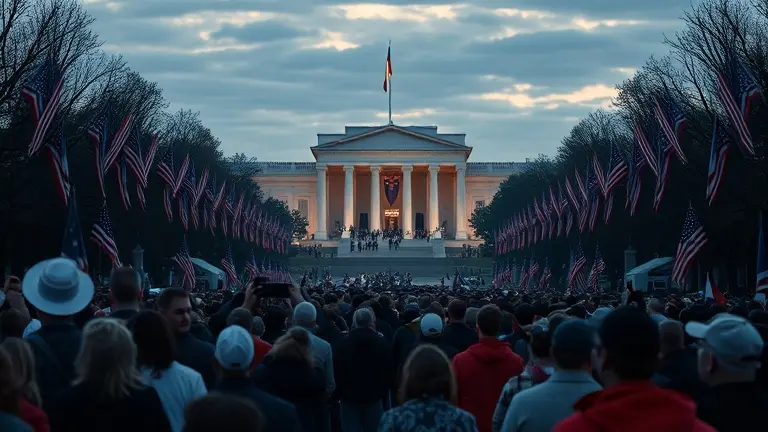
On May 17, 2026, the National Mall in Washington, D.C., will host Rededicate 250, a monumental gathering framed as a “National Jubilee of Prayer, Praise, and Thanksgiving.” Positioned as a pivotal spiritual prelude to the United States’ official 250th anniversary celebrations, the event reflects a surging movement among conservative and Christian groups aiming to re-center the nation on what they define as its foundational religious roots. Yet, beyond the spiritual choreography, the event serves as a bellwether for the intensity of the “culture wars” that are rapidly defining the lead-up to the 2026 milestone.
For the careful observer, Rededicate 250 is more than a religious service; it is an investigation into the contested narrative of American identity. As various ideological factions clash over the role of faith in government, the demand for nuanced, data-driven analysis has never been higher. This deep-dive feature examines the mobilization strategies behind this major event, tracing the path from grassroots faith movements to the broader political implications that will shape the discourse of our country’s landmark 250th anniversary.
Understanding ‘Rededicate 250’: A National Jubilee on the Mall
The Rededicate 250 event, held on the National Mall in Washington, D.C., on May 17, 2026, represented a significant mobilization of religious advocacy groups seeking to influence the cultural conversation surrounding the United States’ upcoming semiquincentennial. Framed as a “National Jubilee of Prayer, Praise, and Thanksgiving,” the gathering served as a spiritual precursor to the official 250th-anniversary celebrations of the Declaration of Independence. By assembling thousands of participants in the nation’s capital, organizers aimed to create a public platform for what they defined as a critical period of national introspection and moral re-alignment.
The Vision of National Rededication
At the core of the Rededicate 250 movement is the assertion that the United States is currently at a spiritual crossroads. The event’s organizers, which included prominent figures from Christian media and conservative think tanks, utilized the National Mall to advocate for:
- Foundational Restoration: A concerted effort to return the country to what proponents describe as its “foundational religious roots.”
- Spiritual Stewardship: The belief that prayer and public worship are essential tools for guiding the nation as it enters its third century of existence.
- Proactive Engagement: Mobilizing faith-based communities to participate actively in the broader 250th-anniversary discourse.
By situating this event on the National Mall, organizers sought to symbolically align their movement with the core tenets of American history. For supporters, the day was a necessary “step of faith” designed to set a tone of gratitude and repentance. Conversely, the event sparked robust national debate, with critics questioning the intersection of organized religious movements and public policy. As the U.S. approaches 2026, Rededicate 250 serves as a focal point for understanding the evolving tension between secular government traditions and the desire of various religious factions to exert influence over the nation’s historical narrative and future identity.
The Broader Trend: Religious Mobilization and the U.S. 250th

The Rededicate 250 event, held on the National Mall, was far from an isolated spiritual gathering; rather, it served as a high-profile manifestation of a coordinated, long-term strategy by conservative and Christian organizations. As the United States approaches its 250th anniversary, various faith-based groups are actively working to shape the national narrative, framing the semiquincentennial not merely as a secular government milestone, but as a critical moment for a spiritual reawakening. This movement seeks to assert that American foundational identity is inextricably linked to religious tradition, positioning these groups as the primary guardians of the country’s historical legacy.
Strategizing for 2026: A National Campaign
Evidence suggests that these efforts represent a significant uptick in religious mobilization intended to influence public policy and cultural discourse leading into 2026. By utilizing large-scale public demonstrations and multi-media advocacy, organizers are attempting to bridge the gap between religious practice and national patriotism. This trend is characterized by:
- Narrative Ownership: Proactive attempts to define the “true meaning” of American independence through the lens of Judeo-Christian history.
- Institutional Alignment: Strengthening partnerships between non-profit religious entities and influential political organizations to solidify a cohesive base.
- Cultural Resurgence: Framing contemporary political debates within the context of a “national jubilee,” designed to gain broader traction beyond traditional church demographics.
Ultimately, Rededicate 250 functions as a strategic touchstone in a much larger, ongoing debate regarding the role of religion in the public sphere. As the U.S. moves closer to its 250th-anniversary celebrations, the tension between competing interpretations of American identity—those highlighting secular democratic values versus those emphasizing a religious mandate—is expected to intensify. These initiatives reflect a broader cultural movement that prioritizes the restoration of perceived foundational values, ensuring that religious influence remains at the forefront of the upcoming national milestone.
Religion, Government, and the American ‘Culture Wars’

The Rededicate 250 event, held on the National Mall, serves as a poignant microcosm of the broader ideological divisions currently shaping the United States as it approaches its 250th anniversary. By framing the nation’s upcoming semiquincentennial through the lens of spiritual renewal, organizers have tapped into a deeply held belief among many Americans that the country’s foundational religious roots are essential to its future stability. However, this perspective has intensified the ongoing debate regarding the separation of church and state, highlighting a stark divergence in how different sectors of the population view the intersection of faith and public policy.
For supporters, the gathering was viewed as a necessary “step of faith,” designed to reclaim a perceived traditional identity that has been eroded by secularization. Conversely, critics and secular advocacy groups have labeled such mobilizations as political stunts that threaten the pluralistic framework of American democracy. This tension is not an isolated phenomenon but rather a precursor to the intense cultural debates expected throughout 2026. As political and religious spheres increasingly overlap, observers note that these events serve as high-visibility markers in the modern culture wars.
The discourse surrounding the event generally follows these core arguments:
- Proponents’ View: Emphasize that the American experiment was built upon Judeo-Christian values, arguing that national prosperity and moral clarity depend on a conscious, public re-commitment to those origins.
- Critics’ Perspective: Express concern that elevating specific religious mandates in the public square excludes non-Christian citizens and violates the constitutional spirit of religious neutrality.
- Societal Impact: Research, including data from organizations like Pew Research, indicates that the American electorate remains highly polarized on these issues, making the role of faith in government one of the most volatile topics leading into the nation’s milestone year.
Ultimately, Rededicate 250 functions as a bellwether for how the United States will define its identity during its 250th-anniversary celebrations. The event underscores that for millions of Americans, history is not merely a record of the past, but a battlefield for defining the moral and spiritual trajectory of the nation’s future.
Perspectives on the Semiquincentennial Anniversary
The approach of the United States semiquincentennial has catalyzed a profound national conversation regarding the country’s identity, values, and historical trajectory. As the nation prepares for its 250th anniversary in 2026, the interpretation of this milestone has become a focal point of intense ideological competition. Events like Rededicate 250 reflect a specific movement among conservative and Christian organizations that view the anniversary as an urgent opportunity to affirm the nation’s foundational religious roots. Proponents of this perspective argue that the U.S. was established upon a providential framework and that the path to a prosperous future requires a collective spiritual realignment.
In contrast, a significant segment of the American public approaches the anniversary through a secular or multicultural lens. These groups argue that a proper commemoration should emphasize the progress made in inclusivity, democratic expansion, and the secular protections enshrined in the Constitution. For these citizens, the 250th anniversary is less about “rededicating” the country to a specific faith and more about reflecting on the evolution of a pluralistic society.
Navigating the Ideological Divide
The divergence in these perspectives illustrates the growing intensity of modern culture wars. Key points of contention include:
- Historical Narrative: Supporters of the Rededicate 250 initiative emphasize the role of religious leaders and faith-based values in the American founding, often framing the event as a necessary return to tradition.
- Pluralism vs. Providentialism: Secular advocates warn that elevating religious interpretations of national history risks alienating citizens from diverse backgrounds or no religious affiliation.
- Public Sphere Role: Debates persist over whether government-sanctioned celebrations should remain strictly neutral or if they should acknowledge the religious convictions that motivated many historical figures.
Ultimately, how the U.S. observes this milestone remains highly segmented by political and religious affiliation. While some view the anniversary as a call to spiritual renewal, others see it as a critical moment to advocate for a more representative and secular understanding of American heritage. This tension suggests that the road to 2026 will continue to be defined by competing visions for the American soul.
Navigating the Future of American Identity
As the countdown to the U.S. semiquincentennial accelerates, events like Rededicate 250 signal a deepening shift in how the nation processes its historical and spiritual legacy. Whether viewed as a necessary revival or a flashpoint for modern culture wars, the event underscores the necessity for citizens to engage with these complex sociopolitical currents with heightened analytical clarity. Understanding the intersection of faith and governance requires more than just passive reading; it demands sustained intellectual stamina.
In an era of relentless information saturation and deep polarization, maintaining the mental focus to objectively evaluate these competing narratives is an increasingly significant challenge. This is where supporting your cognitive health becomes essential for any serious observer of American history. By prioritizing your brain’s processing power, you move beyond the noise, gaining the ability to synthesize complex, high-stakes debates into actionable insight.
The Brain Song serves as an indispensable tool for the modern researcher and news enthusiast, designed to combat mental fatigue and sharpen the focus required to digest dense, long-form analysis. By optimizing your cognitive performance, you ensure that you are not merely a spectator, but a sharp-minded participant in the most consequential national discourse of our generation.
 Optimize your cognitive performance for the next phase of national discourse—discover how to sharpen your focus with The Brain Song today.Sharpen My Cognitive Edge Today!