
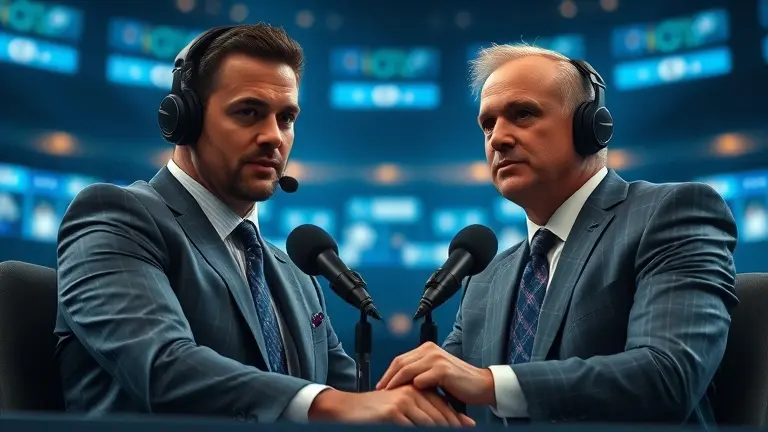
When the high-stakes world of national broadcasting collides with a career-defining public crisis, the resulting shockwaves expose the fragile power dynamics beneath the surface. Following Tony Romo’s OWI arrest, CBS Sports’ decision to place the $180 million analyst on indefinite leave has triggered more than just a search for a replacement in the booth; it has unveiled a bubbling undercurrent of internal resentment that media powerbroker Colin Cowherd insists was already eroding Romo’s standing. This isn’t merely about a legal misstep; it is a clinical look at the ‘morality clause’ economy, where astronomical contracts are balanced against the volatile brand image of modern sports icons.
As Dallas Cowboys owner Jerry Jones steps into the fray with public expressions of unwavering support, the narrative has shifted from an employment dispute to a litmus test of influence. Is this the moment the long-standing synergy between star talent and league owners is finally put to the test? By dissecting the intersection of institutional resentment, contractual liability, and the unchecked power of figures like Jones, we uncover a reality where a single mistake can dismantle even the most secure professional empires.
The Anatomy of a Media Crisis: Romo, CBS, and the Arrest That Changed Everything
The professional landscape for Tony Romo shifted abruptly on July 23, 2026, following his arrest for Operating While Intoxicated (OWI) in Wisconsin. While the legal proceedings initiated a standard law enforcement process, the immediate reaction from CBS Sports transformed this individual incident into a high-stakes corporate crisis. By placing Romo on indefinite leave, the network signaled that the brand’s image and their multi-platform broadcasting commitments superseded the personal status of their lead analyst. This rapid administrative pivot serves as a catalyst for examining the fragility of elite broadcasting careers when professional conduct falls under public scrutiny.
From Legal Incident to Corporate Fallout
The decision to sideline Romo was not merely a reaction to a single arrest; it was an activation of morality clauses and risk-mitigation protocols inherent in high-value contracts. Media analysts, including Colin Cowherd, have noted that the OWI charge functioned as a breaking point rather than an isolated error. Key elements contributing to this corporate tension include:
- Contractual Weight: Romo’s massive $180 million contract has long been a subject of internal debate among network executives, creating a pressure-cooker environment where performance and optics are under a constant microscope.
- Institutional Resentment: Reports indicate that the relationship between Romo and CBS was reportedly strained prior to the incident, with leadership questioning the return on investment of such a lucrative deal.
- Brand Alignment: In the modern sports media ecosystem, networks prioritize avoiding controversy that could alienate major corporate sponsors, leaving little room for error for talent of Romo’s profile.
The situation has been further complicated by the vocal support of Jerry Jones, the Dallas Cowboys owner. By engaging publicly with Romo, Jones has moved the discourse beyond a simple employment dispute, turning it into a debate over the influence of team owners within the broadcasting industry. As CBS navigates this uncertainty, the industry is left to wonder whether the network will attempt to sever ties permanently or if external political pressure—facilitated by figures like Jones—will force a complicated reconciliation. This crisis represents a pivotal moment in understanding how massive financial commitments and personal accountability collide in modern sports media.
Colin Cowherd’s Analysis: Behind the Scenes of the $180 Million Contract

The recent Colin Cowherd CBS Romo comments have shed light on the fragile nature of massive sports broadcasting deals. Cowherd’s assertion that there was significant internal resentment toward Tony Romo long before his recent OWI arrest highlights a broader issue in modern sports media: the “contractual friction” created when a talent’s salary significantly outweighs their perceived production value. When a network commits $180 million to a single on-air personality, the margin for error effectively vanishes. Executives and production staff often view such compensation packages as an anchor on the department’s budget, leading to an environment where minor professional lapses are amplified by institutional exhaustion.
The Anatomy of Institutional Resentment
This situation serves as a stark case study in how high-value contracts can erode workplace culture. When a star is perceived as failing to meet the expectations attached to a record-breaking deal, the professional distance between management and talent quickly morphs into active friction. Cowherd’s insights suggest that for CBS, the OWI arrest was not the primary cause of the current fracture, but rather the final stressor in a relationship already strained by:
- Financial Scrutiny: The pressure to justify an $180 million valuation creates a “perform or perish” atmosphere that filters down to every producer and executive managing the broadcast.
- Production Misalignment: Disagreements regarding on-air preparation and stylistic choices often escalate when the person in the booth is viewed as “untouchable” due to contract length.
- Media Optics: With high-profile figures like Jerry Jones maintaining close ties to talent, the network’s ability to manage its own personnel is often questioned by the public, further complicating the internal dynamic.
Ultimately, the friction Cowherd describes is a cautionary tale for the industry. As broadcasting networks continue to battle for top-tier talent, the “Romo-CBS” dynamic illustrates that a massive contract is no shield against a PR crisis. Instead, it acts as a magnifying glass, ensuring that when the relationship reaches a breaking point, the fallout is both public and irreversible.
The Jerry Jones Factor: Influence, Leverage, and the ‘Litmus Test’ for Power

The recent controversy surrounding Tony Romo’s indefinite leave from CBS has triggered a wider investigation into the structural power dynamics of the NFL media landscape. Central to this narrative is Jerry Jones, the Dallas Cowboys owner whose vocal public support for the former quarterback transcends simple mentorship. Industry analysts are framing this situation as a definitive “litmus test” to determine the extent of Jones’s influence over major broadcast networks. While Colin Cowherd’s CBS Romo comments highlighted deep-seated internal resentment regarding Romo’s $180 million contract, Jones’s intervention suggests he may be testing whether his franchise’s massive value still grants him veto power or significant leverage in executive-level personnel decisions at the network level.
Assessing the Reach of Team Owner Influence
Observers are now closely watching how the network responds to the pressure Jones is applying behind the scenes. If CBS moves to terminate or significantly alter Romo’s deal, it would signify a shift in the traditional power balance between team owners and the broadcast giants that rely on NFL television rights. Key aspects of this unfolding power struggle include:
- The Strategic Alliance: Jones’s public statements indicate an active effort to control the narrative, framing Romo as a figure worthy of redemption rather than institutional exile.
- Media Leverage: By maintaining close contact with the talent, Jones forces networks to acknowledge his role as a stakeholder in their broadcasting product.
- Corporate Sensitivity: CBS is currently navigating a delicate PR crisis where they must weigh their reputation against the potential loss of access or goodwill with one of the NFL’s most influential owners.
Ultimately, whether this manifests as a backroom negotiation or a public standoff remains to be seen. If Jones successfully maneuvers to secure Romo’s future, it will establish a new precedent for how much control team owners can exert over the analysts who cover their organizations, effectively blurring the lines between media independence and league-sanctioned narratives.
Broadcasting Politics: The Future of High-Value Talent Contracts

The unfolding situation involving Tony Romo, CBS, and the vocal commentary from Colin Cowherd regarding CBS Romo comments serves as a definitive case study in the shifting landscape of sports media. When high-value broadcasting contracts reach the $180 million threshold, the internal dynamics between network executives and on-air talent undergo a radical transformation. As Cowherd noted, perceived internal “resentment” often simmers beneath the surface of these massive deals. The OWI arrest has acted as a catalyst, pulling back the curtain on how fragile the relationship between elite analysts and their employers truly is when public sentiment aligns with existing corporate friction.
The Litmus Test for Institutional Power
The involvement of Jerry Jones adds a layer of complexity that transcends typical employment disputes. Jones’s public support for Romo, coupled with industry speculation about his potential leverage, illustrates that the most powerful team owners in the NFL do not merely influence league policies—they exert pressure on the media apparatus that covers their sport. This triangle creates a new precedent for how broadcasting talent is managed:
- Contractual Vulnerability: Massive guaranteed money no longer guarantees job security when moral turpitude clauses are triggered by high-profile legal incidents.
- External Influence: Network executives must now weigh internal morale and public optics against the influence of powerful league stakeholders who may protect their former players.
- The “Untouchable” Myth: The Romo situation proves that even “untouchable” talent is subject to sudden evaluation when their presence becomes a fiscal and reputational liability.
Future contract negotiations for elite analysts will likely shift toward more rigid conduct requirements. Networks are increasingly wary of the financial drain caused by talent that carries excessive “baggage.” As this narrative continues, the industry will monitor whether the influence of figures like Jerry Jones can actually sway institutional decisions, or if the bottom-line interests of major media conglomerates will supersede the personal loyalties that defined the previous era of sports broadcasting.
Mastering Resilience in a High-Stakes Career
The saga of Tony Romo at CBS serves as a stark reminder that in the upper echelons of professional sports media, your career is only as stable as your last public appearance. Whether it is navigating the boardroom politics of a multi-million dollar contract or managing the fallout from a sudden PR crisis, the pressure to maintain peak cognitive function is relentless. In an industry where one lapse in judgment can derail years of momentum, clear-headedness is the ultimate professional asset.
For high-performers operating under this level of scrutiny, the difference between a total collapse and a successful comeback is often decided by mental endurance. This is where The Brain Song becomes an essential tool. Designed to combat the mental fatigue that clouds high-stakes decision-making, it provides the cognitive clarity necessary to navigate complex corporate challenges with precision. By integrating this 12-minute daily routine into your life, you are not just managing stress—you are fortifying your mind against the volatility of your environment.
You don’t need to wait for a crisis to optimize your mental performance; you need the resilience to handle whatever comes next with unflinching focus. Reclaim your competitive edge and sharpen your decision-making abilities before the pressure demands more than you can give.
 Reclaim your mental edge and sharpen your focus for the challenges ahead with this 12-minute daily routine.Yes, I Want This Now!