
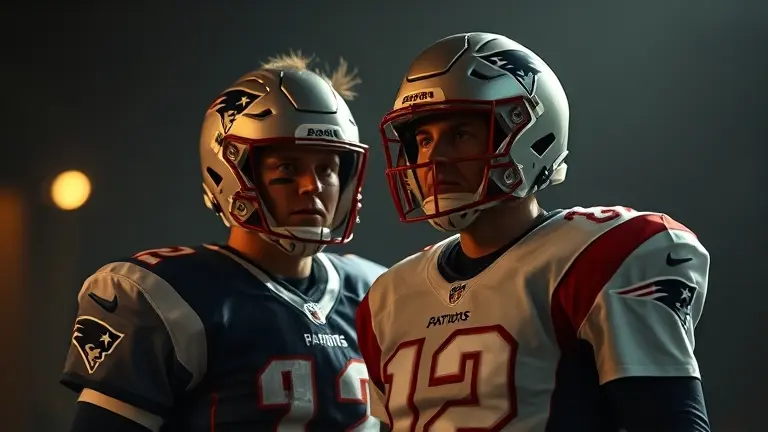
In the high-stakes world of the NFL, legends are defined not just by their physical prowess, but by their psychological endurance. New revelations from former New England Patriots wide receiver Josh Gordon have peeled back the curtain on the obsessive training culture orchestrated by Tom Brady. During a recent interview, Gordon disclosed that Brady’s pursuit of excellence went far beyond the practice field; he actually required his receivers to live in his home during the offseason, subjecting them to grueling, repetitive drills designed to achieve perfect synchronization.
This behind-the-scenes look at the New England Patriots dynasty highlights a leadership style that bordered on total immersion. For Brady, the difference between a champion and a runner-up was found in the marginal gains of cognitive processing and mental repetition. As we analyze this ‘cost of greatness,’ we must ask: was this intense method the true catalyst for his Super Bowl success, and is it a sustainable blueprint for the next generation of professional athletes?
Inside the TB12 Method: Josh Gordon Reveals Brady’s Mandatory Offseason Living Arrangements

The legend of Tom Brady and his unparalleled work ethic recently gained a new layer of intrigue thanks to former New England Patriots wide receiver Josh Gordon. In a candid revelation that has circulated throughout sports media over the last 24 hours, Gordon disclosed the extreme measures Brady employed to ensure synchronization with his receiving corps. According to Gordon, the seven-time Super Bowl champion effectively “made” his pass-catchers move into his home during the offseason, transforming his residence into an extension of the Patriots’ training facility to execute hours of grueling, highly repetitive passing drills.
The Psychology of Obsessive Preparation
This “live-in” training approach highlights the intense culture of excellence that defined the Patriots dynasty. For Brady, success was not merely a byproduct of talent but the result of absolute, total immersion. By housing his receivers, Brady eliminated the distractions of the outside world, creating a high-pressure environment where timing, route precision, and chemistry were refined through sheer repetition. Key takeaways from this intensive method include:
- Total Immersion: Moving teammates into his home forced a lifestyle shift, ensuring that football preparation was the primary focus of their daily existence.
- Repetitive Precision: The drills were designed to build muscle memory, ensuring that Brady and his receivers moved as a single unit during live game situations.
- Leadership Dynamics: Brady’s ability to demand this level of commitment underscores his role as the ultimate team architect, holding his colleagues to the same rigorous standards he applied to himself.
Evidence suggests that this level of dedication was the “secret sauce” behind the Patriots’ sustained dominance. While current NFL training protocols have evolved to emphasize rest and recovery, the insights shared by Josh Gordon serve as a stark reminder of the relentless drive required to secure a legacy in professional sports. Whether such extreme measures would be received as favorably in the modern, player-empowerment era remains a significant topic of debate among fans and analysts alike.
The Cost of Greatness: Was Tom Brady’s Immersive Training Sustainable?
The recent revelations from Josh Gordon regarding his time with the New England Patriots offer a rare glimpse into the hyper-focused environment cultivated by Tom Brady. By essentially requiring receivers to reside at his home for intensive, repetitive passing drills, Brady blurred the lines between professional obligation and lifestyle integration. While this method arguably forged the championship-level precision that defined the Patriots dynasty, it raises critical questions about whether such extreme immersion is a sustainable blueprint for modern NFL success or a psychological burden that few players can withstand.
Leadership Versus Obsession
The distinction between an elite leader and an obsessive taskmaster often lies in the results. For Brady, the “cost of greatness” was a calculated investment. The physical and mental output required during those offseason sessions forced teammates to synchronize their timing, sight adjustments, and route running to Brady’s exact specifications.
- Psychological Impact: Living where you work creates a high-pressure environment that can either solidify a championship culture or lead to player burnout.
- Skill Acquisition: The sheer volume of reps achieved in Brady’s backyard arguably accelerated the learning curve for mid-season additions like Gordon.
- Modern Compatibility: Today’s NFL emphasizes player autonomy and wellness, making it highly unlikely that a contemporary quarterback could demand similar 24/7 access to teammates without facing significant pushback.
Evidence suggests that while this intensity was the cornerstone of the Patriots’ success, it was a unique arrangement built on mutual respect and the singular goal of winning a Super Bowl. For the average player, this level of scrutiny might have felt suffocating, yet for those seeking to reach the pinnacle of the sport, it served as the ultimate trial by fire. Whether this model could be replicated in the current era remains a point of intense debate among fans and analysts alike, as the league continues to navigate the evolving balance between intense preparation and the preservation of mental health.
Modern NFL Culture vs. The Patriots Era: Has the Game Outgrown Brady’s Demands?

The revelation that Josh Gordon and other New England Patriots receivers were effectively required to move into Tom Brady’s residence for offseason training offers a stark contrast to the modern NFL landscape. During the 2018 era, this immersion was the hallmark of a culture of excellence. Brady’s methodology relied on total psychological and physical buy-in, creating a synchronized passing game that yielded championships. However, the current NFL environment has shifted toward a more player-empowered model, where work-life balance, individual training regimens, and restrictive collective bargaining agreements often take precedence over team-mandated, around-the-clock preparation.
The Shift in Professional Standards
In today’s league, the “Brady way” faces significant structural hurdles. The modern player-contract-focused environment often encourages athletes to prioritize private coaching and specialized trainers during the offseason. While Brady’s approach fostered chemistry through repetitive, grueling drills, current quarterbacks must navigate a complex landscape of expectations:
- Collective Bargaining Limitations: Newer NFL policies strictly regulate mandatory contact hours, making the 2018-style “live-in” training camps nearly impossible to enforce organizationally.
- The Rise of Personal Brands: Contemporary players frequently prioritize independent marketing and fitness ventures, which can conflict with the singular, team-first devotion Brady demanded.
- Specialized Development: Many players now prefer off-site training facilities designed for recovery and specific athletic metrics rather than solely team-directed passing synchronization.
Evidence suggests that while Brady’s obsessive preparation was the primary catalyst for his success, it represents a bygone era of total institutional control. Modern quarterbacks aiming to replicate that level of dominance now face a difficult challenge: they must cultivate the same elite chemistry without the leverage to demand constant physical presence. Whether the game has outgrown Brady’s demands is a matter of debate, but it is clear that in the post-2026 NFL, individual agency has fundamentally altered how team cohesion is built.
Fan Perspectives: Should Today’s Quarterbacks Emulate the Brady Blueprint?

The recent revelations from Josh Gordon regarding his time with the New England Patriots have ignited a fierce debate across social media platforms like X (formerly Twitter) and Reddit. Fans are grappling with a fundamental question: Is the “Brady Blueprint”—a high-pressure, immersive environment where teammates live and breathe football during the offseason—a prerequisite for championship-level success, or is it an outdated, invasive relic of a different era? While older cohorts of fans frequently point to the seven Super Bowl rings as absolute justification for Tom Brady’s intensity, younger NFL followers often argue that player autonomy and personal space are essential for mental longevity in today’s game.
The Divide: Sacrifice vs. Modern Balance
Sentiment analysis across community forums highlights two distinct schools of thought regarding the Tom Brady approach to leadership:
- The Pro-Intensity Camp: Supporters argue that greatness is not achieved through convenience. They contend that the elite chemistry fostered by repetitive, grueling drills is exactly why Brady’s offenses were notoriously difficult to stop in high-leverage situations.
- The Modern Autonomy Camp: Critics suggest that modern athletes prioritize mental health and external professional development during the offseason. They argue that “forcing” receivers into one’s home could lead to burnout or team resentment if the results do not manifest on the scoreboard.
Polling data emerging from sports commentary outlets suggests that while fans respect the results, many would hesitate to participate in such an environment. The central dilemma remains whether the current generation of NFL superstars can replicate this specific brand of dedication without the pressure of a live-in training camp. Ultimately, while fans are divided on the sustainability of such methods, the consensus remains that Josh Gordon provided a rare, unvarnished look at the sacrifice required to achieve the level of dominance Brady maintained throughout his tenure in New England. Whether this immersion is viewed as inspiring or excessive, it remains the gold standard against which all contemporary quarterback-receiver chemistry is measured.
The Blueprint for Elite Mental Performance
Tom Brady’s legacy in New England wasn’t built on talent alone; it was forged through an uncompromising standard of cognitive immersion. Josh Gordon’s revelation about Brady’s mandatory offseason drills offers more than just a glimpse into the Patriots’ locker room—it exposes the extreme psychological toll required to sustain greatness at the highest level. The reality is that the pressure of championship performance demands a mental clarity that most athletes, let alone everyday high-performers, struggle to maintain.
While the prospect of living in a quarterback’s house to master repetitive passing drills is an extreme measure, the underlying principle is universal: success is a product of optimized neural function. You don’t need to sacrifice your offseason to reach that level of clarity. By tapping into the same neuroscience-based principles that fuel elite mental resilience, you can cultivate that championship-level focus on your own terms.
This is where The Brain Song changes the game. Designed as a cognitive performance tool, it focuses on optimizing your Brain-Derived Neurotrophic Factor (BDNF) levels, effectively accelerating learning speed and sharpening mental focus under pressure. It’s the modern, non-invasive method for those who demand more from their minds. If you are ready to stop settling for average cognitive output and start operating with the precision of a legend, this is your next step.
 Want to build your own ‘championship-level’ focus? Discover the 12-minute auditory routine elite performers use to sharpen their mental edge.Transform My Mental Performance Today!