
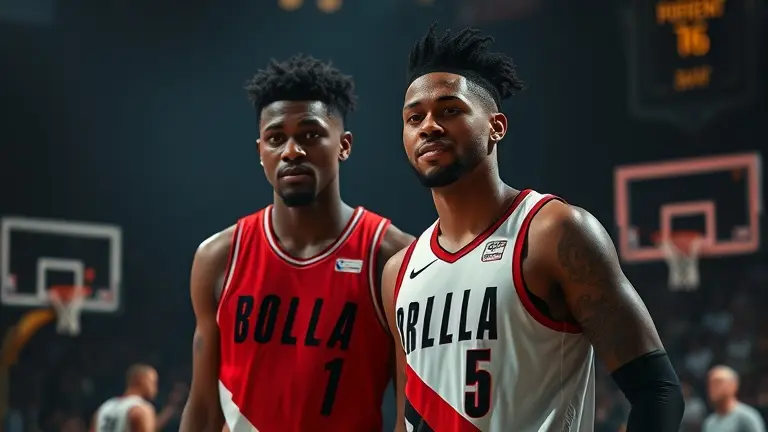
The basketball world stopped on its axis when the news broke: the Portland Trail Blazers have officially traded for Ja Morant, sending Jerami Grant and Kris Murray to Memphis. As the dust settles on this blockbuster move, the inevitable question remains: Did Ja Morant get traded simply to create a highlight-reel duo, or are we witnessing the birth of a championship-caliber dynasty? This trade forces an immediate re-evaluation of the Western Conference hierarchy, pushing Portland into an ‘all-in’ push that effectively ends the era of roster experimentation.
While the initial reactions focus on the star-power pairing of Damian Lillard and Ja Morant, the real intrigue lies in the tactical feasibility of the experiment. Can two elite, high-usage guards share the floor without sacrificing efficiency, or will the coaching staff face a logistical nightmare? This analysis goes beyond the news cycle to dissect the systemic fit, exploring how this shift ripples through the entire rotation and changes the strategic landscape for the remainder of the Trail Blazers’ core.
The Blockbuster Shift: Anatomy of the Morant-to-Portland Trade
The NBA landscape underwent a seismic transformation on June 29, 2026, when the Portland Trail Blazers secured a ja morant trade that immediately reshaped Western Conference hierarchies. By acquiring the dynamic superstar in exchange for Jerami Grant and Kris Murray, Portland has effectively signaled an aggressive “all-in” strategy. This move marks the end of an era in Memphis, as the Grizzlies officially pivot toward a comprehensive franchise reset, parting ways with their franchise cornerstone after seven seasons. For fans asking, did ja morant get traded, the answer is a definitive shift that unites arguably the most lethal backcourt in modern basketball history: Morant and Damian Lillard.
Tactical Implications of the “All-In” Push
The pairing of Lillard and Morant presents an unprecedented tactical experiment. While critics immediately point to potential defensive vulnerabilities, the offensive ceiling of a backcourt featuring two high-usage, elite playmakers is undeniably high. Portland’s front office is clearly prioritizing perimeter dominance and transition speed over traditional positional size. Key factors currently being evaluated by analysts include:
- Strategic Staggering: Managing the high-usage rates of both stars to ensure optimal efficiency throughout the 48-minute rotation.
- Defensive Reconfiguration: How the remaining core, including defensive-minded players like Deni Avdija and Toumani Camara, must adjust to cover the ground left behind by the departed Grant.
- The Memphis Reset: Assessing the long-term value of the assets received by the Grizzlies and how they intend to build around the draft capital and rotational flexibility provided by the departure of their former franchise face.
This trade effectively halts rumors regarding other potential Portland acquisitions, such as Jaylen Brown, as the organization now shifts focus toward optimizing the chemistry between its new star duo. The success of this move will likely be defined by whether the Blazers can maintain a defensive identity while leaning into the unprecedented firepower of one of the most unconventional backcourt pairings ever assembled.
System Fit: Navigating the Lillard-Morant Backcourt Dynamic

The acquisition of Ja Morant in the blockbuster trade involving Jerami Grant and Kris Murray has fundamentally transformed the Portland Trail Blazers into one of the most volatile yet explosive offensive units in the NBA. By pairing Morant with Damian Lillard, the Blazers have effectively abandoned traditional positional hierarchy in favor of a “1A-1B” backcourt structure. While questions regarding “did Ja Morant get traded” have been replaced by inquiries into tactical fit, the core challenge remains: how to distribute high-usage possessions between two ball-dominant stars. Historical dual-guard experiments, such as Lillard’s previous tenure with C.J. McCollum or the Harden-Paul synergy in Houston, suggest that success hinges on secondary playmaking development and perimeter spacing.
Strategic Implications of the Duo
The primary tactical friction lies in managing ball-dominance metrics. To avoid diminishing returns, the coaching staff will likely rely on staggered rotations, ensuring at least one elite creator remains on the floor at all times. However, the closing minutes of games will require a shift toward a shared-responsibility model:
- Secondary Playmaking: Both stars must adapt to off-ball movement to manipulate defensive coverages, as static spacing will result in stagnant isolation play.
- Defensive Liabilities: Pairing two undersized guards creates clear switching vulnerabilities. To mitigate this, players like Deni Avdija and Toumani Camara will be tasked with enhanced defensive rebounding and perimeter containment to mask the backcourt’s size deficiencies.
- Transition Pace: The synergy between Morant’s rim-rushing ability and Lillard’s deep-range gravity creates a pick-your-poison scenario for opposing defenses.
While the offensive ceiling is arguably the highest in the league, the defensive floor remains a concern. The transition from a traditional floor general role to a dual-engine offense requires significant discipline. If the front office prioritizes offensive output, the strategy will center on high-tempo, transition-heavy basketball that maximizes Morant’s athleticism while leveraging Lillard’s gravity to open driving lanes that were previously closed.
Projecting Impact: Data-Driven Performance Simulations

The ja morant trade to the Portland Trail Blazers introduces one of the most intriguing analytical variables in modern NBA history. By pairing Morant with Damian Lillard, Portland has transitioned from a traditional roster construction to a high-octane, dual-engine offensive system. Current simulation models suggest that Morant’s elite rim-pressure gravity will fundamentally alter the defensive attention paid to the perimeter. As defenses collapse to contain Morant’s historic paint-touch frequency, the floor spacing for Lillard is projected to improve significantly, likely leading to a higher volume of uncontested catch-and-shoot opportunities for the veteran guard.
Usage Rate Redistribution and Offensive Ceiling
Integrating two high-usage superstars requires a calculated sacrifice in individual counting stats to optimize collective efficiency. Based on historical data regarding dual-point-guard lineups, the coaching staff will likely employ a staggered rotation to ensure at least one elite playmaker anchors the offense at all times.
- Usage Balancing: While both players are accustomed to high usage, the move suggests a strategic pivot where Jerami Grant and Kris Murray’s departing usage is absorbed by the backcourt, allowing for a faster, transition-heavy pace.
- Offensive Ceiling: The team’s offensive rating is expected to trend upward, as the gravity generated by Morant creates a vertical spacing dynamic that the Blazers previously lacked.
- Strategic Fit: With did ja morant get traded inquiries dominating search trends, the focus for analysts is now shifting toward how this offensive firepower compensates for potential defensive vulnerabilities on the perimeter.
While concerns regarding defensive length persist, the offensive ceiling of this backcourt is theoretically limitless. By forcing opposing defenses to choose between protecting the rim against Morant’s verticality or staying glued to Lillard’s deep-range threat, Portland has manufactured a pick-your-poison scenario for opposing coordinators. This analytical shift marks a clear departure from the team’s previous structural limitations, prioritizing raw scoring potential to secure an “all-in” push for a championship.
The Memphis Pivot: What the Grizzlies Gain in the Reset

The ja morant trade represents a seismic shift for the Memphis Grizzlies, effectively closing a seven-season chapter defined by elite athleticism and highlight-reel basketball. While fans are rightfully asking “did ja morant get traded” due to the magnitude of the deal, the return from the Portland Trail Blazers offers a pragmatic blueprint for a roster re-tooling rather than a complete, bottom-out rebuild. By acquiring Jerami Grant and Kris Murray, Memphis is prioritizing veteran stability and positional versatility to stabilize a core that had become overly reliant on high-usage isolation play.
Strategic Value of the Return
The inclusion of Jerami Grant provides an immediate infusion of floor spacing and defensive adaptability that the Grizzlies lacked during the final years of the Morant era. Grant’s ability to defend multiple positions and knock down shots from the perimeter creates a gravity that will open driving lanes for Memphis’s developing backcourt pieces. Meanwhile, Kris Murray represents a calculated long-term investment. His developmental timeline fits seamlessly into a Grizzlies frontcourt that values basketball IQ and high-effort wing play.
Re-tooling vs. Total Rebuild
Evidence suggests that Memphis is avoiding a “fire sale” mentality, instead opting for a roster construction that emphasizes team-oriented basketball. Key takeaways regarding the Grizzlies’ new identity include:
- Versatility Over Reliance: Moving away from a single, high-usage superstar allows the coaching staff to implement a more egalitarian offensive system.
- Cap Flexibility: The incoming contracts allow Memphis to remain nimble in free agency while evaluating which younger players are ready to take the next step.
- Balanced Rotation: With the addition of Grant, the Grizzlies effectively bridge the gap between their developmental prospects and established veteran experience, ensuring they remain competitive while establishing a new, sustainable cultural foundation.
By pivoting toward a balanced roster, Memphis is banking on the idea that collective depth can outweigh the singular, high-octane production that characterized the previous seven years.
Deciphering the Blueprint of a New NBA Powerhouse
The acquisition of Ja Morant is more than just a roster change for the Portland Trail Blazers; it is a profound tactical gamble that demands a new level of strategic scrutiny. Whether this experiment flourishes as a championship-contending backcourt or falters under the weight of usage-rate concerns, the analysis of these complex rotations will define the next chapter of NBA discourse. Understanding the interplay between high-usage stars requires not just surface-level passion, but a high degree of cognitive precision to synthesize the tactical layers of every possession.
Just as the Trail Blazers’ coaching staff must navigate the intense mental chess match of balancing Lillard and Morant, you need absolute clarity to unpack these strategic shifts. Processing the high-volume data and intricate schematics behind this trade requires a sharp, resilient mind. That is where The Brain Song becomes your essential edge, acting as a cognitive optimization tool that helps you digest complex statistical analysis without the common drain of mental fatigue.
By incorporating our daily routine, you aren’t just following the game; you are mastering the underlying logic that drives it. Prepare yourself to look beyond the headlines and truly understand the architecture of this historic move.
 Sharpen your analytical edge for the upcoming season; start your 12-minute daily cognitive routine here.Yes, I Want This Now!