

When the final whistle blew at Levi’s Stadium on June 25, 2026, the scoreless draw between Paraguay and Australia was met with a mixture of confusion and begrudging admiration. Dubbed ‘The Pact of California’ by savvy analysts and global football fans, this tactical stalemate served as a masterclass in modern tournament game theory. By opting for a controlled, low-risk encounter, both nations effectively secured their paths to the Round of 32, proving that in the expanded format of the 2026 World Cup, sometimes the most aggressive strategy is to refuse to play the opponent’s game at all.
This match wasn’t just a defensive shut-out; it was a sophisticated chess match played on grass. For the casual observer, the lack of goals might have seemed underwhelming, but for those tracking the complex qualification scenarios of the new World Cup, it was a pivotal moment of high-stakes precision. As we peel back the layers of this tactical draw, it becomes clear that navigating the evolving architecture of international football requires more than just sports knowledge—it demands the same level of cognitive sharpness that the players themselves displayed under the California sun.
The Pact of California: Analyzing the Paraguay vs. Australia Stalemate

On June 25, 2026, the atmosphere at Levi’s Stadium in Santa Clara was electric, yet the tension on the pitch told a different story. As the match between the Paraguay national football team and the Australia national football team progressed, it became increasingly clear that both sides were prioritizing stability over high-risk attacking maneuvers. The resulting 0-0 draw, quickly dubbed “The Pact of California,” serves as a quintessential case study in the evolving game theory of the expanded 2026 FIFA World Cup format. By securing a point, Australia effectively punched their ticket to the Round of 32, while Paraguay solidified their path, leaving little room for error for their group competitors.
Tactical Pragmatism in the 2026 Format
The tactical nature of this fixture highlights how the expanded tournament structure incentivizes risk management in final group games. With the pressure of the new bracket, avoiding a loss became the primary directive for both managers. Rather than an aimless stalemate, the performance was a calculated display of defensive discipline. Insights from outlets like Sky Sports and The Athletic confirm that the match dynamics reflected a mutual understanding: a draw provided the safest route to advancement.
- Strategic Advancement: Australia’s defensive transition successfully neutralized Paraguay’s wing play, ensuring the clean sheet required to progress.
- Refereeing Efficiency: Despite active social media discourse regarding Clément Turpin’s officiating, the match remained controlled, allowing the tactical stalemate to proceed without disruption.
- The “Pact” Logic: In the context of the Paraguay vs. Australia standings, the single point was mathematically superior to the volatility of an open, end-to-end encounter that could have jeopardized both teams’ qualification chances.
This standoff was not a failure of offense, but a masterclass in reading the group stage landscape. As we look toward the knockout stages, the ability of these squads to play for the result rather than just the win demonstrates a level of maturity essential for navigating the high-stakes environment of the modern World Cup.
Updated Group D Standings: Who Advanced and Why?
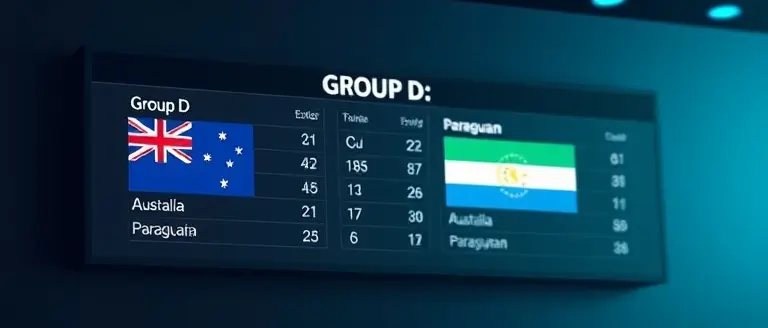
The final whistle at Levi’s Stadium in Santa Clara confirmed a result that shifted the momentum of the 2026 FIFA World Cup. Following the 0-0 draw between the Paraguay national football team vs Australia national football team, the updated Group D standings reflect a tactical masterclass in tournament management. By securing a point, Australia effectively cemented their progression to the Round of 32, while Paraguay moved into a favorable position to advance as one of the top-performing third-placed teams under the expanded 48-team tournament format.
Understanding the Mathematical Advantage
The stalemate has been widely analyzed as a strategic outcome—often dubbed the “Pact of California”—where both sides prioritized defensive stability over high-risk attacking play. In the context of Paraguay world cup aspirations, the math is straightforward:
- Australia’s Qualification: With their final group tally, the Socceroos maintained an unassailable points buffer, ensuring they bypass the complex permutations usually required for second-place finishers.
- Paraguay’s Position: Paraguay’s defensive discipline ensured their goal difference remained neutral, a critical metric when comparing the third-placed teams across all eight groups.
- Tactical Game Theory: By refusing to open up the game, both managers acknowledged that the risk of a late-match counter-attack defeat outweighed the potential reward of a win, given that both teams’ previous performances had already established a robust baseline of points.
Implications for the Knockout Stage
The Australia vs Paraguay fixture highlighted how the new 2026 structure rewards game management. While neutral fans may have hoped for a high-scoring thriller, the pragmatic reality of international football often dictates that avoiding a loss is the most efficient path forward. As we look at the Paraguay vs Australia implications, the draw provides both nations with essential recovery time and a defined roadmap into the knockout rounds. The Paraguay vs Australia prediction market failed to account for this mutual insurance, as both teams effectively navigated the final 90 minutes to ensure their survival in the competition.
Strategic Draws in the 2026 World Cup Format

The expanded format of the 2026 FIFA World Cup has fundamentally altered the risk-reward calculus for teams entering the final matchday of the group stage. As seen in the recent paraguay national football team vs australia national football team standings, the math governing progression is no longer just about winning; it is about efficiency. The “Pact of California” serves as a masterclass in modern game theory, where both sides recognized that a 0-0 draw provided the path of least resistance to the Round of 32. By prioritizing defensive stability over the volatility of an all-out attack, coaches can effectively mitigate the risk of a counter-attacking defeat that would jeopardize their entire tournament.
The Evolution of Tactical Control
In this new structure, coaches are increasingly utilizing real-time data from parallel matches to dictate their intensity. When Australia vs Paraguay concluded in a scoreless stalemate, the tactical discipline on display highlighted how modern squads monitor the “live” standings. Key factors driving these strategic decisions include:
- Goal Differential Protection: Avoiding the risk of a late-game breakdown that could negatively impact tie-breakers.
- Energy Preservation: Conserving physical resources for the knockout stages, which now feature an extra round compared to previous iterations.
- Result Certainty: When a draw guarantees advancement, the incentive to chase a high-risk goal diminishes significantly.
This pragmatic approach, while sometimes criticized as “defensive,” is a direct byproduct of the expanded qualification criteria. The paraguay vs australia prediction markets may have anticipated a high-scoring affair, but the reality of Paraguay world cup aspirations required a calculated, low-variance performance. By controlling the tempo, both teams were able to manipulate the group dynamics to their advantage, showcasing a sophisticated understanding of the 2026 tournament structure that favors calculated advancement over aggressive, uncontrolled play. Moving forward, fans should expect similar tactical stalemates as teams become more adept at playing the tournament, not just the match.
The Road to the Round of 32: Looking Ahead

Following the strategic 0-0 draw at Levi’s Stadium, the Paraguay national football team vs Australia national football team standings reflect a tactical masterclass in group-stage management. With Australia successfully securing their path to the Round of 32, the focus now shifts toward the high-stakes intensity of single-elimination football. For the Socceroos, the “Pact of California” provides a crucial momentum boost, allowing the squad to recuperate and prepare for a bracket that rewards defensive discipline over high-risk attacking play. Analysts suggest that the team’s ability to shut down opposition threats will be their primary asset as they transition into the knockout phase, where a single error can end their World Cup campaign.
Strategic Outlook for the Knockout Phase
The expanded 2026 format introduces new complexities, but both teams have positioned themselves favorably to navigate the tournament bracket. Paraguay, while awaiting final confirmation on their definitive placement, remains in a commanding position to advance. Their disciplined performance against Australia indicates a team that prioritizes structural integrity, a trait essential for overcoming top-tier opponents in the upcoming knockout games.
- Australia’s Momentum: Having avoided defeat in their final group match, the team carries significant psychological confidence into their next fixture.
- Tactical Flexibility: Both managers have demonstrated the willingness to utilize a low block to force results, a strategy that is increasingly common in high-pressure World Cup scenarios.
- Potential Matchups: Based on current projections, both teams are likely to face high-intensity opposition from either Group C or E, necessitating a quick pivot from defensive containment to clinical counter-attacking.
The road ahead remains demanding, but by prioritizing tournament life over aggressive goal-hunting, these squads have mastered the unique demands of the 2026 FIFA World Cup. As the competition progresses, the efficiency displayed in this draw will serve as a foundational blueprint for their survival in the Round of 32.
Mastering the Tactical Mindset
The ‘Pact of California’ stands as a definitive example of how elite football is shifting toward a more cerebral, calculated game. As the 2026 World Cup progresses, the ability to anticipate these tactical shifts will separate the casual fan from the true analytical expert. Understanding the nuance of group standings and the invisible pressure of tournament progression requires a level of mental clarity that few achieve in the heat of the moment.
Just as the teams at Levi’s Stadium relied on intense tactical focus to secure their knockout spots, following the intricate dynamics of the 2026 tournament requires sustained cognitive performance. This is where The Brain Song becomes your ultimate competitive advantage. By optimizing your mental clarity and focus, you gain the processing speed necessary to decode complex qualification scenarios and tactical formations in real-time, ensuring you never miss a beat of the tournament’s evolution.
Sharpening your cognitive edge isn’t just about mental health—it’s about upgrading your experience of the world’s biggest sporting event. Equip yourself with the analytical power of a professional scout and transform the way you interpret every play on the pitch.
 Sharpen your focus to keep up with the tactical nuances of the 2026 World Cup; start your 12-minute daily brain-boosting routine today.Yes, I Want This Now!