
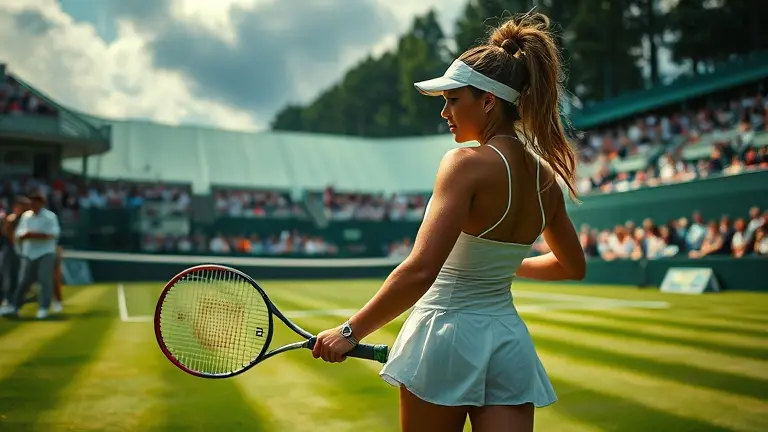
The grass courts of the 2026 Bad Homburg Open have become a crucible of chaos, transforming a routine Wimbledon tune-up into a theater of high-stakes drama. As the quarter-finals reach their intensity on June 25th, the landscape of professional tennis has been irrevocably altered. From the stunning exit of top-seeded Iga Swiatek at the hands of a relentless Emma Navarro to the sentimental but ultimately cut-short campaign of the legendary Venus Williams and prodigy Alex Eala, the tournament is proving that on grass, pedigree often bows to sheer tactical execution and mental fortitude.
This week in Germany has offered more than just match results; it has provided a masterclass in the psychological demands required to navigate the rapid-fire nature of grass-court tennis. As players recalibrate their strategies for the pressures of London, the spotlight is turning toward the subtle interplay of focus, split-second decision-making, and the cognitive stamina that separates grand-slam contenders from the rest of the field. In this high-performance environment, victory is rarely just about power—it is about achieving a state of total mental synchronization.
Bad Homburg Open 2026: The Critical Road to Wimbledon
The Bad Homburg Open has firmly established itself as the premier WTA 500 grass-court tune-up on the professional circuit. Running from June 20 to June 27, 2026, the tournament serves as a high-stakes litmus test for the world’s elite athletes ahead of the All England Club. Because grass is arguably the most challenging surface to master—requiring distinct footwork, low-center-of-gravity agility, and rapid adjustment to erratic ball bounces—the timing of this event is crucial. Players who excel here gain the match fitness and tactical confidence necessary to contend for the prestigious Wimbledon title just days later.
As the tournament progresses through its high-intensity quarter-final phase, the atmosphere in Germany has become increasingly electrified. For the top seeds and rising stars alike, these matches are not merely about winning a trophy; they are about calibrating their games for the demands of major competition. The field in 2026 has been particularly notable, featuring both seasoned veterans and hungry prospects. The “Road to Wimbledon” narrative is being written in real-time, with performance indicators at Bad Homburg often serving as a reliable predictor for success in London.
Key factors currently driving the significance of this year’s competition include:
- Surface Specialization: The unique grass courts in Bad Homburg mimic the conditions players will face at Wimbledon, making it the ideal laboratory for testing serve-and-volley tactics.
- Ranking Stakes: As a WTA 500 event, the tournament offers substantial points that can significantly impact seeding heading into the summer Grand Slam.
- Tactical Pressure: Players are forced to minimize unforced errors on a surface where rallies are typically shorter and more aggressive, providing a rigorous stress test for their championship form.
With the quarter-finals revealing high-profile upsets and the emergence of new tactical partnerships, the remainder of the week will be instrumental in identifying who has truly mastered the grass. The 2026 edition of the event proves once again that for the elite, the path to greatness is paved on the courts of Bad Homburg.
Shockwaves in Germany: The Exit of Iga Swiatek

The Bad Homburg Open landscape shifted dramatically on June 25, 2026, as top-seeded Iga Swiatek suffered a surprising quarter-final exit at the hands of Emma Navarro. The 7-5, 2-6, 6-3 defeat marks a significant moment in the lead-up to Wimbledon, underscoring the inherent volatility of grass-court tennis. Swiatek, who has long dominated on clay, continues to face challenges adapting her aggressive baseline game to the lower bounce and increased speed of natural grass, a surface that frequently punishes even the most consistent players on the WTA tour.
Tactical Implications and Grass-Court Volatility
Navarro’s tactical approach highlighted the growing gap between pure clay-court prowess and the specialized demands of grass. By disrupting Swiatek’s rhythm with varied pace and strategic net approaches, Navarro successfully navigated the pressure points that defined the match. This upset serves as a cautionary tale for high-profile contenders, proving that technical precision is often secondary to surface-specific adaptability during this brief two-week window before the Championships at the All England Club.
Key factors contributing to this quarter-final shake-up include:
- Surface Transition: The rapid shift from the European clay circuit to grass remains the most difficult adjustment in the tennis calendar.
- Aggressive Neutralization: Navarro’s ability to take the ball early prevented Swiatek from dictating play, forcing the top seed into uncharacteristic errors.
- Bracket Turbulence: With Swiatek eliminated, the draw has opened up, providing a clear path for other contenders like Naomi Osaka to establish momentum and gain critical match fitness before heading to London.
As the tournament reaches its conclusion, this result reaffirms why the Bad Homburg Open is viewed as a vital “tune-up” event; it exposes tactical weaknesses that players must refine under high-stakes conditions before the grass-court Grand Slam begins.
The Venus Williams and Alex Eala Experiment Ends

The Bad Homburg Open served as the backdrop for one of the most intriguing narratives of the 2026 grass-court season: the high-profile doubles pairing of tennis legend Venus Williams and Filipino rising star Alex Eala. This “legend-meets-prodigy” collaboration generated massive media buzz, drawing global attention to the tournament as fans and analysts alike watched to see how Eala’s developing game would complement the seasoned veteran’s championship pedigree. The partnership was viewed as a significant milestone for Eala, providing her with invaluable court time alongside one of the sport’s greatest icons in a high-stakes environment.
However, the journey concluded on June 25, 2026, when the duo faced a tactical masterclass from the established doubles team of Tereza Mihalikova and Olivia Nicholls. In their quarter-final showdown, Mihalikova and Nicholls demonstrated superior coordination on the tricky grass surface, effectively neutralizing the offensive threats posed by the Williams-Eala tandem. Despite flashes of brilliance and the undeniable chemistry that captivated the crowd, the veteran-prodigy duo was eliminated from the tournament, marking the end of an experiment that offered a compelling look at the generational shift in professional tennis.
Key Takeaways from the Partnership
- Strategic Exposure: For Alex Eala, playing alongside Venus Williams in a WTA 500 event provided a unique blueprint for navigating professional grass-court transitions ahead of Wimbledon.
- Tactical Deficits: Mihalikova and Nicholls secured the win by exploiting court positioning, proving that even legendary star power can be outmaneuvered by disciplined doubles specialists.
- Legacy Impact: The partnership highlighted the growing influence of diverse, international talent in top-tier events, further cementing the Bad Homburg Open’s reputation as a vital proving ground for emerging players.
While the loss marks the end of this specific partnership, the experience remains a cornerstone moment in Eala’s career, underscoring her readiness to compete at the elite level of the WTA tour.
Winners & Losers: Evaluating the Quarter-Final Standings
As the Bad Homburg Open reaches its critical quarter-final juncture on June 25, 2026, the grass courts of Germany have proven to be a ruthless testing ground for players seeking momentum before Wimbledon. With the field narrowing, the distinction between those peaking at the right time and those struggling with surface transitions has become starkly apparent. Tactical precision on this fast-paced surface remains the primary differentiator, separating true title contenders from those whose game plans remain unrefined ahead of the upcoming Grand Slam.
The Winners: Finding Grass-Court Rhythm
Several players have successfully navigated the tricky conditions this week, positioning themselves as major threats for the Wimbledon fortnight:
- Emma Navarro: By delivering a stunning 7-5, 2-6, 6-3 upset over top-seeded Iga Swiatek, Navarro has proven she has the mental fortitude and defensive adaptability to dismantle the world’s best.
- Naomi Osaka: Her continued presence in the bracket remains a focal point for fans and analysts alike; Osaka’s power game has translated effectively to the grass, signaling a serious return to form.
- Tereza Mihalikova and Olivia Nicholls: In the doubles draw, this pair displayed tactical brilliance, efficiently neutralizing the high-profile experimental duo of Alex Eala and Venus Williams to advance deep into the tournament.
The Losers: Form and Footing Challenges
The “Loser” category this week is largely defined by high-profile exits that have shaken up the bracket:
- Iga Swiatek: While she remains a dominant force on tour, her early departure from this WTA 500 event highlights the volatility of grass-court tennis and the immediate pressure of the “Road to Wimbledon” circuit.
- The Eala-Williams Partnership: Although the “legend-prodigy” experiment captured global headlines and generated massive interest in the Philippines, the pair’s quarter-final exit underscores the difficulty of chemistry and timing in high-stakes professional doubles.
Ultimately, the results in Bad Homburg suggest that the grass-court season remains wide open. While veterans are seeking to reclaim their dominance, the rise of newer talent indicates a potential generational shift as players fight to master the unique bounce and speed of the iconic German courts.
Unlock Your Peak Cognitive Performance
As we witness the tactical battles defining the Bad Homburg Open, it becomes clear that elite athleticism is only one half of the equation. Whether it is neutralizing a high-profile doubles pairing like Eala and Williams or overcoming the nerves of a major tournament, the difference between success and defeat often rests in the mind. The ability to maintain laser-like focus while blocking out the chaos of a stadium crowd is the hallmark of every champion currently eyeing the Wimbledon trophy.
Just as these pros rely on intense mental conditioning, you can bridge the gap between your current state and your peak potential. High-level performance is not an accident; it is the result of optimized cognitive clarity. If you are seeking to eliminate mental fog and sharpen your focus under pressure, you are looking for the same cognitive edge that defines the world’s best athletes during their most critical moments.
The Brain Song offers a science-backed, non-invasive method to train your brain for the same high-performance state seen on the grass courts of Germany. By integrating our specialized 12-minute auditory routine into your daily regimen, you can cultivate the precise mental synchronization required to tackle your own high-stakes challenges with newfound clarity and speed.
 Elevate your focus to match the pros—discover how The Brain Song’s 12-minute auditory routine can sharpen your mental game.Transform My Mental Clarity Today!