
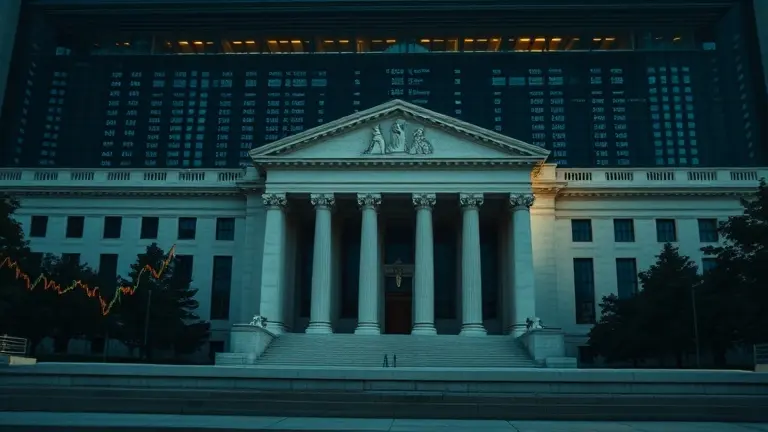
The Dow Jones Industrial Average’s jarring 507-point drop on June 17, 2026, was not merely a reaction to current pricing—it was a seismic shift in investor sentiment regarding the future of federal reserve interest rates. As Federal Reserve Chair Kevin Warsh concluded his first major policy meeting, the market’s hope for immediate rate relief was met with a stark, hawkish reality. By holding rates steady at 3.50% to 3.75% and hinting at future hikes to stifle persistent inflation, the Fed has effectively initiated the ‘Warsh Era,’ a new chapter of monetary policy that demands a complete re-evaluation of long-term sector rotation.
For the astute investor, this meeting was the ‘pivot’ that separated the spectators from the strategists. With the market in the throes of a massive readjustment, the distinction between resilient sectors and those vulnerable to high-rate environments has never been clearer. Understanding the nuances of the new policy direction is no longer just about tracking indices; it is about decoded intelligence. As we look toward the remainder of 2026, those capable of cutting through the noise to understand the implications of the Fed’s 14-point plan will hold the advantage in this high-stakes, higher-rate landscape.
,slug:
The June 17 Pivot: Understanding the 507-Point Dow Decline
The June 17, 2026, session served as a stark wake-up call for investors who had anchored their portfolios on the hope of imminent monetary easing. The Dow Jones stock markets experienced a sharp retraction, shedding 507 points—a 1% decline—as the financial community grappled with the Federal Reserve’s firm commitment to a high-interest-rate regime. While the decision to maintain federal reserve interest rates in the 3.50% to 3.75% range was widely expected, the underlying message conveyed by new Chair Kevin Warsh acted as a catalyst for a broad-based sell-off. Market sentiment shifted abruptly from morning optimism to afternoon pessimism once the “hawkish” nature of the Fed’s projections became clear to institutional traders.
Divergence Between Market Expectations and Fed Reality
The volatility observed in the Dow Jones Industrial Average (DJIA) reflects a fundamental disconnect between Wall Street’s pricing models and the current inflation-fighting mandate. For weeks, investors had priced in a pivot toward rate cuts, anticipating that the central bank would prioritize growth-oriented support. Instead, the Fed’s communication suggested that persistent inflationary pressures necessitate a “higher-for-longer” approach, with the distinct possibility of further interest rate hikes later in the year.
This strategic divergence triggered a rapid repricing of assets across several key areas:
- Investor Shock: The immediate 507-point drop confirms that the market had not fully accounted for a hawkish signal from the new Fed leadership.
- Sector Rotation: Tech-heavy indices like the Nasdaq felt the brunt of the pressure, falling 1.3% as growth valuations are increasingly pressured by higher capital costs.
- Policy Credibility: The “Warsh Era” officially began with a mandate that places inflation control above immediate market sentiment, forcing investors to abandon “fed pivot” narratives.
By choosing to prioritize long-term price stability over short-term market comfort, the Federal Reserve has set a challenging environment for equities for the remainder of 2026. This repositioning is not merely a reaction to current data, but a preemptive strike against structural inflation, which will likely dictate the performance of dow jones stock markets for the foreseeable future.
The Warsh Doctrine: Decoding a New Era of Monetary Policy

The Federal Reserve’s decision on June 17, 2026, to maintain federal reserve interest rates between 3.50% and 3.75% marked more than just a pause; it signaled the official arrival of the “Warsh Doctrine.” In his inaugural policy decision as Chair, Kevin Warsh moved decisively to dismantle market complacency, pivoting away from the prevailing “dovish” expectations of rate cuts. While the Dow Jones stock markets initially held steady on the anticipation of relief, the reality of the Fed’s hawkish projections triggered a sharp 507-point retreat, underscoring a fundamental shift in how the central bank views the persistence of inflation.
Moving Beyond Dovish Hopes
The Warsh Doctrine is characterized by a prioritized commitment to price stability over immediate, growth-stimulating monetary easing. For investors, the takeaway is clear: the Fed is no longer incentivizing speculative growth if it comes at the cost of long-term economic stability. Key indicators of this shift include:
- Prioritizing Inflation Control: Warsh has signaled a willingness to implement further rate hikes in H2 2026 if core inflation metrics fail to retreat toward target levels.
- The 14-Point Plan Impact: Insights into Warsh’s structural policy framework suggest a more rigorous, data-dependent approach to sector oversight, likely favoring defensive industries over high-growth tech.
- Contrarian Reality: Markets were priced for a pivot toward accommodation, but the Fed’s messaging confirmed that “higher for longer” remains the governing mantra for the remainder of the year.
This strategic recalibration necessitates a change in investor behavior. As we look toward the remainder of 2026, the disconnect between market optimism and the Fed’s hawkish reality suggests that volatility will remain elevated. Investors must prepare for a landscape where sector rotation—moving capital from rate-sensitive technology stocks into more stable financial or consumer staples—becomes a critical defensive mechanism in an era of sustained, non-zero interest rates.
Expectation vs. Reality: Why the Fed Chose Hikes Over Cuts

The June 17, 2026, Federal Reserve policy meeting served as a sobering “reality check” for dow jones stock markets, effectively dismantling the prevailing market narrative that an era of monetary easing was imminent. Heading into the decision, institutional investors had priced in a high probability of immediate rate cuts, betting that the Fed would prioritize economic growth over inflation containment. However, the first policy decision under Chair Kevin Warsh signaled a sharp departure from these expectations, confirming that the central bank remains focused on the structural persistence of inflation rather than temporary market volatility.
The Divergence in Economic Outlook
The tension between market sentiment and Federal Reserve policy stems from differing interpretations of current economic data. While investors focused on cooling consumption, the Fed highlighted the following drivers behind their “hawkish” stance:
- Persistent Inflationary Pressures: Despite efforts to normalize prices, the Fed’s data suggests that inflation is becoming more embedded in the economy, necessitating a “higher-for-longer” approach to federal reserve interest rates.
- The Warsh Doctrine: Kevin Warsh’s initial messaging indicates a shift toward aggressive preemptive action rather than reactionary policy shifts, favoring interest rate hikes to prevent further destabilization of the dollar.
- Risk Management: Policymakers view the potential for runaway inflation as a greater long-term threat to the Dow and broader indices than the short-term pain of higher borrowing costs for corporations.
This pivot toward potential hikes in the second half of 2026 implies that the “soft landing” scenario is no longer the Fed’s primary focus. Instead, the central bank is prioritizing price stability, which historically forces a major reassessment of equity valuations. As the market digests this new reality, investors should expect increased volatility as the “Warsh Era” forces a rotation out of speculative growth sectors and into defensive assets capable of weathering a high-rate environment. The shift from a dovish bias to a hawkish posture marks a critical inflection point for the US economy, requiring a disciplined, long-term portfolio strategy.
Portfolio Strategy: Protecting Your Assets in H2 2026

The sudden shift in sentiment regarding federal reserve interest rates following the June 17 meeting necessitates a tactical pivot for investors navigating the Dow Jones stock markets. As Chair Kevin Warsh signals a potential return to a tightening cycle, the market’s transition from “rate-cut optimism” to “higher-for-longer reality” creates immediate pressure on growth-heavy portfolios. Investors must look beyond the 507-point dip and assess how the “Warsh Doctrine” influences sector performance throughout the remainder of 2026. Prioritizing capital preservation and identifying high-quality cash-flow generators will be critical as the cost of borrowing potentially climbs.
Adjusting Sector Exposure for a High-Rate Environment
In an environment where borrowing costs remain elevated or increase, the landscape for sector rotation shifts significantly. To mitigate risks, consider the following strategic adjustments:
- Prioritize Financials: Banks often benefit from wider net interest margins in a rising-rate environment. Focus on high-capital-adequacy institutions within the Dow that are positioned to capitalize on sustained yields.
- Defensive Reallocation: Consumer staples and healthcare, traditionally viewed as defensive havens, tend to offer more stability during periods of volatility compared to speculative tech stocks, which face valuation compression when interest rates rise.
- Duration Management: If you hold fixed-income assets, be mindful of interest rate sensitivity. Short-term debt instruments are generally safer in this climate, as they mitigate the price drops associated with longer-duration bonds.
Maintaining a long-term perspective is the most effective defense against short-term market noise. While the volatility in the Dow Jones industrial average reflects immediate uncertainty, historical data confirms that consistent, diversified portfolios are best equipped to survive policy shifts. Avoid reactionary selling; instead, view this period as an opportunity to rebalance toward quality equities with strong balance sheets that can navigate persistent inflation without relying on cheap credit. By aligning your holdings with the realities of the new Federal Reserve policy cycle, you can better protect your assets against the challenges defining H2 2026.
Mastering the Warsh Era: Securing Your Cognitive Advantage
The June 17, 2026, market reaction serves as a definitive signal: the era of easy money is officially in the rearview mirror. As investors grapple with the reality of the ‘Warsh Doctrine’ and the looming threat of interest rate hikes, those who cling to outdated strategies will undoubtedly falter. Navigating the volatile landscape of the second half of 2026 requires more than just traditional fundamental analysis; it demands an ironclad psychological discipline to interpret complex, hawkish Fed signals without the interference of emotional bias.
In an era of rapid market rotations, the most dangerous asset in your portfolio is mental fatigue. When the Dow Jones stock markets fluctuate based on subtle shifts in policy language, your ability to remain clear-headed determines whether you capitalize on the volatility or fall victim to a panic-driven sell-off. This is exactly where The Brain Song becomes your most critical financial asset. By utilizing specialized neuroscience-based auditory stimulation, you can strip away the mental fog that clouds judgment during high-stress trading sessions, allowing for the deep cognitive focus needed to dissect Chair Warsh’s 14-point policy framework.
Enhancing your mental sharpness is no longer a luxury; it is a prerequisite for high-level strategy. The Brain Song acts as a cognitive ‘force multiplier,’ ensuring you stay sharp and decisive while others react in confusion. Integrating this tool into your daily preparation is the strategic edge required to turn H2 2026’s policy uncertainty into your long-term success. It is time to treat your brain with the same rigor you apply to your portfolio.

Optimize your analytical performance for the second half of 2026; incorporate this 12-minute daily routine to ensure your brain is as prepared as your portfolio.
Sharpen My Cognitive Edge Now!