

In early 2026, the Atlantic Meridional Overturning Circulation (AMOC)—the vast oceanic conveyor belt regulating global temperatures—has returned to the center of a volatile scientific and political firestorm. As researchers point to the growing ‘North Atlantic warming hole’ as a potential precursor to systemic instability, public discourse has fractured between urgent academic warnings and the cacophony of social media alarmism. Amidst heated debates over reduced monitoring budgets, finding the truth requires moving beyond headline-grabbing fears to examine the thermodynamic realities of our oceans.
Understanding the AMOC isn’t just an exercise in climate literacy; it is a vital step in navigating the uncertainty of the next century. While the risk of a full collapse by 2100 remains a subject of intense peer-reviewed scrutiny rather than settled fact, the erosion of our ability to track these tipping points is a genuine cause for concern. By balancing clear, evidence-based science with a critical look at the current data, we can separate genuine indicators of shift from the digital noise, ensuring that we remain informed participants in our planetary future.
Understanding the AMOC Discourse: Why the Ocean Current is Making Headlines in 2026

In June 2026, the Atlantic Meridional Overturning Circulation (AMOC) has moved from the pages of specialized oceanographic journals to the center of global public discourse. This surge in interest is driven by a convergence of alarming environmental indicators and a contentious political climate surrounding climate science transparency. At the heart of the discussion is the “cold blob”—a persistent area of cooler-than-average sea surface temperatures in the North Atlantic. Researchers interpret this phenomenon as a potential signal that the “global conveyor belt” of ocean currents is losing its vigor, raising urgent questions about the stability of the Earth’s climate system over the coming decades.
The Intersection of Science and Policy
The scientific concern is rooted in new 2026 climate models, which suggest a significant risk of systemic slowing. However, the discourse has been further complicated by recent reports, such as those covered by New Scientist, detailing proposed cuts to US ocean-sensing networks. Critics argue that reducing the funding for these vital monitoring systems—which provide the real-time data necessary to track tipping points—is akin to removing the dashboard from a vehicle while driving through hazardous terrain.
Key factors fueling this 2026 dialogue include:
- Modeling Uncertainty: While some high-profile projections warn of a 59% slowing by 2100, scientists emphasize that these figures remain probabilistic, not guaranteed outcomes.
- The Funding Gap: The reduction in observational infrastructure has triggered a meta-debate about whether policy decisions are actively hindering our ability to predict, and therefore prepare for, a potential AMOC collapse.
- Viral Narratives: Social platforms have become breeding grounds for speculation, often blurring the line between rigorous climate projections and “doomerist” narratives that lack scientific nuance.
By examining the evidence, it is clear that while the AMOC is under unprecedented scrutiny, the primary challenge remains reconciling the long-term scientific need for precision monitoring with short-term political and fiscal constraints. As researchers push for more robust data, the public is tasked with navigating the difference between speculative alarmism and the sober reality of a changing climate.
The Global Conveyor Belt: How the AMOC Regulates Earth’s Climate
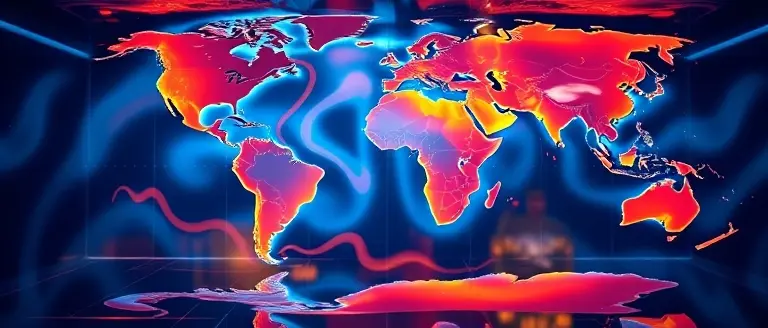
The Atlantic Meridional Overturning Circulation (AMOC) functions as a massive, continuous global conveyor belt that redistributes heat across the planet. By transporting warm, salty surface water from the tropical Atlantic northward toward the Arctic, this system acts as a thermal regulator, keeping Western Europe and parts of North America significantly milder than their latitudes would otherwise suggest. As this warm water travels north, it releases heat into the atmosphere, eventually cooling and becoming denser. This heavy, saline-rich water then sinks into the deep ocean basins, beginning its long, slow return journey southward along the ocean floor.
The Thermodynamics of Density
The stability of this circulation relies entirely on the precise balance of two factors: salinity and temperature. In the North Atlantic, the sinking of cold, salty water—a process known as deep-water formation—is what “pulls” the surface currents forward. If this delicate balance is disrupted, the entire system risks stalling. Current climate models identify several critical factors that threaten this mechanism:
- Freshwater Influx: The melting of Arctic ice and Greenland’s glaciers pours vast amounts of fresh water into the North Atlantic. Fresh water is less dense than salt water, effectively “capping” the surface and preventing the cold water from sinking.
- Thermal Expansion: As global temperatures rise, the surface water remains warmer, further reducing its density and inhibiting the downward flow that drives the conveyor belt.
- The “Cold Blob” Phenomenon: Scientists observe a cooling trend in the subpolar North Atlantic, often referred to as the “warming hole.” This anomaly is a primary indicator that the northward heat transport is weakening, which could serve as an early warning sign of a potential AMOC collapse.
Understanding these mechanics is essential for interpreting why scientists are so concerned about current climate trends. The AMOC is not merely a regional current; it is a fundamental component of the Earth’s climate system. A significant slowdown would not only alter global weather patterns but could permanently shift regional climates, making the integrity of our ocean monitoring infrastructure a matter of global security rather than just academic interest.
Interpreting the 2026 Models: Separating Scientific Fact from Alarmism

Recent climate modeling from early 2026 has reignited global discourse regarding the AMOC collapse, projecting a potential 59% slowing of this vital ocean current by the year 2100. While these figures appear alarming, it is critical to distinguish between a gradual, long-term weakening trend and an instantaneous system failure. In scientific terms, the Atlantic Meridional Overturning Circulation functions as a massive global conveyor belt, transporting warm surface water from the tropics to the North Atlantic. Recent data suggests this mechanism is losing stability, but characterizing this as an overnight catastrophe misrepresents the fluid, non-linear nature of ocean physics.
Understanding the 2100-Horizon and Climate Uncertainty
The challenge in providing a definitive timeline for an AMOC tipping point lies in the complexity of Earth’s climate feedback loops. Current research utilizes sophisticated reanalysis data, yet scientists remain cautious about assigning a specific calendar date to a collapse. The uncertainties arise from several key factors:
- Non-Linear Dynamics: Climate systems do not always move in a straight line; threshold effects can cause abrupt shifts that are notoriously difficult to forecast with precise accuracy.
- The “Cold Blob” Phenomenon: Persistent anomalies in the North Atlantic—often referred to as a “warming hole”—are being closely monitored as an indicator of reduced heat transport, but these signals are subject to seasonal and decadal variability.
- Model Limitations: While modern models are vastly improved, they struggle to account for every micro-scale interaction in deep-ocean salinity and temperature shifts, leading to wide confidence intervals.
Ultimately, the focus of the scientific community is on the trajectory of the current rather than the fear-driven narratives found on social platforms. When researchers discuss a tipping point, they are describing a threshold beyond which the system may reorganize itself—a process that would likely unfold over decades rather than days. Recognizing this nuance is essential for developing evidence-based climate policy and maintaining accurate public expectations.
The Price of Ignorance: The Critical Role of Ocean Monitoring Data

As scientific discourse surrounding the AMOC collapse intensifies, a troubling meta-narrative has emerged: the systematic reduction in funding for critical ocean-sensing networks. Monitoring the Atlantic Meridional Overturning Circulation is not merely a scientific exercise; it is an essential component of global climate security. By scaling back the deployment of buoys, satellite arrays, and deep-sea sensors, the US risks entering a period of profound uncertainty at the very moment when the North Atlantic is signaling potential systemic shifts.
Why Data Integrity Matters
Cutting ocean science budgets is akin to navigating a violent storm with a broken radar. Without high-fidelity, real-time data, the scientific community is effectively flying blind. The absence of robust monitoring creates a dangerous information vacuum that prevents researchers from distinguishing between minor, natural climate variability and the early onset of a catastrophic tipping point. Key consequences of these budget cuts include:
- Diminished Early Warning Capabilities: A lack of coverage prevents the detection of the ‘cold blob’ or warming hole anomalies that serve as leading indicators for AMOC instability.
- Increased Model Uncertainty: Policy decisions rely on precise climate models; when raw data inputs are removed, the resulting projections become speculative rather than empirical.
- Policy Paralysis: Without clear, evidence-based data, policymakers cannot justify adaptive measures or long-term infrastructure investment, leading to reactive rather than proactive governance.
The current scientific consensus emphasizes that whether the AMOC is truly on a trajectory toward collapse or simply undergoing a period of fluctuating strength, our ability to confirm the outcome is being actively compromised. By defunding these observational pillars, we are not avoiding bad news—we are ensuring that when the data eventually forces a realization, it will likely be too late to initiate effective mitigation strategies. Reliable monitoring is the bridge between scientific hypothesis and actionable global policy.
Maintaining Clarity in an Uncertain Climate
The science of the AMOC confirms that while our climate system is under unprecedented stress, the path to 2100 is not yet written in stone. What remains clear is that the data we collect today serves as our best early-warning system. The current frustration regarding monitoring budgets is a necessary catalyst for policy, yet it also highlights a silent crisis: the cognitive exhaustion that comes from constant exposure to systemic, high-stakes uncertainty.
While staying informed about our planet’s future is vital, the constant cycle of alarming climate news can create a state of mental fatigue and cognitive overload; protecting your mental bandwidth is just as important as monitoring our environmental data. When you are processing complex, unsettling information, your ability to remain sharp and resilient is your most valuable asset.
This is where The Brain Song becomes a essential tool for your daily routine. By offering a science-based, neuro-acoustic intervention, it helps you stabilize your focus and clear the ‘brain fog’ that often accompanies intense informational gathering. It aligns perfectly with a rational approach to climate study, allowing you to engage with the data without the debilitating effects of anxiety or mental burnout. It is not just about staying informed; it is about staying sharp enough to understand the information that matters most.
 Reclaim your focus and clarity; try this 12-minute neuroscience-based audio routine to stay sharp while navigating today’s complex information landscape.Yes, I Want to Reclaim My Focus!