
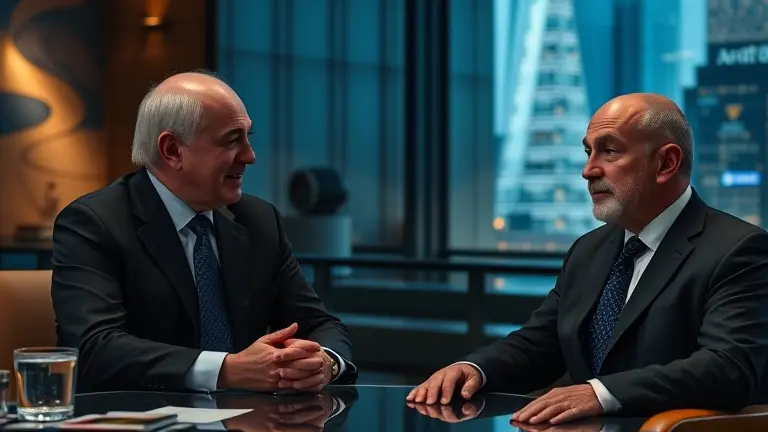
When Andrew Ross Sorkin sat down with Jeff Bezos on CNBC’s Squawk Box, the headlines were predictably captured by the ensuing political skirmishes between the Amazon founder and New York City’s leadership. However, to focus solely on the viral soundbites is to miss the far more consequential transformation occurring in real-time: the pivot toward a post-political, AI-centric economic reality. Sorkin navigated a conversation that transcended the typical ‘he-said-she-said’ news cycle, touching upon the structural shifts currently redefining the global workforce and the capital allocation strategies of the world’s most influential innovators.
As Bezos dismissed the common ‘doomsayer’ narratives surrounding artificial intelligence, he laid out a vision for a technological landscape where human utility is not replaced, but fundamentally augmented. For investors and business leaders, the takeaway is clear: we are moving past the era of debate and into an era of forced adaptation. Understanding this shift is no longer just about analyzing corporate policy—it is about refining your own ability to process complex information and maintain peak decision-making resilience as AI accelerates the pace of business.
The Sorkin-Bezos Dialogue: Beyond the Political Headlines

The high-profile interview between Andrew Ross Sorkin and Jeff Bezos on CNBC’s Squawk Box (May 20-21, 2026) quickly became a flashpoint in the national discourse. While much of the mainstream media fixated on the friction between Bezos and New York Mayor Zohran Mamdani—specifically regarding the critique of the NYC school system—the interaction held significant weight for observers of corporate strategy. Sorkin effectively utilized his platform to probe the intersection of private-sector efficiency and public-sector limitations, creating a dialogue that transcended standard financial reporting.
Strategic Insights Amidst the Noise
Beyond the viral soundbites and the political “spats” that dominated the news cycle, the conversation provided a rare window into the current operational philosophy of Amazon and Blue Origin. Sorkin pressed for clarity on how large-scale organizations must adapt to a rapidly shifting economic landscape. Key takeaways that investors and business leaders should prioritize include:
- AI Realism: Bezos dismissed the alarmist rhetoric surrounding Artificial Intelligence, positioning himself against the “doomsayers” to advocate for a more pragmatic, productivity-focused integration of machine learning in the workforce.
- The Future of Work: The discussion highlighted a shift in how Bezos perceives institutional scalability, using his controversial school system analogy to emphasize his belief in rigorous performance metrics as a pillar of organizational success.
- Economic Implications: The interview served as a reminder that the relationship between billionaire innovators and government regulatory bodies is becoming increasingly politicized, signaling a new era of reactive, high-stakes corporate communication.
By moving past the surface-level controversy, it becomes clear that this session with Sorkin was not merely a debate on municipal policy, but a demonstration of how corporate titans are positioning their narratives in a volatile regulatory climate. For the informed professional, the underlying discussion on AI regulation and the deployment of new technologies remains the true value proposition of this historic exchange.
Bezos on AI: Defying the ‘Doomsayer’ Narrative

During his exclusive sit-down with Andrew Ross Sorkin on CNBC’s Squawk Box, Jeff Bezos articulated a pragmatic vision for artificial intelligence that stands in stark contrast to the alarmist rhetoric currently permeating Silicon Valley. While much of the public conversation has been hijacked by existential “doomsayer” narratives—fearing that super-intelligent systems might eventually pose a threat to human survival—Bezos dismissed these speculative risks as distractions from the immediate, tangible benefits of the technology. For Sorkin and his viewers, the message was clear: Bezos views AI not as a sentient adversary, but as a sophisticated tool for industrial optimization and logistics efficiency.
Shifting the Regulatory Focus
Bezos advocates for a measured approach to regulation that prioritizes practical application over preemptive containment. By focusing on incremental innovation, he argues that the tech sector can better address real-world challenges, such as cloud infrastructure scalability and supply chain accuracy. His perspective suggests that the industry should pivot away from theoretical debates and toward:
- Operational Efficiency: Utilizing AI to streamline complex logistical systems, drawing a direct parallel to the infrastructure that built the Amazon model.
- Resource Allocation: Encouraging venture capital to fund startups that solve tangible enterprise problems rather than those chasing vague, long-term AI-safety milestones.
- Economic Productivity: Embracing automation as a driver of workforce evolution rather than a simple replacement mechanism.
This stance carries significant implications for the broader tech sector and investment landscape. By de-emphasizing the “doomsayer” narrative, Bezos is essentially signaling a preference for a pro-innovation regulatory environment that favors companies already capable of integrating large-scale models into existing infrastructures. Investors should note that this rhetoric aligns with Amazon’s recent AI strategy, which prioritizes building robust cloud-based AI ecosystems. As Andrew Sorkin noted in his follow-up reporting, this professional pivot marks a maturation of the billionaire-media dialogue, shifting from personality-driven clashes toward serious, strategic discussions on how AI will define the next decade of American economic output.
Economic Foresight: Future of Work and Productivity

While the viral soundbites surrounding the recent interview between Andrew Ross Sorkin and Jeff Bezos captured the headlines, the substantive economic commentary provided by the Amazon founder offers a more critical roadmap for investors. During the May 2026 ‘Squawk Box’ appearance, the discussion pivoted toward the structural shifts in labor and the integration of artificial intelligence within large-scale enterprise models. Sorkin effectively pressed Bezos on the evolving definition of productivity, moving away from simple headcount metrics toward a model defined by human-AI synergy. Bezos signaled that the future of work is not merely about automation replacing labor, but about accelerating the throughput of complex systems where AI acts as a force multiplier for human decision-making.
Strategic Implications for Labor and Tech Integration
Investors should interpret Bezos’s stance as a push toward high-capital efficiency. The broader economic insight here is that firms focusing on “operational agility”—the ability to scale output without linearly increasing the cost of human capital—will likely outperform in the coming decade. Andrew Sorkin probed the tension between this efficiency and regulatory hurdles, yet Bezos remained dismissive of alarmist “doomsayer” rhetoric, suggesting that the integration of AI is an inevitable evolution of productivity rather than a existential threat to the workforce.
Key takeaways for investors looking to position their portfolios amidst these shifts include:
- Prioritize Human-Capital Synergy: Favor companies that deploy AI tools to augment high-skilled labor rather than those attempting to rely solely on automated cost-cutting.
- Monitor Systemic Throughput: Assess enterprise value based on operational speed and the ability to iterate at the velocity of software, as demonstrated by the Amazon logistical model.
- Ignore Political Noise: Use the analysis provided by financial journalists like Sorkin to filter out the reactive political drama and isolate the long-term economic signals regarding enterprise infrastructure.
Ultimately, the takeaway from the interview is that labor-tech synergy is becoming the primary driver of corporate valuation. Businesses that successfully bridge the gap between legacy operational models and advanced AI integration are currently the most stable candidates for long-term growth. Investors who focus on these technical metrics rather than the, at times, polarizing commentary will likely identify more durable competitive advantages in the marketplace.
Strategic Takeaways for Modern Investors

The recent high-profile dialogue between Andrew Ross Sorkin and Jeff Bezos on CNBC’s Squawk Box provided more than just viral political friction; it offered a masterclass in long-term capital allocation and corporate resilience. For investors navigating an increasingly volatile economic landscape, the interview highlighted a fundamental shift in how leadership views the intersection of governance and technological disruption. Sorkin expertly probed the boundaries of corporate efficiency, but the real value for market participants lies in Bezos’s unwavering commitment to the “Day 1” philosophy, even as his ventures expand into aerospace and advanced AI.
Navigating Regulatory and AI Uncertainty
Rather than retreating in the face of widespread anxiety regarding generative artificial intelligence, Bezos signaled a clear dismissal of “doomsayer” narratives. Evidence suggests that for the modern investor, this indicates a strategic preference for early-stage integration over defensive waiting. By prioritizing functional utility, Bezos continues to align his capital with sectors poised for structural growth. Key takeaways for portfolio strategy include:
- Rejection of Reactive Governance: Markets often over-correct to political rhetoric. Investors who focus on long-term efficiency metrics—much like those Sorkin debated with the founder—are better positioned to bypass temporary regulatory noise.
- The Persistence of ‘Day 1’ Logic: Bezos’s philosophy dictates that any stagnation is the precursor to failure. Investors should look for management teams that treat every fiscal quarter as if the company were a startup, prioritizing innovation over incremental margin protection.
- AI as an Efficiency Lever: The conversation underscored that AI is not merely a service-layer product but a fundamental operational shift. Bezos’s stance implies that corporations treating AI as an R&D experiment rather than an operational necessity will likely fall behind in the coming decade.
Ultimately, the Andrew Sorkin interview reinforces a broader investment thesis: that long-term outperformance requires ignoring the daily political “spats” that dominate headlines. Instead, by focusing on the underlying economic drivers—scale, technological integration, and a refusal to allow bureaucratic inertia to hinder progress—investors can better identify firms that maintain a competitive edge regardless of the shifting political tide.
Mastering Your Mind in the AI Era
The core lesson from the Andrew Ross Sorkin and Jeff Bezos interview is that the future of competitive advantage will not be determined by political noise, but by how effectively you integrate emerging technology into your own strategic framework. While the world remains fixated on the friction of the day, high-performing individuals must pivot toward cultivating a sharper, more adaptable mental edge. The technological infrastructure of tomorrow is already being built, but the most critical asset in your portfolio remains your own cognitive clarity and learning velocity.
While Bezos focuses on the macro-technological shift AI brings to the global workforce, the most critical infrastructure for the future isn’t just silicon—it is your own cognitive edge. This is where The Brain Song becomes the essential utility for the modern professional. By leveraging neuroscience-based auditory stimulation, it bridges the gap between the overwhelming demands of an AI-driven economy and your need for sustained focus and intellectual endurance. It is the perfect tool for ensuring that your internal ‘software’ keeps pace with the rapid advancements you are tracking in the market.
Aligning your daily routine with evidence-based cognitive maintenance is the natural next step for anyone looking to navigate the complexities of this decade with precision. Don’t just watch the AI revolution unfold from the sidelines; proactively sharpen your mental capacity to master it. Invest in your cognitive resilience today and ensure you stay ahead of the curve as the business landscape continues to shift at an unprecedented speed.
 Optimize your own neural performance to keep pace with the AI revolution—start your 12-minute daily cognitive routine here.Transform My Cognitive Edge Today!