
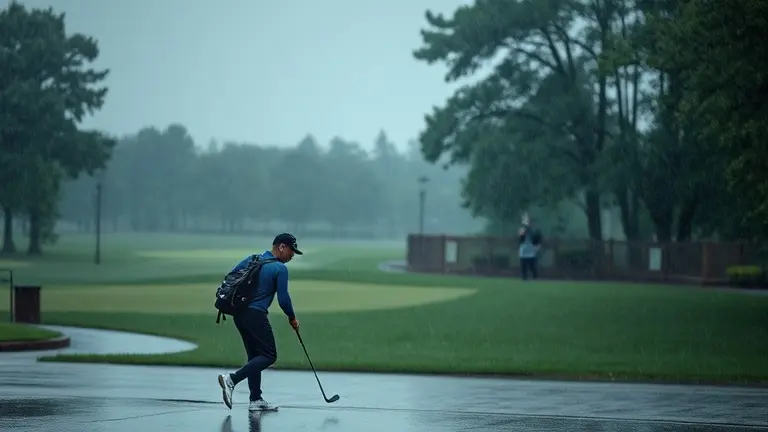
The first week of May 2026 will be long remembered by Charlotte residents and sports fans alike as a period defined by meteorological volatility. As heavy rainfall saturated the region—marking the most significant precipitation event since the fall of 2025—the atmosphere at the Quail Hollow Club shifted from competitive excitement to frustration. The Truist Championship, a premier event in our local sporting calendar, faced repeated delays as course conditions oscillated from unplayable to receptive and windy, leaving spectators and organizers searching for answers behind the disruption.
This wasn’t just a typical spring shower; it was a complex weather pattern that left local events, including those highlighted during Navy Week, scrambling for cover. Beyond the inconvenience, these events spark a deeper conversation about our region’s climate patterns and how we adapt our lives when the skies open up. By looking at the meteorology behind the record-breaking rain, we can better understand the “why” behind the washouts and perhaps find a more productive way to spend our time when the outdoors are simply off-limits.
The May 2026 Storm Pattern: A Deep Dive into Charlotte’s Unprecedented Rainfall

The first week of May 2026 marked a significant meteorological milestone for the Charlotte region, characterized by a stagnant weather pattern that triggered the heaviest rainfall observed since the fall of 2025. Over a grueling 48-hour period, various sectors across the city recorded accumulation totals exceeding 2 inches. This deluge was not merely a brief spring shower but a prolonged atmospheric event driven by a stalled low-pressure system that effectively parked itself over the Piedmont, tapping into a sustained moisture feed from the Gulf of Mexico.
Understanding the Meteorological Anomaly
The disruption was exacerbated by the lack of a significant steering current, which meant that the moisture-laden clouds were unable to move out of the area efficiently. This lack of atmospheric “ventilation” forced the system to release its payload over a concentrated geographic footprint, transforming urban infrastructure and sporting venues alike. The impact was immediately visible at the Quail Hollow Club, where the Truist Championship faced repeated delays. Golf course conditions shifted rapidly from “unplayable” due to surface saturation to “receptive” as drainage efforts took hold, only to be compounded later by high-velocity wind gusts that challenged players’ ability to navigate the saturated fairways.
Key factors contributing to this extreme weather event include:
- Atmospheric Stagnation: A “blocked” flow pattern preventing the rapid transit of low-pressure cells.
- Tropical Moisture Influx: An anomalous atmospheric river effect pulling deep-layer moisture into North Carolina.
- Localized Orographic Influence: The interaction between the moist air mass and the regional topography, which enhanced rainfall totals across the Charlotte metro area.
This episode serves as a stark reminder of the increasing climate volatility facing the region, where once-infrequent heavy precipitation events are testing the limits of major event logistics. As local meteorologists noted during Navy Week outreach, understanding these high-impact weather operations is essential for both residents and event organizers to mitigate future risks associated with unpredictable spring storm cycles.
Truist Championship Rain Delays: How Weather Dictated Play at Quail Hollow

The Truist Championship rain delay serves as a stark reminder of how volatile Charlotte weather can fundamentally rewrite the playbook for professional golf. During the first week of May 2026, the Quail Hollow Club faced a series of meteorological challenges that tested both course infrastructure and player endurance. The disruption began when historic precipitation—the heaviest the region has seen since fall 2025—saturated the greens, rendering the course physically unplayable. Officials were forced to pause competition as standing water compromised the integrity of the putting surfaces and fairways, leading to significant logistical hurdles for the tournament organizers.
As the weather systems shifted, the tactical environment at Quail Hollow underwent a rapid evolution, moving from hazardous saturation to a “receptive” state. This transition drastically altered professional golf strategies in the following ways:
- Softer Greens: With the ground saturated, balls stopped nearly instantly upon landing, allowing players to attack pins aggressively rather than relying on traditional bounce-and-roll calculations.
- Increased Spin Rates: The receptive turf allowed for higher-lofted approach shots, creating a distinct advantage for players with high-spin profiles.
- Wind Factor: Once the heavy rain subsided, emerging gusty winds introduced a new layer of complexity, forcing athletes to adjust their trajectories to account for unpredictable crosswinds over the now-softened turf.
These shifts illustrate the broader impact of Charlotte record rainfall May 2026 on sporting events. When the course moved from being unplayable to a highly receptive surface, the skill set required to win shifted toward precision iron play. The intersection of severe weather and tournament administration demonstrates that modern golf at this level is as much about navigating meteorological uncertainty as it is about athletic ability. For spectators and analysts, these delays provided a rare look at how elite players calibrate their game to account for rapidly changing environmental variables.
Expert Meteorological Insights: Explaining the ‘Stalled’ Pattern to Residents

The severe weather experienced in Charlotte during the first week of May 2026 was not merely a series of isolated storms, but rather the result of a persistent, “stalled” pressure system that funneled moisture directly into the region. Local meteorologists, including those featured during Navy Week outreach activities, have described this pattern as a high-pressure block that effectively trapped low-pressure weather systems over North Carolina. By acting as an atmospheric barrier, this system prevented the typical west-to-east progression of storm fronts, forcing localized, heavy rainfall to dump more than 2 inches of precipitation over a 48-hour period. This event marks the heaviest rainfall since fall 2025, creating significant challenges for infrastructure and outdoor operations alike.
Why Stalled Systems Create High-Impact Disruptions
The impact of this atmospheric stalling was most visible at the Truist Championship at Quail Hollow Club. To understand why the golf course shifted from “unplayable” to “receptive” and finally “windy,” one must look at how the soil saturation interacts with changing air pressure. When a system stalls, it saturates the ground, preventing the drainage required for professional-grade fairways. As the system eventually broke down, it transitioned into a high-gradient wind event. Residents and event organizers faced these consequences because:
- Saturation Limits: The sheer volume of rain exceeded the ground’s absorption capacity, leading to standing water that forced repeated tournament delays.
- Atmospheric Pressure Shifts: As the stalled system finally migrated, the rapid change in pressure caused gusty winds, which dramatically altered the “receptivity” of the greens—a critical factor for the professional golfers at Quail Hollow.
- Localized Intensity: The stagnation caused convective clouds to “train” over the same geographic areas, resulting in rainfall totals that far exceeded standard seasonal averages for early May in Charlotte.
This meteorological anomaly highlights the increasing climate volatility facing the region. While Charlotte weather is generally predictable, these stalled patterns demonstrate that even a static high-pressure ridge can lead to multi-day disruptions that impact high-profile events and local daily life. By analyzing the “why” behind the rain, we gain a better understanding of how regional topography and atmospheric blocking collaborate to produce such extreme, record-breaking rainfall events.
Beyond the Clouds: Community Impact and Navy Week Education

While the Charlotte weather patterns in early May 2026 presented significant logistical hurdles for the city, the resilience of the community remained on full display. The arrival of the heaviest rainfall since the fall of 2025 forced a rapid pivot in operations for major city events, most notably the Truist Championship at Quail Hollow Club. As the course transitioned from “unplayable” to “receptive” and eventually “windy,” tournament organizers and city officials relied on real-time data to ensure safety, demonstrating a sophisticated approach to climate volatility management.
Leveraging Meteorology for Public Engagement
The timing of these atmospheric disruptions coincided with Navy Week in Charlotte, creating an unexpected yet powerful educational opportunity for local residents. Rather than shuttering outreach efforts, the US Navy and local meteorologists utilized the active weather as a live laboratory. Residents were invited to engage with Navy personnel and weather experts who broke down the complex systems driving the rainfall, providing a bridge between abstract science and the tangible impact of the Charlotte record rainfall May 2026. This initiative offered several key takeaways for the community:
- Public Safety Literacy: Increased awareness of how severe weather, such as flash flooding and sustained high winds, influences city-wide infrastructure.
- Operational Meteorology: Insights into how organizations like the Navy monitor environmental conditions to maintain mission readiness during high-profile public activities.
- Data-Driven Decision Making: Understanding the rigorous testing and analysis required to determine when it is safe to resume outdoor sporting events or public gatherings.
By transforming a week of meteorological turbulence into an interactive learning experience, the city successfully turned a challenging situation into a demonstration of scientific preparedness. The collaboration between event organizers and weather professionals highlighted the critical importance of localized forecasts in maintaining community normalcy during periods of extreme environmental flux.
Turn Charlotte’s Washout Into a Workshop Masterpiece
The erratic Charlotte weather we experienced this past week served as a stark reminder that even the most meticulously planned outdoor events are at the mercy of Mother Nature. While the heavy rains, which marked the most significant precipitation event since late 2025, certainly disrupted the momentum at the Truist Championship, they also forced a collective pause for many of us across the region. Instead of viewing these forced indoor hours as lost time, we can reframe them as a unique opportunity to reclaim our focus and channel that restless energy into something tangible.
While the heavy rainfall may have sidelined the Truist Championship and your outdoor weekend plans, these weather-enforced indoor days are the perfect catalyst to finally start that home project you have been putting off. When the weather outside makes the course at Quail Hollow unplayable, it is the ideal time to invest in high-value indoor craftsmanship. Ted’s Woodworking is the ultimate solution, providing over 16,000 professional-grade blueprints that eliminate the guesswork and frustration typically associated with DIY projects, ensuring your success regardless of the storm outside.
 Don’t let the Charlotte rain stall your productivity; grab the ultimate library of 16,000 professional woodworking plans and turn these washout days into your most productive weekend yet.Start My Crafting Project Now!