
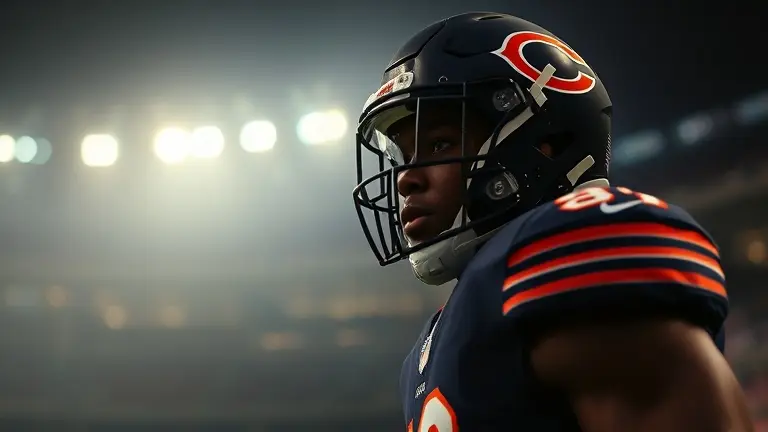
In the high-stakes world of the NFL, few outcomes are as jarring as a draft pick failing to record a single snap. The recent news that the Chicago Bears have waived cornerback Zah Frazier, following a 2025 rookie season spent entirely on the sidelines for undisclosed ‘personal reasons,’ marks a quiet but definitive end to a tenure filled with unanswered questions. Drafted with the hope of strengthening the secondary, Frazier’s departure just before rookie minicamp leaves behind a complex narrative of potential, medical ambiguity, and the cold reality of roster management.
While reports surface regarding Frazier’s own claims of being ‘medically cleared’ prior to his release, the situation highlights a broader, often overlooked aspect of professional sports: the profound psychological and cognitive pressure placed on athletes when their career trajectory is abruptly stalled. As we navigate the intersection of team investment and player welfare, it is essential to look beyond the headlines and consider the mental resilience required to weather such career-defining transitions.
Zah Frazier Waived: A Timeline of the Chicago Bears Cornerback’s Tenure

The tenure of Zah Frazier with the Chicago Bears stands as one of the most enigmatic chapters in the franchise’s recent history. Drafted in the fifth round of the 2025 NFL Draft, the cornerback arrived in Chicago with high expectations. However, his professional journey took an unexpected turn, as he failed to record a single snap during his entire rookie season. Throughout the 2025 campaign, the organization officially categorized his absence as being related to “personal reasons,” a designation that kept both the media and the fanbase in the dark regarding the specifics of his situation.
The uncertainty surrounding Frazier’s status culminated on May 7, 2026, when the Bears officially waived the defensive back, just one day prior to the start of the team’s rookie minicamp. This abrupt decision has generated significant discussion, particularly following recent reports that Frazier claimed he was “medically cleared” to return to play prior to his release. This disconnect between the player’s self-assessment and the organization’s roster management strategy has introduced a layer of ambiguity that contrasts sharply with the team’s standard operational transparency.
Key Developments in the Frazier Saga
The departure of the former fifth-round pick highlights the volatile nature of roster building in the modern NFL. Several factors summarize this timeline:
- Draft Investment: Selected as a developmental project in 2025, Frazier was expected to provide depth in the secondary.
- The “Personal Reasons” Designation: The team maintained a firm stance of privacy throughout 2025, providing no on-field opportunities for the cornerback.
- Final Release: The May 2026 waiver occurred mere hours before the team transitioned into new off-season programming.
- Contradictory Narratives: The public discrepancy between Frazier’s claimed medical clearance and the team’s decision to cut ties has become the focal point of current speculation.
This situation serves as a stark reminder of the delicate balance teams must maintain between supporting player welfare and managing the business realities of salary cap constraints and positional needs. As Frazier now enters the free-agent market, the lack of game film from his rookie year presents a unique challenge for his future career trajectory.
Navigating Roster Management and Draft Capital Risks
The NFL is a cold business where roster management often hinges on a delicate balance between potential and availability. For an organization like the Chicago Bears, the situation involving Zah Frazier serves as a stark reminder of the risks inherent in draft capital allocation. When a fifth-round selection spends an entire season on the sidelines due to “personal reasons,” the front office is forced to conduct a complex cost-benefit analysis. While teams generally exercise patience with mid-round picks, the lack of on-field development time—combined with the necessity of roster spots for incoming talent—frequently necessitates difficult personnel decisions.
Evaluating Investment vs. Performance
When a player experiences a “lost” rookie season, the administrative burden on a franchise is significant. Front offices must weigh the financial commitment of a rookie contract against the reality of a player’s inability to contribute. In the case of Frazier, the ambiguity surrounding his health status and his subsequent claim of being “medically cleared” adds layers of complexity to standard roster evaluation. Teams must navigate these scenarios by:
- Continuous Assessment: Utilizing team medical staff to verify clearance against individual player claims.
- Cap Management: Evaluating whether a player’s guaranteed money and signing bonus impacts the organization’s ability to sign active, contributing depth.
- Developmental Opportunity Cost: Determining if the roster spot occupied by an unavailable player is better served by a prospect capable of participating in minicamp and preseason rotations.
Ultimately, the release of a player before a second rookie minicamp suggests that the team reached a point where the investment in the player’s potential no longer outweighed the functional need for an active, available body. While fans often scrutinize the emotional side of such cuts, the front office is primarily driven by the necessity of building a cohesive, performing unit. The outcome for Frazier underscores the volatile nature of NFL careers, where even high-upside prospects remain susceptible to the harsh realities of professional roster constraints and the need for immediate, tangible on-field production.
The Intersection of Player Privacy and Public Speculation

The case of Zah Frazier serves as a stark reminder of the delicate balance between an athlete’s right to medical privacy and the inherent public interest that accompanies professional sports. When an NFL organization cites “personal reasons” for a player’s extended absence, it creates an information vacuum often filled by fan speculation. In the instance of the Chicago Bears waiving Frazier after a lost 2025 season, the tension between these competing interests has reached a boiling point. Protecting an athlete’s private health or personal circumstances is not merely a courtesy; it is a fundamental aspect of labor rights within the league. However, the lack of transparency often complicates the fan experience, leaving supporters to guess why a high-draft-capital prospect failed to register a single snap.
Navigating Medical Uncertainty in the NFL
The recent discourse regarding Frazier’s assertion that he was “medically cleared” prior to his release highlights the challenges in evaluating roster management. Without access to proprietary team records, observers must rely on fragments of information, which often leads to unintended narratives. To maintain a balanced perspective, analysts should consider several factors:
- Standard of Disclosure: Teams are legally and ethically bound to prioritize the privacy of their employees, limiting what they can disclose regarding non-football injuries or personal matters.
- The Business Reality: NFL organizations operate with finite roster spots and salary cap constraints. When a player cannot contribute, teams must weigh the “sunk cost” of draft capital against the potential for future production.
- Preventing Sensationalism: Unverified claims regarding medical status should be handled with skepticism. A player’s personal assessment of their health may not always align with the rigorous, high-stakes standards required by a team’s training staff.
Ultimately, the departure of Zah Frazier from the Bears’ organization underscores a difficult business reality. While the professional sports industry thrives on performance metrics and public engagement, there remains a necessary space for private human struggle. Moving forward, the industry must continue to refine how it communicates these absences, ensuring that both player privacy and the expectations of the fanbase are respected without resorting to speculative reporting.
What’s Next for the Bears’ Secondary: Shifting Priorities

The departure of Zah Frazier from the Chicago Bears roster serves as a stark reminder of the volatile nature of NFL roster management, particularly concerning fifth-round draft picks who fail to see the field. By waiving Frazier shortly before the team’s 2026 rookie minicamp, the organization has effectively cleared a spot for younger, available talent to compete for a secondary role. While the team had invested significant draft capital into Frazier, his total absence during the 2025 season meant that the Bears’ defensive depth chart had already adjusted to life without him. For the front office, this move is a pragmatic recalibration, allowing the team to allocate precious practice reps to players capable of contributing immediately in a demanding league.
Impact on Cornerback Depth and Roster Strategy
The loss of Frazier forces the Chicago Bears to lean more heavily on their existing veteran core and the incoming class of undrafted free agents. Managing a secondary is a numbers game, and teams typically prefer to cultivate a pipeline of prospects who can provide immediate special teams utility while developing in the defensive scheme. With Frazier’s roster spot now open, the team’s priority shifts toward:
- Maximizing Rookie Minicamp Reps: The focus transitions to integrating new talent who can immediately compete for depth chart visibility rather than carrying “stashed” prospects with uncertain availability.
- Evaluating Secondary Flexibility: The coaching staff will look to cross-train defensive backs, ensuring that versatility compensates for any lack of sheer roster volume.
- Prioritizing Availability: The front office is signaling that in the current competitive environment, sustained availability is a fundamental requirement for maintaining a roster spot, even for high-upside developmental prospects.
Moving forward, the Bears’ strategy likely involves a “next-man-up” mentality. By finalizing this cut, the coaching staff can focus exclusively on participants who are present and prepared to execute the defensive playbook. While the ambiguity surrounding Frazier’s “medically cleared” claims creates a layer of public speculation, the team’s priority remains the 2026 season and building a secondary that is both resilient and fully engaged in the ongoing training cycle.
Maintaining Cognitive Resilience Amid Career Uncertainty
The sudden conclusion of Zah Frazier’s time in Chicago serves as a sobering reminder that the journey of a professional athlete is fraught with volatility. Whether due to physical injury or complex personal obstacles, the ability to adapt when plans fall through is what separates those who navigate life’s transitions from those who are defined by them. For athletes and professionals alike, the mental strain that accompanies unexpected career pivots can lead to a sense of fog that hinders recovery and future decision-making.
Just as NFL teams prioritize cognitive sharpness to prevent on-field mistakes, individuals must prioritize their mental maintenance when facing high-stress shifts. This is where The Brain Song becomes an indispensable tool. By utilizing neuroscience-based auditory stimulation, it provides a science-backed, non-invasive method to regain mental clarity and sharpen focus. It is designed to support the very cognitive edge required to process setbacks and remain clear-headed during the most challenging chapters of a career.
By integrating this tool into your daily routine, you are not just recovering from a transition; you are actively optimizing your mental capacity for the road ahead. Don’t let uncertainty dictate your performance. It is time to invest in your cognitive health and regain the clarity you need to move forward with purpose and resilience.
 Regain your mental edge and sharpen your focus; discover how The Brain Song is helping individuals stay clear-headed during life’s most challenging shifts.Yes, I Want to Sharpen My Focus Now!