
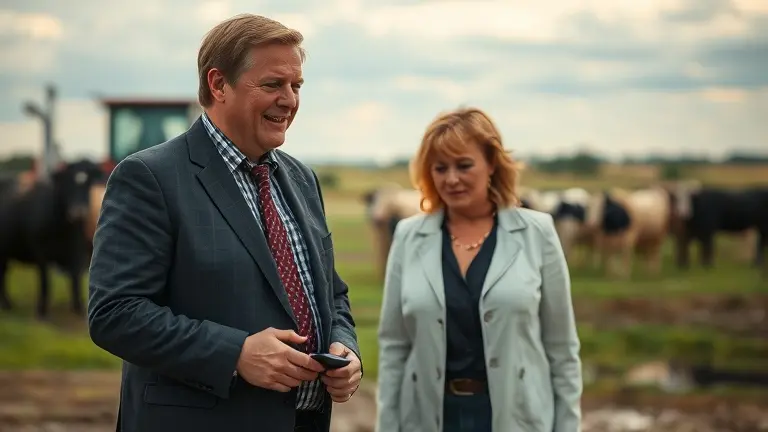
The intersection of personal politics and professional viability has rarely been more visible than in the case of Tom Zuiderveld, husband of Idaho state Senator Glenneda Zuiderveld. Recent developments reveal that the couple has faced an 80% decline in household income, triggered directly by a backlash against the Senator’s aggressive stance on immigration policy. As an independent sales representative servicing dairy farms—a sector heavily reliant on immigrant labor—Zuiderveld found his business relationships terminated as a form of ideological protest. This incident is not merely a political headline; it is a profound lesson on the fragility of business models when they are over-exposed to the volatility of political identity.
For independent business owners, the Zuiderveld situation serves as a sobering case study on the mechanics of social boycotts in B2B environments. It exposes the hidden risks inherent in relying on a niche market where political consensus can dictate financial survival. As rural economies face increasing pressure from ideological divides, understanding how to insulate one’s livelihood from such external shocks has become a business necessity. This article explores how individuals can navigate these turbulent waters by moving away from vulnerable, single-stream dependencies toward a model of personal economic sovereignty.
,slug:
The Economic Fallout: The Case of Tom and Glenneda Zuiderveld
The situation surrounding Tom Zuiderveld business lost income serves as a stark illustration of how political polarization can permeate professional spheres, particularly within the interconnected world of rural agriculture. As the husband of Idaho state Senator Glenneda Zuiderveld, Tom Zuiderveld experienced a rapid decline in his independent sales business, specifically in the distribution of synthetic oil to regional Idaho dairy farmers. The catalyst for this financial strain was the Senator’s vocal and legislative support for an aggressive immigration crackdown. Because the local dairy industry is heavily dependent on migrant labor to maintain daily operations, the Senator’s policy platform was perceived as a direct threat to the economic viability of these farms.
The Mechanics of the Economic Boycott
The resulting backlash manifested as a series of contract terminations that culminated in an estimated 80% reduction in the couple’s annual income. Reports indicate that Tom Zuiderveld saw approximately $125,000 in annual commissions vanish as farm owners severed ties. This transition from a professional B2B relationship to an economic boycott highlights a growing trend where private-sector entities use their purchasing power to signal political dissatisfaction. Key factors contributing to this outcome include:
- High Sensitivity to Policy: Agricultural operations that rely on non-domestic labor view immigration restrictions as an existential threat to production.
- Collective Professional Protest: The termination of contracts acted as a unified social and economic sanction against the Senator’s legislative agenda.
- Visibility of Consequences: The proximity between the Senator’s public stance and the private business interests of her family made the couple a clear target for those feeling the pressure of restrictive policy proposals.
This case underscores the inherent risks for families of public officials who operate within industries directly affected by the official’s policy decisions. It provides a cautionary study on the vulnerability of business owners to the secondary effects of political controversy, demonstrating that in the current climate, personal professional endeavors are rarely insulated from the fallout of partisan legislative agendas.
The Price of Polarization: How Political Stances Impact Business Continuity

The recent case involving Tom Zuiderveld business lost income serves as a stark case study on the vulnerability of family-operated enterprises when private business interests collide with high-profile political positions. In rural economies, where trust and social cohesion are the currencies of commerce, a lawmaker’s stance on divisive issues—such as an immigration crackdown in Idaho—can rapidly shift from political discourse to tangible economic repercussions. When business-to-business (B2B) relationships are built upon shared community values, any perceived misalignment between a spouse’s political advocacy and the practical labor needs of partners, such as Idaho dairy farmers, can lead to an immediate withdrawal of support.
The Mechanics of B2B Accountability
This phenomenon highlights a shift in how stakeholders hold public figures accountable. In the past, political criticism was often reserved for the ballot box; today, the intersection of labor dependencies and political identity has turned commercial contracts into proxies for protest. For independent sales representatives and consultants, this creates an unprecedented layer of risk. Evidence suggests that when a household’s income is tied to an industry—in this case, agriculture—that relies heavily on the very demographics targeted by a spouse’s policy, the potential for economic fallout is magnified.
Key dynamics contributing to this professional risk include:
- Interconnected Dependencies: Agricultural sectors often rely on a delicate equilibrium of immigrant labor, making aggressive immigration policies a direct threat to the operational viability of client farms.
- The “Proxy Effect”: Business partners are increasingly conflating the political actions of a public servant with the private business activities of their family members.
- Erosion of Neutrality: The standard expectation of professional neutrality is waning, as clients prioritize their own long-term business survival over traditional social or political alliances.
For business owners in highly visible positions, this trend necessitates a proactive strategy to insulate their professional lives from the volatility of partisan politics. Understanding that ideological stances can carry a literal market cost is now essential for navigating modern rural business landscapes.
Strategies for Business Resilience in Politically Charged Climates

The recent financial challenges faced by Tom Zuiderveld serve as a sobering case study for independent contractors and business owners regarding the intersection of personal political associations and professional viability. When an entrepreneur’s household is linked to a polarizing public figure—such as an Idaho state legislator pushing for a strict immigration crackdown—the resulting economic boycott can manifest rapidly within B2B relationships. To insulate a business from such volatility, owners must prioritize diversification and structural autonomy. Relying heavily on a single niche or a concentrated demographic of clients, such as Idaho dairy farmers who depend on specific labor pools, creates a single point of failure that is highly susceptible to sudden political shifts.
Essential Tactics for Risk Mitigation
To maintain stability, professionals should implement the following strategies to safeguard their revenue streams:
- Client Diversification: Spread your service offerings across different industries or geographic regions to ensure that a localized political movement or policy backlash does not eliminate your total annual income.
- Professional Boundary-Setting: Maintain a clear demarcation between your personal life and your business identity. For those with family members in public office, establishing a distinct corporate brand can help decouple your professional services from political rhetoric.
- Proactive Crisis Communication: If your business becomes a target of public scrutiny, draft a clear, professional communication plan that reinforces your value proposition, acknowledges client concerns, and reaffirms your commitment to professional service standards.
- Revenue Hedging: Maintain an emergency reserve and explore secondary income channels that are less sensitive to your immediate community’s political climate.
Evidence suggests that when business interests and political activism collide, the “lost income” experienced by Tom Zuiderveld—reportedly totaling $125,000 in commissions—can become a permanent reality if the underlying client base feels their economic interests are being threatened. By treating political risk as a standard business variable, entrepreneurs can build greater resilience against the unpredictability of the current GOP ideological divide and regional socio-economic trends.
Navigating the Republican Party’s Escalating Split on Immigration

The current landscape of the Republican Party reflects a growing chasm between populist-driven legislative agendas and the pragmatic economic requirements of rural, agriculture-dependent economies. The case of Tom Zuiderveld and his business lost income serves as a stark case study of how the immigration crackdown in Idaho can inadvertently dismantle the financial stability of those within the lawmaker’s own sphere. While legislative goals often prioritize ideological messaging, the reality for industries like dairy farming—which rely heavily on a stable, immigrant-led labor force—is that policy changes translate directly into operational instability.
Economic Fragility in the Agricultural Sector
Dairy farming is uniquely susceptible to shifts in immigration enforcement because the industry requires specialized, year-round labor that is increasingly difficult to source through domestic channels. When a public official like Senator Glenneda Zuiderveld pushes for aggressive immigration policies, they create an inherent conflict of interest for their private-sector counterparts. The fallout experienced by the Zuiderveld family highlights how B2B relationships in rural communities are no longer insulated from the political volatility of their local representatives.
- Labor Dependency: Dairy farms require consistent, skilled manual labor; disruptions lead to immediate declines in production capacity.
- The Boycott Mechanism: In niche markets, suppliers often face “social boycotts” from clients who view the policy stances of a business owner’s family as an existential threat to their enterprise.
- Alignment Failure: When local political rhetoric conflicts with the bottom-line needs of industry partners, the traditional GOP alliance between agrarian interests and conservative lawmakers begins to erode.
Evidence suggests that when political stances prioritize national ideological signaling over regional economic health, local economies suffer. For business owners, this underscores a pressing need to navigate political risks more carefully, as the ideological divide within the GOP continues to influence the viability of family-run businesses across the American West.
Building Your Personal Economic Fortress
The situation facing Tom Zuiderveld serves as a stark reminder that in our hyper-polarized era, professional stability can evaporate overnight based on political affiliation or client perception. When your livelihood is tethered to a single, specialized client base, you are inherently vulnerable to shifts in social sentiment and political climate. This case study underscores the critical need for true economic independence—the kind that cannot be canceled or boycotted by external stakeholders.
The most effective insulation against this volatility is cultivating high-demand, tangible trade skills that you control entirely. By diversifying your skillset beyond corporate or niche industry reliance, you reclaim the power over your income. Ted’s Woodworking offers exactly this: a robust, scalable roadmap to mastering a craft that remains permanently in demand, regardless of which way the political winds are blowing. It is not just a skill; it is your ultimate business survival tool.
By investing in your own hands-on expertise, you create a layer of value that is immune to social boycotts and corporate disruption. It is time to stop relying on fragile professional networks and start building a foundation on your own terms, ensuring your financial future remains firmly in your hands. There is no better time to insulate your family and secure your independence.
 Build your own buffer against economic uncertainty: master a trade that nobody can take away from you.Secure My Independent Future Today!