
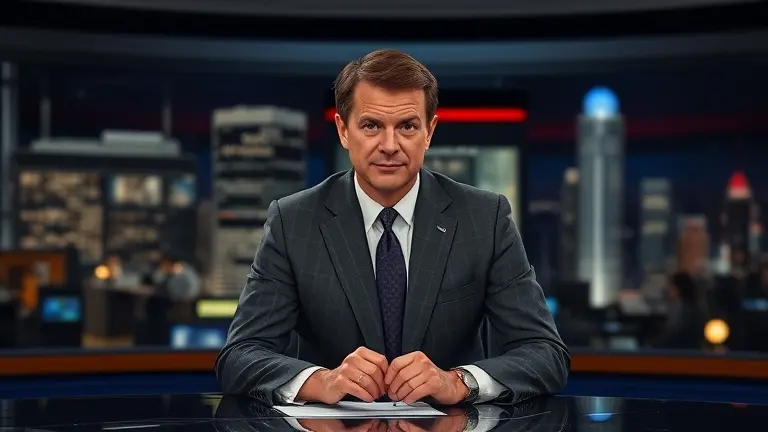
The landscape of American evening news is undergoing a tectonic shift, and nowhere is this more apparent than at CBS Evening News. Since Tony Dokoupil assumed the anchor chair in January 2026, the broadcast has grappled with a persistent and troubling trend: plummeting viewership that reached a new nadir in April 2026. This isn’t merely a case of personality preference; it is a profound reflection of the instability currently rocking the network. With reports of internal friction under the leadership of Bari Weiss—and anonymous staffer critiques leaking into the public sphere—the network is struggling to define its identity in an era where institutional trust is at an all-time low.
As Nielsen data confirms a continuous downward trajectory, industry observers are forced to ask: is this a temporary stumble for an anchor, or is it a systemic failure of the traditional nightly broadcast model? In a volatile media climate where audiences are increasingly bifurcated, the CBS Evening News brand finds itself trapped between the weight of legacy expectations and the cold, hard realities of a digital-first audience. To understand the future of the network, we must first look at the cognitive exhaustion inherent in consuming—and creating—news in this high-pressure, polarized landscape.
The CBS Evening News Transition: Analyzing the 2026 Ratings Crisis
Since Tony Dokoupil stepped into the lead anchor chair of the CBS Evening News in January 2026, the broadcast has faced a challenging transition period marked by persistent instability. The network’s ambitious effort to revitalize its flagship evening program has been met with a harsh reality as viewership numbers trended downward throughout the first quarter. This volatility reached a critical point in April 2026, when Nielsen ratings confirmed that the program had dipped to record lows, consistently drawing fewer than 4 million total viewers across multiple weeks.
Understanding the Nielsen Data and Internal Friction
The statistical decline is multidimensional, reflecting broader challenges for network television in the digital era. Recent industry reporting, including data cited by TV Insider, highlights a troubling performance trajectory for the program:
- Total Viewer Attrition: Aggregate viewership experienced a documented 2% decrease, underscoring a struggle to retain the legacy audience.
- Key Demographic Decline: The 12% drop in the vital 25–54 age demographic highlights a widening disconnect between the broadcast’s current editorial strategy and the modern viewer.
- Narrative Conflict: While CBS representatives have attempted to frame the situation by comparing April 2026 data to April 2025, the industry consensus remains focused on the persistent downward trajectory observed during Dokoupil’s tenure.
Compounding these metrics is a highly publicized internal struggle at CBS News under the editorial leadership of Bari Weiss. The situation was thrust into the public eye by a Vanity Fair exposé that featured anonymous staff members critiquing the anchor’s professional credentials. These reports labeled Dokoupil a “useful idiot” and suggested his appointment was driven more by appearance than traditional journalistic substance. This atmosphere of internal dissent has coincided with the program’s failure to gain traction, signaling that the network’s editorial pivot is currently failing to translate into the stability or audience growth required for a premier evening news brand.
Quantifying the Decline: What the Nielsen Data Reveals

The current state of Tony Dokoupil CBS News ratings presents a challenging narrative for the network’s executive team. Throughout April 2026, Nielsen data consistently highlighted a downward trend for the CBS Evening News, with total viewership figures dipping below the critical 4 million mark for several consecutive weeks. While network spokespeople have occasionally pointed to year-over-year fluctuations to suggest stability, the broader industry consensus, backed by reports from TV Insider and The Hollywood Reporter, indicates a significant struggle to retain the legacy broadcast’s traditional audience base.
Analysis of Demographic Erosion
The data reveals a more concerning picture when segmenting by age, which remains the primary currency for advertisers. Beyond the headline figures, the broadcast has experienced:
- A 12% decline in the key advertising demographic, suggesting that the shift in editorial direction under new leadership has failed to capture the younger, news-active audience segments CBS sought to attract.
- A steady erosion of the “core” evening news viewer, a demographic traditionally defined by loyalty to institutional anchors and standard journalistic presentation.
- A decoupling of the network from its historical performance metrics, signaling that the “personality-driven” pivot has yet to provide the necessary growth to offset the attrition of the older, established viewership.
From a business perspective, this performance dip carries substantial weight. As total viewership continues to reach record lows, the network’s advertising leverage—particularly during the high-value commercial breaks surrounding the nightly broadcast—is increasingly under pressure. Agencies and brands, wary of shrinking reach, may demand price adjustments, further tightening the budgetary constraints at CBS News. While internal leadership remains committed to their current vision, the Nielsen data serves as an objective reality check regarding the viability of this model. The ongoing volatility in audience sentiment suggests that the network is at a critical juncture: either it must successfully bridge the gap between its new editorial identity and its legacy viewership, or it risks a long-term devaluation of its most recognizable news brand.
The Business of Legacy Media: Beyond the Anchor Persona

The current struggles regarding Tony Dokoupil CBS News ratings represent a pivotal moment in the decline of traditional appointment viewing. While internal critiques regarding anchor selection and newsroom culture often dominate headlines, the broader reality is that network evening broadcasts are grappling with a fundamental shift in audience consumption habits. As digital platforms continue to fragment the media landscape, the traditional model of the “authoritative anchor” is struggling to maintain relevance among younger, tech-savvy demographics who prioritize on-demand, personalized content over the rigid structure of 6:30 p.m. hard news.
The Structural Erosion of Network News
The decline of the ‘CBS Evening News’ cannot be viewed in a vacuum. Industry-wide data suggests that legacy networks are facing a multifaceted crisis that extends beyond any single talent’s performance. Several structural factors are contributing to this downward trajectory:
- Platform Fragmentation: The rise of streaming and social media journalism has effectively neutralized the “gatekeeper” status once held by network anchors.
- The Trust Gap: Increased political polarization has created a disconnect between legacy branding and modern audience expectations for ideological alignment.
- Appointment Viewing Decay: The decline in total viewership—evidenced by the record lows recorded in April 2026—highlights a systemic preference for episodic, multi-screen engagement rather than linear broadcasts.
Ultimately, the business model of legacy television is under intense pressure to pivot toward more nimble, digital-first strategies. As networks like CBS navigate leadership transitions, the emphasis on the anchor persona is increasingly being overshadowed by the urgent need to address declining reach and advertising efficacy. Whether these broadcasts can evolve to meet the demands of a fragmented market remains the primary existential question for legacy journalism. The struggle for ratings is not merely a personality issue; it is a signal that the traditional evening news format may no longer function as the singular cultural touchstone it once was.
Strategic Outlook: The Future of the CBS Evening News Brand

The current trajectory of Tony Dokoupil CBS News ratings presents a complex challenge for the network’s leadership. As the broadcast struggles to regain its footing in an era of fractured viewership, CBS faces a pivotal decision regarding its editorial identity under the influence of Bari Weiss. To stabilize the brand, the network must reconcile its traditional institutional credibility with the demands of a modern, personality-driven digital landscape. The internal friction documented in recent reports suggests that the “evening news” format itself—not just the anchor—is under intense scrutiny by an audience that is increasingly migrating toward fragmented, opinion-based platforms rather than traditional legacy broadcasts.
Rebuilding Institutional Trust
For CBS News to reverse the downward trend, industry experts suggest several strategic pivots are required:
- Editorial Calibration: Balancing bold, non-traditional editorial choices with the neutral, authoritative tone historically expected of the “CBS Evening News” brand.
- Streamlining Leadership Narratives: Reducing the visibility of internal newsroom politics, which have recently served as a distraction from the network’s core mission of reporting global and domestic events.
- Demographic Engagement: Moving beyond traditional Nielsen-tracked metrics to capture the younger, cord-cutting audience through robust multi-platform integration.
The path forward hinges on whether CBS views its current slump as a personnel issue or a symptom of systemic obsolescence in the evening news model. By fostering a more cohesive internal culture and clearly defining its value proposition in a polarized political climate, the network may be able to stem the flow of viewers. Failure to address these underlying structural issues—rather than merely focusing on anchor performance—could lead to a prolonged crisis that threatens the long-term viability of one of America’s most storied news brands.
Restoring Clarity in a Volatile Media Era
The dismal ratings for CBS Evening News serve as a microcosm of a broader issue: the exhaustion of the modern information cycle. As executives and anchors struggle to maintain an audience, it is clear that the relentless barrage of news content has created a pervasive, institutional ‘brain fog.’ For those navigating high-pressure careers or trying to stay informed in this chaotic environment, maintaining cognitive focus is no longer optional—it is a competitive necessity.
This is where The Brain Song becomes essential. While the media industry grapples with structural decline, you don’t have to sacrifice your own mental sharpness to the constant noise of the daily news cycle. Designed to counteract the cognitive fatigue of information overload, this tool uses neuroscience-based auditory stimulation to help you reclaim your focus and mental acuity, allowing you to cut through the clutter and perform at your peak.
Investing in your cognitive health is the most effective way to stay ahead in an age of distractions. By integrating this 12-minute daily routine into your life, you are not just managing burnout—you are optimizing your brain for success in a world that never stops talking.
 Reclaim your cognitive edge and cut through the media noise with a simple 12-minute daily routine.Yes, I Want This Now!