
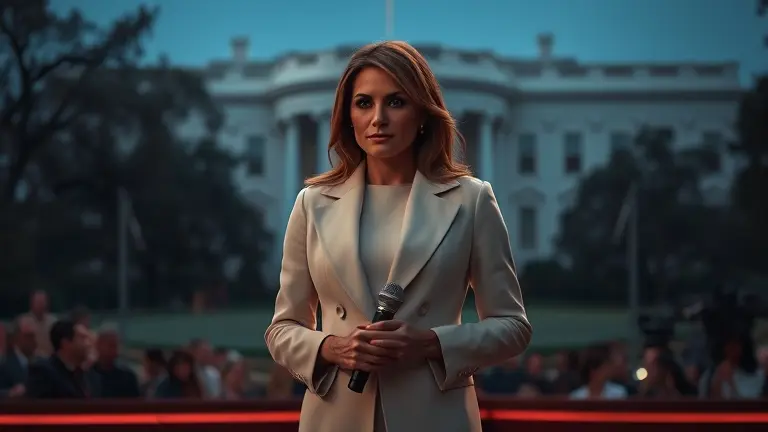
On April 23, 2026, a single remark on a late-night talk show set off a shockwave that transcended entertainment news, spiraling into a high-stakes political confrontation. When Jimmy Kimmel described First Lady Melania Trump as having a \”glow like an expectant widow,\” few could have predicted the intensity of the backlash that followed. Coming just days before a volatile shooting incident at the White House Correspondents’ Dinner, the joke became a lightning rod for accusations of inciting violence, with the Trump family demanding immediate network accountability from ABC.
This incident has sparked a necessary, albeit heated, debate regarding the boundaries of political satire in an era of extreme polarization. As the public and media figures grapple with the fine line between protected free speech and the perception of inflammatory rhetoric, the controversy serves as a poignant case study on the changing expectations for late-night hosts. Navigating through the noise of this conflict requires not only a commitment to truth but also an understanding of the immense psychological pressure currently facing the American electorate.
The Jimmy Kimmel ‘Expectant Widow’ Controversy: A Timeline of Events
The controversy surrounding the Jimmy Kimmel joke originated on April 23, 2026, during the host’s late-night monologue. While discussing the current political climate, Kimmel remarked that Melania Trump possessed a “glow like an expectant widow.” At the time, the comment was framed as a satirical critique of the former First Lady’s public demeanor, but the remark quickly transformed into a volatile flashpoint following subsequent events. Given Melania Trump’s age and the heightened tensions within the American political landscape, the statement was perceived by many as deeply personal rather than traditional political satire.
The situation escalated dramatically following a shooting incident at the White House Correspondents’ Dinner, which occurred shortly after the broadcast. The timing of these two events led to a direct link in the public discourse between the kimmel trump commentary and the broader atmosphere of political violence. In response to the outcry, the Trump administration issued a formal demand for ABC to terminate the host’s contract, labeling the content as “hateful” and an incitement to violence.
Key developments in this timeline include:
- April 23, 2026: Jimmy Kimmel airs the monologue containing the “expectant widow” remark.
- Late April 2026: A shooting incident occurs at the White House Correspondents’ Dinner, sparking national debate over media rhetoric.
- April 27, 2026: Kimmel delivers a follow-up monologue where he refuses to apologize, asserting that what did kimmel say about melania was misinterpreted by his detractors.
Throughout the controversy, critics have debated the boundaries of protected speech. While Kimmel maintained that his words were not a “call for assassination,” White House officials insisted that such rhetoric contributes to an environment where public figures are placed at risk. This event remains a defining case study in the diminishing tolerance for biting late-night humor in an era of extreme political polarization.
Analyzing the Intersection of Satire and Political Security
The controversy surrounding the Jimmy Kimmel joke concerning Melania Trump—in which the host described the First Lady as having a “glow like an expectant widow”—highlights the precarious role of late-night satire in a hyper-polarized environment. While biting political commentary has long been a staple of American television, the proximity of this remark to the shooting incident at the White House Correspondents’ Dinner has fundamentally altered the public discourse. When the joke aired on April 23, 2026, it was framed by the host as standard comedic hyperbole; however, the subsequent security breach forced a recontextualization of the language used, leading critics to argue that such rhetoric contributes to an atmosphere of instability.
The Impact of Timing on Public Perception
The intensity of the backlash from President Donald Trump and his administration stems largely from the chronological overlap between the televised remarks and the security crisis. Analysts suggest that the incident serves as a case study for how intent and interpretation diverge:
- Contextual Shifts: What might be perceived as routine satire during stable political periods can be viewed as “hateful” or a “call to assassination” when localized near acts of violence.
- The “Expectant Widow” Framing: The specific choice of words invited intense scrutiny regarding the boundary between protected speech and potentially inciting rhetoric.
- Network Accountability: The demand for ABC to take “stringent action” underscores the growing pressure on media organizations to police their talent against accusations of inciting harm.
In his April 27 response, Kimmel maintained that his words were misconstrued, reinforcing the industry-wide debate over the responsibilities of comedians in modern American media. As the situation continues to develop, it raises fundamental questions about whether late-night hosts can maintain their traditional, acerbic style without violating the heightened security sensitivities of the current political landscape. The incident underscores a shift in societal tolerance, where the line between political jab and perceived threat has become increasingly blurred.
Corporate Pressures: How Networks Manage Political Demands
The controversy surrounding the Jimmy Kimmel joke involving Melania Trump has placed ABC under unprecedented institutional scrutiny. When political figures—in this case, the Trump administration—publicly demand the termination of network talent, media corporations face a precarious balancing act. They must weigh the importance of maintaining creative autonomy and protecting their comedians’ free speech against the necessity of preserving corporate reputation and mitigating potential regulatory or advertising fallout. History shows that networks often resist calls for firing talent to avoid the appearance of capitulating to political pressure, yet they must also navigate the risks associated with perceived inflammatory rhetoric in a polarized environment.
Balancing Creative Freedom and Neutrality
The incident highlights the tension between traditional late-night biting satire and the current climate of heightened political violence. When what Kimmel said about Melania was interpreted as a “call to assassination” by the White House, the corporate response required careful legal and public relations maneuvering. Networks typically manage these high-stakes controversies through several strategic avenues:
- Contractual Autonomy: Most host contracts include strong creative freedom clauses, making termination for on-air jokes legally and financially complex for a parent company.
- Public Statements: Networks often provide measured, neutral statements that emphasize their support for the host’s right to satire while acknowledging the concerns of the public.
- Mitigation of Political Risk: Executives monitor the potential impact on FCC oversight and advertiser relationships, which are often the primary drivers behind pressure to censor talent.
Evidence suggests that modern networks prioritize their long-term credibility with viewers over short-term political appeasement. By refusing to remove Kimmel, ABC has signaled a commitment to maintaining the independence of its late-night lineup. However, as kimmel trump tensions continue to escalate, the precedent established by this event may influence how future media entities handle the fine line between protected political expression and speech that, in the eyes of officials, borders on inciting harm. The ongoing fallout reinforces that in today’s political landscape, the cost of satire is no longer just a loss of audience favor, but a direct confrontation with the highest levels of government.
The Changing Landscape of Late-Night Comedy
The recent controversy surrounding the Jimmy Kimmel joke directed at Melania Trump highlights a profound shift in the American entertainment landscape, where the traditional boundaries of late-night satire are increasingly blurred by intense political polarization. When Kimmel remarked that the First Lady possessed a “glow like an expectant widow,” he likely intended to tap into the biting, satirical tradition of his predecessors. However, the subsequent public outcry and the demand from the Trump administration for ABC to terminate his contract suggest that the modern audience—and political figures themselves—are no longer viewing late-night monologues as protected comedic territory. Instead, every quip is now scrutinized under a political microscope, often stripped of its comedic intent and analyzed as potential inciting rhetoric.
This case study reveals several critical factors affecting the survival of provocative humor in today’s media climate:
- Heightened Sensitivity to Language: In an era of political instability, the audience’s appetite for aggressive satire has diminished. Phrases that might have been considered standard “punching up” or “punching down” in previous decades are now interpreted as literal threats.
- The Weaponization of Outrage: The escalation following the kimmel trump spat illustrates how political figures can mobilize their base by framing satirical remarks as dangerous, creating immense pressure on networks to exercise self-censorship.
- Shrinking Creative Liberty: As networks weigh the threat of political fallout, talent may find their scripts increasingly vetted, potentially signaling the end of the “equal opportunity” offender era of late-night comedy.
Ultimately, the conflict over what did jimmy kimmel say about melania trump demonstrates that the monologue format, once a staple of American culture, is struggling to adapt to a reality where the line between protected speech and incendiary discourse is perpetually shifting. If the industry continues to prioritize risk management over creative license, the biting, irreverent nature of late-night television may permanently give way to a more sanitized, cautious, and politically neutral form of entertainment. The future of the late-night monologue remains uncertain as creators navigate this high-stakes environment where a single miscalculation regarding a public figure’s reputation or personal life can spark a national crisis.
Maintaining Clarity Amidst Political Firestorms
The controversy surrounding the recent Jimmy Kimmel joke illustrates the precarious tightrope walk performed by modern satire. As we have examined, the intersection of heated political rhetoric, evolving public sensitivities, and the pressure of 24-hour news cycles has turned standard comedic commentary into potential lightning rods for national outrage. Whether one views the backlash as a necessary stand against inflammatory language or as a threat to protected speech, the resulting media landscape remains undeniably dense and emotionally exhausting to navigate.
While examining the intense emotional toll of these modern political scandals, it is essential to protect your own mental clarity and ability to remain objective amid the noise. Constant exposure to such polarizing events can lead to significant cognitive fatigue, making it difficult to process information without succumbing to the burnout of a hyper-partisan culture. To stay sharp and maintain an analytical mindset when analyzing complex media environments, you need a tool that restores your focus and shields you from the mental fog caused by information overload.
This is where The Brain Song serves as an invaluable wellness counterpart. By utilizing a non-invasive, neuroscience-based auditory routine, you can effectively regulate your cognitive state and regain the mental edge needed to digest modern political discourse without the overwhelming stress. It provides the specific neurological support required to process this heavy media environment with calmness and precision.
 Regain your mental edge and clear the fog of the 24-hour news cycle; try the 12-minute auditory routine today.Yes, I Want To Restore My Focus Now!