
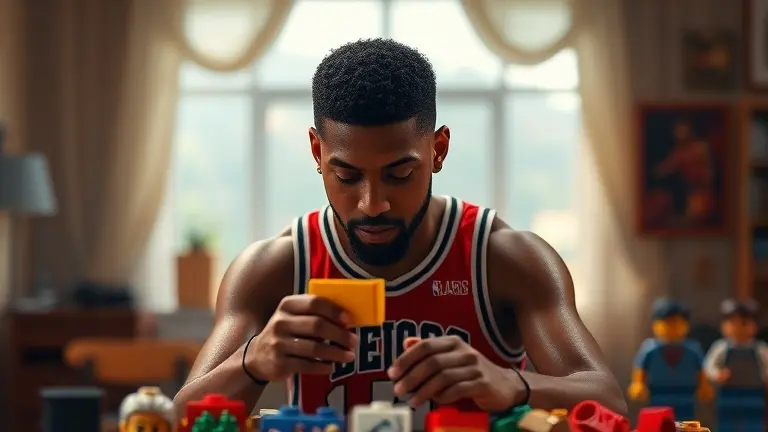
On April 28, 2026, the name Anthony Davis dominated headlines for two starkly different reasons, pulling the NBA superstar between the high-stakes chaos of a federal investigation and the quiet focus of his personal recovery. While federal authorities unravel a gambling scheme involving the illicit sale of internal player injury data—a scandal that has sent shockwaves through league integrity protocols—Davis has simultaneously captured public attention for a surprising, humanizing habit: building complex LEGO sets to navigate the immense pressure of professional contract negotiations.
This convergence of a serious privacy breach and a relatable coping mechanism highlights a growing reality for modern athletes: the desperate need for a ‘flow state’ as an anchor amidst external volatility. As the NBA faces renewed scrutiny over information security and player privacy, the contrast between the turmoil of the gambling probe and the meditative peace found in construction offers a unique window into the professional athlete’s life. It forces us to ask how those at the highest level of performance manage their mental space when the walls of their private lives are being breached by greed.
Damon Jones Guilty Plea and the NBA Privacy Controversy
The landscape of professional basketball faces a significant integrity challenge following the recent guilty plea of former NBA player and assistant coach Damon Jones. As part of a sprawling federal gambling investigation, Jones admitted to participating in a scheme that involved the illicit sale of nonpublic information to external bettors. Central to the allegations are claims that Jones attempted to profit by disclosing sensitive, private medical data concerning Anthony Davis and LeBron James. This breach of confidentiality marks a troubling intersection between the rise of legalized sports betting and the sanctity of athlete health records.
Implications for NBA Data Security
The unauthorized disclosure of an athlete’s injury status poses a direct threat to the competitive fairness of the league. Because betting markets rely heavily on the accuracy of injury reports, the leaking of internal medical assessments provides bettors with an unfair advantage, potentially compromising the integrity of game outcomes. The involvement of an individual with deep, historical ties to the league highlights a critical vulnerability in current information silos. Moving forward, the NBA is expected to face mounting pressure to:
- Tighten Internal Protocols: Implement stricter access controls regarding player health data to ensure that only essential personnel can view injury statuses.
- Enhance Surveillance: Increase monitoring of interactions between staff, players, and betting entities to preemptively identify potential leaks.
- Strengthen Legal Safeguards: Pursue more rigorous vetting and non-disclosure agreements for all personnel handling sensitive medical information.
This incident serves as a stark reminder that as the sports betting industry grows, the protection of Anthony Davis and his peers’ personal information must be treated as a matter of national sporting integrity. The federal investigation remains ongoing, but the breach has already ignited a necessary conversation regarding the privacy of high-profile athletes in an era where their physical health is frequently the subject of financial speculation.
Implications for NBA Betting Integrity and Data Security
The recent guilty plea of former NBA player and assistant coach Damon Jones in a wide-reaching federal gambling investigation has sent shockwaves through the league, placing Anthony Davis at the center of an unwanted privacy controversy. By allegedly attempting to sell nonpublic injury data regarding high-profile stars like Davis and LeBron James to external bettors, the scheme has exposed critical vulnerabilities in how internal team information is handled. This breach of trust highlights a significant gap between the league’s rapid expansion into legalized sports betting and its existing internal security protocols.
Strengthening Internal Data Protocols
To preserve the integrity of the game, the NBA is now under immense pressure to re-evaluate how sensitive injury information is transmitted from the training room to the coaching staff and, ultimately, to the public. The reliance on informal communication channels within team structures has proven to be a liability. Moving forward, stakeholders expect the league to implement:
- Centralized Reporting Systems: Transitioning to a strict, encrypted digital portal for all injury disclosures to minimize the number of personnel with access to raw, real-time medical data.
- Enhanced Oversight of Staff: Implementing rigorous background checks and mandatory integrity training for coaching and support staff regarding the handling of sensitive player health information.
- Stricter Third-Party Policies: Developing enforceable contracts with sportsbooks that mandate immediate reporting of suspicious betting patterns related to specific player status updates.
The scandal underscores that player privacy is not just a personal matter but a fundamental pillar of NBA betting integrity. As the league deepens its relationship with commercial partners, it must shift from a model of reactive damage control to a proactive security framework. If player medical status can be commodified by insiders, the credibility of every game outcome is called into question. Consequently, the NBA is expected to roll out more stringent oversight measures to ensure that stars like Anthony Davis are protected from being the subjects of unauthorized, predatory betting schemes.
Finding Zen: Anthony Davis and His LEGO Hobby

Beyond the high-intensity atmosphere of the NBA hardwood, Anthony Davis has cultivated a surprising and meditative outlet to manage the pressures of professional superstardom: LEGO building. Recently featured on the Glass Half podcast, Davis opened up about how this precise, detail-oriented hobby serves as his primary mechanism for emotional regulation. For a player who faces constant public scrutiny and the physical demands of elite competition, the methodical process of assembling complex sets offers a necessary mental reset.
The Role of Focus in High-Pressure Environments
Davis revealed that his commitment to LEGO projects is not merely a pastime but a strategic approach to maintaining mental equilibrium. During recent, high-stakes contract negotiations, Davis utilized his LEGO building sessions to compartmentalize stress. By focusing entirely on the structural integrity of his builds, he was able to detach from the noise and volatility inherent in professional sports business dealings.
This practice highlights a growing trend among elite athletes: the prioritization of mindfulness to protect cognitive health. Key benefits Davis cited from his hobby include:
- Active Mindfulness: The repetitive, tactile nature of snapping bricks together acts as a grounding technique that minimizes intrusive thoughts.
- Cognitive Decompression: It provides a digital detox, moving his attention away from social media and sports analysis toward a tangible, achievable goal.
- Creative Satisfaction: Completing intricate builds creates a sense of accomplishment that is independent of his on-court performance metrics.
By integrating these quiet moments into his rigorous training schedule, Anthony Davis demonstrates that professional longevity requires as much attention to mental maintenance as it does to physical conditioning. This human-interest perspective offers a refreshing look at how one of the league’s most recognizable stars navigates the taxing requirements of his career while finding “Zen” in a box of bricks.
Balancing Professional Pressures and Personal Outlets

The life of an NBA superstar is defined by a paradoxical existence: a high-stakes environment where every movement is scrutinized by bettors and analysts, contrasted against the fundamental human need for mental decompression. For Anthony Davis, this tension has reached an inflection point. On one hand, the recent federal gambling investigation involving Damon Jones highlights the invasive nature of modern sports wagering, where private medical information—such as player injury status—is weaponized for financial gain. This breach of privacy underscores the mounting professional pressures that athletes face, as their physical health becomes a commodity in a volatile, multi-billion-dollar betting market.
The Necessity of Offline Hobbies
To navigate the constant barrage of media cycles and external stressors, athletes are increasingly turning to structured, low-stakes hobbies. As highlighted on the Glass Half podcast, Davis has found a unique form of therapy in building LEGO sets. This tactile, focused activity offers a necessary departure from the high-velocity demands of professional basketball, providing several mental health benefits:
- Stress Management: Engaging in intricate, manual tasks helps disengage from high-pressure contract negotiations and intense game-day expectations.
- Cognitive Distraction: The concentration required for complex building serves as a mindfulness exercise, grounding the athlete in the present moment.
- Defining Identity: Pursuing interests outside of the court allows stars to foster a sense of self that is independent of their performance statistics or market value.
Ultimately, the contrast between the serious allegations involving unauthorized data disclosures and Davis’s quiet, analytical hobby illustrates the duality of the modern sports landscape. While the league continues to tighten security protocols to protect the integrity of the game and player privacy, the ability of individuals like Davis to cultivate a healthy “offline” life is increasingly vital. By prioritizing personal well-being, players can better insulate themselves from the intense, and at times exploitative, pressures that accompany their status in the league.
Mastering Focus: Find Your Calm Beyond the Court
Whether it is the public scrutiny of high-stakes investigations or the everyday pressures of high-performance careers, finding a constructive outlet to reclaim your mental clarity is essential. Anthony Davis has shown us that the path to resilience isn’t found in the noise, but in the precision of a hands-on project. By stepping away from the digital chaos and engaging in tactile, step-by-step creation, you can replicate that same meditative ‘flow state’ that allows elite athletes to process anxiety and emerge more focused.
This is where your personal development moves beyond simple distractions. Just as the building of complex sets provides Davis with a grounded sense of accomplishment, Ted’s Woodworking serves as the sophisticated, pro-level evolution for anyone seeking a tangible, meditative hobby. By channeling your energy into high-quality craftsmanship, you are not just building furniture; you are building a sanctuary of focus that serves as the ultimate antidote to professional stress.
With a comprehensive library of over 16,000 professional projects, you have the opportunity to transform your downtime into a productive, skill-based escape. This is the natural progression for those who understand that true mastery starts with the work of your own hands.
 Find your own ‘calm in the chaos’ by exploring the same level of construction precision as the pros with this comprehensive library of over 16,000 woodworking projects.Start My Crafting Journey Now!