
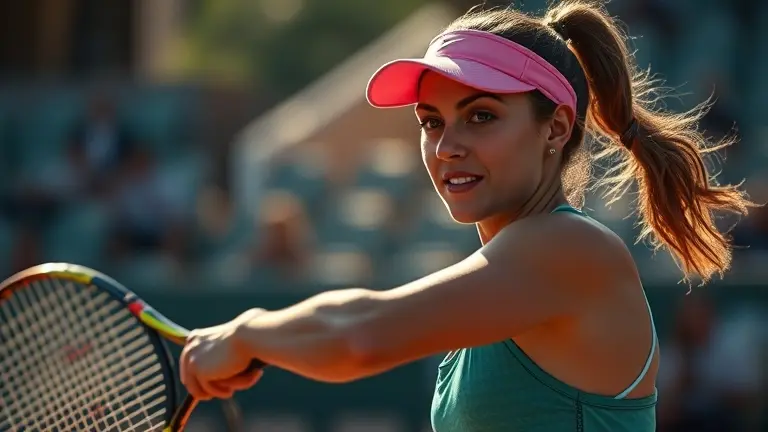
As the 2026 Mutua Madrid Open reaches its high-stakes final week, all eyes are on Kateřina Siniaková. Currently ranked #42, the Czech standout has transformed the red clay of Madrid into a laboratory of tactical precision, showcasing a game built on relentless defensive agility and a profound ability to manipulate court geometry. Moving beyond the superficial metrics of betting odds, Siniaková’s recent performances against challenging opponents like Elvina Kalieva and Caty McNally reveal a seasoned veteran who thrives on the grueling, high-pressure rallies synonymous with professional clay-court tennis.
For the dedicated tennis analyst and the passionate fan, following Siniaková’s trajectory in Madrid is less about guessing the outcome and more about appreciating the mental fortitude required to survive the WTA Tour’s elite grind. Her ability to stay composed under the sweltering Spanish sun—and against the unpredictability of heavy clay—highlights the cognitive demands placed on today’s athletes. To truly grasp the nuances of her play, one must understand that success at this level is as much about the speed of one’s analytical processing as it is about the speed of a forehand winner.
Kateřina Siniaková at the 2026 Mutua Madrid Open: Current Tournament Status

The 2026 Mutua Madrid Open has served as a pivotal stage for Kateřina Siniaková, who continues to demonstrate why she remains a formidable presence on the WTA Tour. Entering the tournament with a WTA ranking of #42, the Czech veteran has leveraged her tactical acumen and adaptability to navigate the challenging clay courts of the Caja Mágica. Her performance throughout the final week of April has been characterized by high-intensity baseline rallies and a refined ability to neutralize aggressive opponents, solidifying her status as a player who can disrupt the draws of higher-seeded competitors.
Tactical Progression and Key Match-ups
Siniaková’s journey in Madrid has been defined by her disciplined preparation and match management. Her recent encounters highlight her tactical range:
- Elvina Kalieva Encounter: Facing Kalieva, Siniaková showcased a masterclass in patience, utilizing deep, angled groundstrokes to keep her opponent on the back foot. By forcing errors through consistent ball placement rather than relying solely on raw power, she proved that her veteran experience is a significant asset on the European red clay.
- Caty McNally Challenge: The match-up against McNally demanded a shift in strategy, focusing on high-percentage serving and net-rushing techniques. Siniaková successfully countered McNally’s tactical variety, demonstrating the versatility that has become a hallmark of her professional career.
As she moves deeper into the tournament bracket, katerina siniakova remains a focal point for analysts observing the evolving nature of clay-court tennis. Her ability to transition from defensive maneuvering to offensive pressure has kept her competitive against the top tiers of the WTA field. Fans and sports analysts alike are closely monitoring her progression, as her current form suggests she is well-positioned to improve upon her mid-tier ranking as the 2026 season advances toward the summer Grand Slams. With her tactical discipline firmly in place, Siniaková continues to be a high-interest athlete in the Madrid draw.
Tactical Breakdown: Siniaková’s Performance on Clay

At the 2026 Mutua Madrid Open, Kateřina Siniaková has demonstrated why her specific brand of tennis is uniquely suited for the nuances of clay. While many tour players rely on raw power, Siniaková utilizes a high-IQ approach that prioritizes court geometry and patient construction. The Caja Mágica provides a distinctive challenge due to its higher altitude, which causes the ball to travel through the air faster than at sea-level clay venues. Siniaková effectively compensates for this by utilizing heavy topspin to keep the ball deep, forcing her opponents—such as Elvina Kalieva or Caty McNally—into uncomfortable defensive positions.
Adapting to the Madrid Surface
Siniaková’s tactical success on the European swing stems from a hybrid style that blends traditional baseline grinding with aggressive net approaches. Unlike players who remain pinned to the back fence, Katerina Siniakova frequently uses the kick serve to draw opponents out wide before transitioning forward. Key technical advantages in her current Madrid campaign include:
- Shot Variety: Her ability to disguise the drop shot prevents opponents from camping on the baseline, a vital tool on clay where movement is paramount.
- Net Versatility: As one of the premier doubles players in the world, Siniaková possesses superior volleys that allow her to shorten points when rallies become overly predictable.
- Defensive Resilience: She excels at absorbing pace, redirecting the speed of heavier hitters back into open areas of the court with precise, angled groundstrokes.
Evidence suggests that these conditions reward her consistency over pure brute force. By minimizing unforced errors and maintaining a high first-serve percentage, she effectively negates the “altitude bounce” that often frustrates more erratic power hitters. As she moves deeper into the 2026 tournament, her veteran composure and technical adaptability remain her greatest assets in overcoming high-energy challengers on the dirt.
Reviewing Key Matchups: From Kalieva to McNally

The 2026 Mutua Madrid Open has served as a defining mid-season test for Kateřina Siniaková. As she navigated the rigorous clay courts of the Caja Mágica, her performances against Elvina Kalieva and Caty McNally underscored her evolution as a veteran competitor on the WTA Tour. These matches highlighted not just her physical conditioning, but her tactical maturity in neutralizing opponents who rely on aggressive, high-pace baseline play. Against Kalieva, Siniaková demonstrated superior court coverage, forcing errors through calculated depth rather than relying solely on power. Her ability to extend rallies beyond the five-shot threshold proved critical in preventing her opponent from finding a rhythm on the slower surface.
Transitioning to the encounter with Caty McNally, the tactical narrative shifted toward serve-placement precision and net-front efficiency. Siniaková’s match analytics during this stretch of the tournament revealed a disciplined approach to break-point conversion, where she prioritized high-percentage shots over lower-probability winners.
Strategic Turning Points and Performance Metrics
- Neutralizing Pace: Siniaková successfully managed the high-bouncing surface by taking the ball on the rise, effectively shortening the time available for opponents to set up their groundstrokes.
- Clutch Performance: In high-pressure games, her first-serve percentage saw a noticeable uptick, allowing her to dictate the early stages of points and minimize the impact of her opponents’ return games.
- Tactical Adaptation: Against McNally, Siniaková utilized well-timed drop shots to pull the American out of her comfort zone, forcing defensive movement that disrupted the pace of the match.
By effectively managing these key matchups, katerina siniakova has solidified her status as a dangerous floater in the Madrid draw. Her ability to pivot from defensive grinding to aggressive point-finishing remains her most potent weapon. As she progresses further into the tournament, the lessons learned from these intense, physical exchanges—specifically regarding her stamina and tactical flexibility—will be instrumental for her upcoming bouts against higher-seeded opposition. Her current trajectory suggests that her clay-court game is finely tuned for the demands of the European swing.
Strategic Outlook: What’s Next for Siniaková in the Draw?
As Kateřina Siniaková advances through the 2026 Mutua Madrid Open, her performance on the red clay has signaled a potential shift in her season trajectory. Currently positioned at #42 in the WTA rankings, Siniaková is leveraging her characteristic tactical discipline to navigate a challenging draw. Having effectively neutralized early-round opponents, she now faces the complex task of maintaining consistency against the tour’s elite movers. Her ability to transition from defense to offense on the slower Madrid surface remains the cornerstone of her success, but deep runs in such a prestigious tournament will require even greater precision in her service games and backhand execution.
Scaling the Rankings and Tactical Priorities
To improve her current standing and push toward the top 30, Siniaková must capitalize on the momentum gained during these final weeks of April. Her path in the remaining draw involves potential collisions with high-seeded players who excel in baseline rallies. Analysts suggest that the key to her continued progression lies in three strategic areas:
- Aggressive Serve Placement: To avoid being pushed back by aggressive returners, Siniaková must prioritize landing a higher percentage of first serves to dictate points early.
- Baseline Neutralization: She needs to maintain her high-percentage rally game, using her lateral movement to frustrate power hitters who typically rely on short-point finishes.
- Mental Toughness: The transition from early-round matches to the pressure of the mid-bracket requires a disciplined mental approach, particularly when facing break-point adversity.
The 2026 katerina siniakova campaign is shaping up to be a critical indicator of her endurance. If she can sustain the physical intensity shown in her recent wins, she is well-positioned to threaten higher-ranked seeds. Continued success in Madrid would provide the necessary ranking points to secure favorable draws in upcoming high-tier events, effectively stabilizing her presence on the professional tour for the remainder of the summer.
Elevate Your Analytical Edge
Kateřina Siniaková’s journey in the 2026 Madrid Open serves as a masterclass in strategic adaptability and mental resilience. By deconstructing her movement patterns and tactical choices, we gain more than just insight into a tennis match; we observe the peak efficiency of a focused mind under extreme pressure. Much like Siniaková relies on her razor-sharp concentration to dismantle opponents, maintaining your own cognitive edge is essential for decoding the intricate layers of professional sports performance.
Just as Siniaková relies on split-second tactical adjustments to dominate on clay, maintaining your own cognitive sharpness is the key to mastering complex data and deep analysis. This is where The Brain Song becomes an indispensable tool for the modern fan. By integrating this science-based, 12-minute neuroscience routine into your daily regimen, you can bridge the gap between being a passive observer and a highly intuitive analyst, significantly enhancing your focus and mental clarity for the remainder of the WTA season.
The ability to perceive the game with greater depth is not just reserved for those on the court; it is a skill that can be cultivated and refined. Whether you are tracking tournament trajectories or managing your own high-stakes personal goals, sharpening your mind is the ultimate performance enhancer. Do not leave your cognitive capacity to chance—embrace the precision required to excel in both the game and your daily pursuits.
 Optimize your own performance and sharpen your tactical insight with the Brain Song’s 12-minute neuroscience-based routine.Transform My Cognitive Focus Now!